
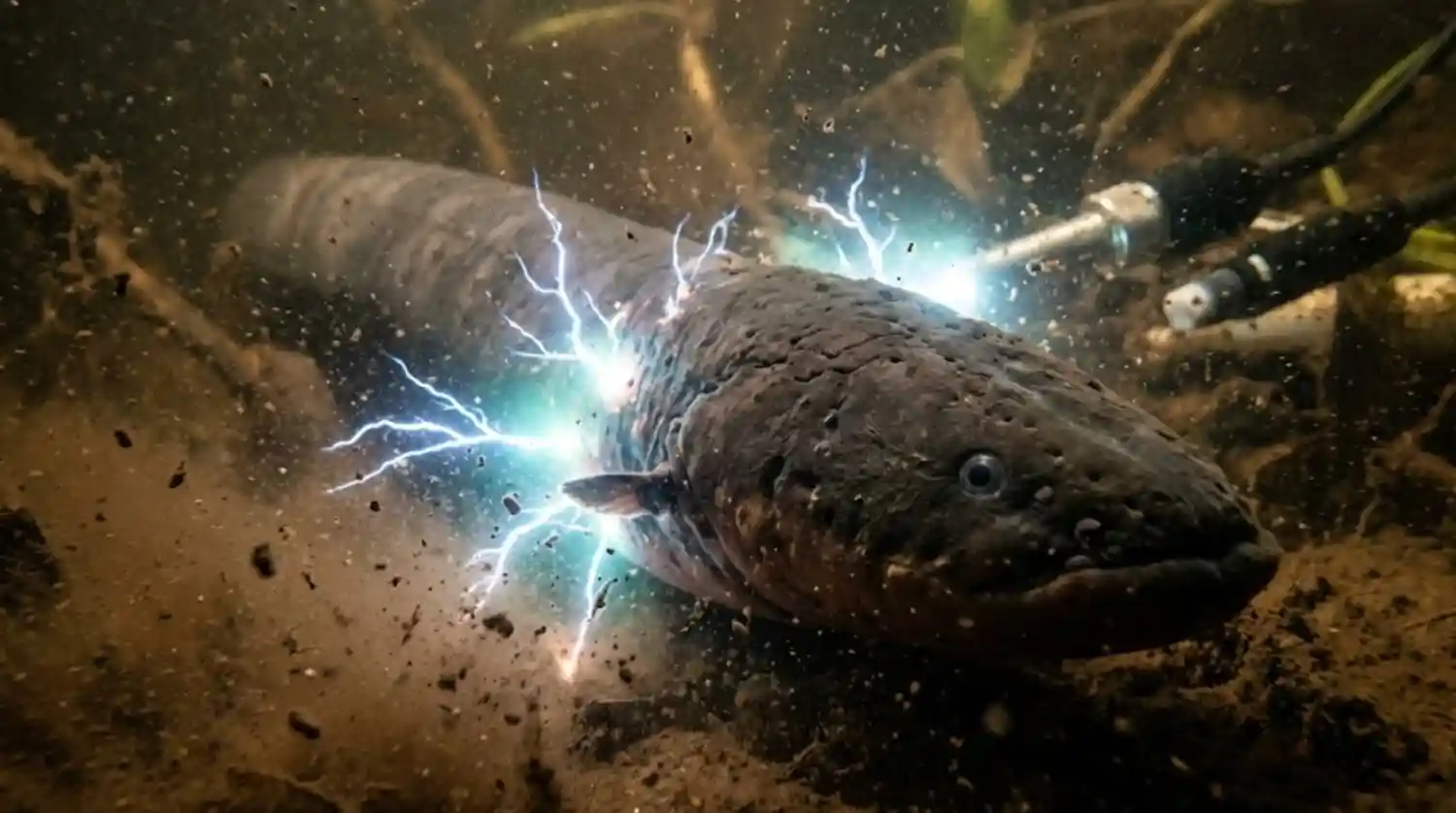
Deep in the rivers of the Amazon Basin lives a creature that challenges conventional ideas about biology. The electric eel, scientifically known as Electrophorus voltai, holds the record for the animal that produces the planet’s strongest electrical discharge. It can generate a shock of 860 volts.
That voltage is more than four times higher than the electricity found in a standard household outlet in Brazil, where domestic power operates at 127 or 220 volts. The ability comes from an extraordinary evolutionary adaptation that allows the fish to move, communicate, hunt and defend itself in places where visibility is almost nonexistent.
The eel’s bioelectrogenesis is far more than a dangerous curiosity. It is part of the ecological balance of the Amazon, functioning as a highly specialized biological tool that supports the animal’s survival and influences the food web of the rivers.
A natural battery built from electrocytes
The secret behind the electric eel’s remarkable voltage lies in highly specialized muscle cells called electrocytes. Unlike ordinary muscle cells, which contract to produce movement, electrocytes are adapted to generate and store electricity.
Thousands of these cells are arranged in stacks, much like batteries, forming electric organs that extend along the fish’s body. An electric eel can grow up to 8.2 feet (2.5 meters) long, and a mature individual may have about 200,000 electrocytes working together as a large natural electrical circuit.
The discharge is an example of precise biological coordination. When the eel decides to release a shock, its brain sends a signal that causes all the electrocytes to align and fire at the same time. The combined voltage from each individual cell produces the massive discharge associated with the animal.
The energy travels through the surrounding water and creates a powerful electric field. Precise control over the process allows the eel to distinguish between a small shock used to map its surroundings and a high-voltage discharge used to incapacitate prey or a predator.
Finding prey in murky water
Bioelectrogenesis is not used only for attacks. In fact, the electric eel relies on it most often for electrolocation and communication, abilities that are particularly important in turbid, poorly lit water where vision is limited.
The fish releases low-voltage electrical pulses to create a field around its body. When an object, whether a rock, plant or another animal, enters that field, it distorts the distribution of electricity. Sensitive receptors in the eel’s skin detect those changes, allowing the fish to build an accurate electrical map of its surroundings even in complete darkness.
This ability is crucial for hunting. The electric eel is a carnivorous predator that feeds on fish and invertebrates. It uses electrolocation to detect prey hidden beneath vegetation or in sediment.
Once the prey is located, the eel releases a high-voltage discharge that stuns the animal and makes capture easier. The method is efficient and prevents the fish from wasting energy on unnecessary chases. Bioelectrogenesis therefore functions as an advanced biological sonar.
By securing the eel’s food supply, this ability also contributes to the population control of other aquatic species in the Amazon. Electricity is not separate from the animal’s ecology. It is the physiological tool that connects the eel’s survival to the broader operation of the river.
An influence on the aquatic food web
The electric eel’s discharge plays a fundamental ecological role by regulating the density of its prey. By controlling the abundance of smaller fish and invertebrates, the predator helps maintain the balance of freshwater ecosystems.
Without these electric predators, some prey species could reproduce excessively, exhaust available food resources and damage local biodiversity. The electric eel therefore acts as a natural biological regulator, helping preserve the integrity of Amazonian freshwater habitats.
Its influence extends beyond feeding. Awareness of its ability to deliver a shock can discourage predators, influence the migratory movements of fish and affect the spatial distribution of other aquatic species.
In some regions, the electric eel is described as a “sound sentinel” and as a keystone species whose preservation is essential to the health of the forest as a whole. Protecting the eel also means protecting thousands of plant and animal species that share its territory. For that reason, the fish is regarded as an indicator of environmental quality.
Brazilian science investigates electric life
The Brazilian Amazon is a natural laboratory for the study of bioelectrogenesis. Institutions such as the National Institute of Amazonian Research, known as INPA, and the Museu Paraense Emílio Goeldi have led fundamental studies of electric eel behavior and physiology.
According to researchers at these institutions, advanced underwater monitoring techniques and genetic analysis have revealed fascinating details about the evolution and ecology of these electric animals. Brazilian science has shown that bioelectrogenesis can transform the way researchers understand biophysics and bioengineering.
Studying electrocytes may also provide clues for creating more efficient and sustainable batteries. Ethical, sustainable bioprospecting is presented as one path for regional development, with the electric eel serving as an example of how scientific knowledge can be connected to social well-being.
Encouraging coexistence allows these guardians to continue their work of cleaning and balancing the waters. In this setting, science turns the observation of an electric fish into an opportunity to understand biodiversity and its possible contribution to innovation.
Conservation, genetics and respect
Despite its biological importance, the electric eel still suffers from misinformation. Fear of accidental shocks can create a negative view of the animal, although it is not aggressive and prefers to flee rather than confront another creature.
Teaching society about the beauty of its biology and the importance of bioelectrogenesis is a crucial step toward conserving the species. Respect for animals that are less conventionally charismatic is also part of an environmental maturity that values every form of life.
Mapping the electric eel’s genome opens the door to discoveries that are still difficult to imagine. Bioelectrogenesis is only the tip of the iceberg. Understanding how these animals deal with pathogens and venoms may offer clues about biological resilience in a world of constant climate change.
Protecting riparian forest areas and urban forest fragments is essential if the eel is to continue moving through its habitat and performing its ecological role. Habitat connectivity allows gene flow, helping ensure that these resistance proteins are passed on to future generations.
Every electric eel preserved can be viewed as a natural “factory” of biological control that operates 24 hours a day, at no cost to public coffers and with incalculable benefits for biodiversity. Its discharge of 860 volts is strong enough to stun large mammals and even caimans, making the fish, proportionally, the undisputed champion of electrical strength among all aquatic carnivores on the planet.
The electric eel is not merely an electric animal. It is also a reflection of the Amazon’s resilience. Its bioelectrogenesis, forged through millions of years of evolution, shows that protecting the whole requires respecting the most fundamental and powerful parts of the natural machinery that keeps the cycle of life turning.
Reporting: Anne Silva / Amazonia Mag

Editor, English Edition — Amazonia Mag
Anne Silva is the editor of Amazonia Mag, the English-language edition of Revista Amazônia. She curates, translates and adapts the outlet's science and environment coverage for an international audience, reporting on Amazon wildlife, flora, rivers, climate and research. Every story she edits is grounded in peer-reviewed studies, official data and on-the-ground reporting from the Revista Amazônia newsroom in Belém, Pará, Brazil. More by Anne Silva →