
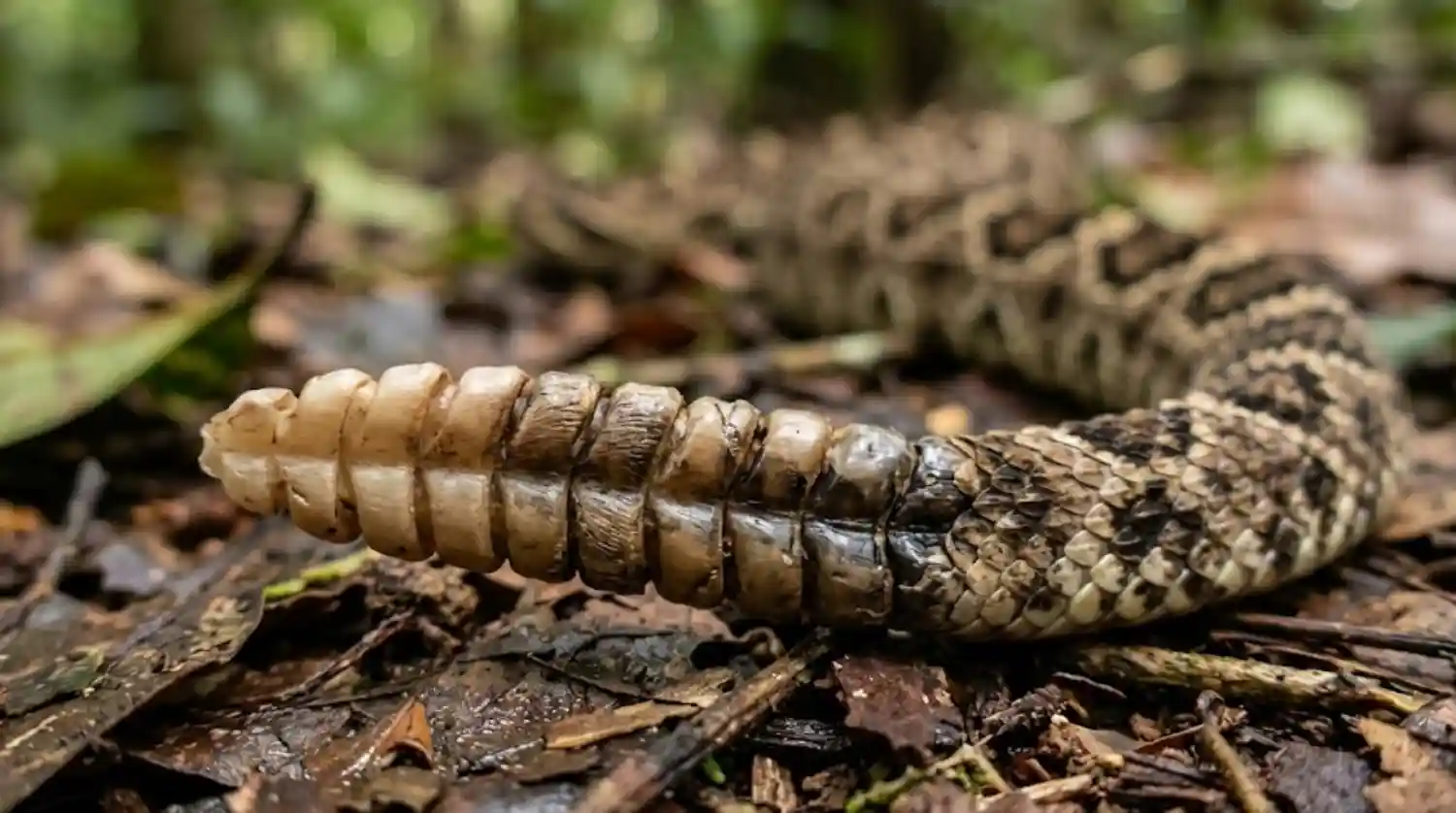
At each new stage of life, the Amazon rattlesnake adds another ring of keratin to its tail. The result is a unique biological instrument that can vibrate up to 50 times per second without tiring the snake’s muscles.
Far from being a hunting tool, the rattle is one of nature’s most efficient communication systems. It is designed to prevent wasted energy and avoid accidents involving large mammals.
Contrary to what common sense might suggest, the rattle is not an announcement of an attack. It is a diplomatic request for distance, one that can preserve the life of both the potential aggressor and the reptile.
The biological engineering behind the sound
To understand this appendage, it is necessary to look at the anatomy of Crotalus durissus. The rattle is made of a series of hollow, interlocking segments composed of the same protein found in human fingernails and hair.
When the snake feels threatened, it contracts specialized muscles at the base of its tail. The sound is created when the keratin rings strike one another. Unlike a toy rattle, which contains internal beads, the rattlesnake produces its signal through the impact of the segments’ walls.
It is a dry percussion system that can be heard from yards away, with the metric distance measured in meters. In the dense low vegetation of Amazonian transition zones and lavrados, the sound works like an acoustic beacon, announcing the animal’s presence before a close encounter occurs.
Many people believe that a snake’s exact age can be determined by counting the rings on its rattle. Science shows that this idea is inaccurate. Each ring forms after a skin shed, or ecdysis, and a healthy rattlesnake may shed several times a year, depending on food availability and climate.
The rattle is also fragile. Over time, it can break because of friction against rocks or branches. What we see, therefore, is not necessarily a complete record of every year the animal has lived.
Instead, the visible structure is a biological record of the snake’s recent growth, a keratin diary that bears witness to its survival on the sandy soils of Brazil’s far north.
A key role in the lavrados of Roraima
The word Amazon often brings to mind dense, humid forests, but the biome also contains savanna areas and lavrados. In those landscapes, including areas found in Roraima, the subspecies Crotalus durissus ruruima performs a fundamental ecological role.
The rattlesnake acts as a natural controller of rodent populations. Without these top predators, a demographic explosion among rats and other small mammals could disrupt local plant life because those animals consume large quantities of seeds and shoots.
When seeds and young shoots are eaten excessively, the natural regeneration of vegetation is hindered. By helping regulate these small mammals, the snake supports the relationship between predators, prey and plants.
Maintaining rattlesnake populations is also a direct indicator of the region’s environmental health. These snakes are ectothermic animals, meaning that their body temperature depends on the surrounding environment.
Sustainable land management and the preservation of ecological corridors allow the rattlesnake to continue working as a kind of “sound sentinel.” Protecting its habitat helps keep the Amazon’s complex food web intact.
It also allows evolutionary processes that have lasted for millennia to continue without the destructive interference of deforestation or indiscriminate hunting. Protecting the snake is therefore connected to protecting vegetation and the interactions that support the ecosystem.
A defensive behavior, not an invitation to fight
The use of the rattle is a fascinating example of acoustic aposematism. In biology, aposematism occurs when an animal displays warning signals to tell potential predators that it has chemical or physical defenses.
For the rattlesnake, sound is a preventive investment. Producing venom is metabolically expensive for the snake because the venom contains complex proteins that take days to synthesize.
If the snake can drive an intruder away with noise alone, it saves its chemical ammunition for what matters most: capturing its next prey. The rattle helps resolve danger before the animal has to use a more costly defense.
Herpetological studies indicate that the rattlesnake has a relatively calm temperament compared with other snakes in the region, such as the jararaca. It prefers to escape or remain motionless.
It turns to the rattle only when it feels that its “safety bubble” has been invaded. This behavior demonstrates an evolutionary sophistication in which aggression is a last resort rather than an automatic response.
Recognizing this characteristic is essential for challenging the negative image that many people still have of reptiles. It also encourages peaceful coexistence based on respect for each species’ natural space.
A moving biochemical library
Amazonian biodiversity is not limited to what can be seen. It extends to the molecular level, where the venom of Brazil’s rattlesnake is studied by several national research institutes, including the Butantan Institute.
Unlike North American species, Brazil’s rattlesnake has a potent neurotoxin called crotoxin. This substance has been studied for its analgesic and even antitumor properties.
By preserving the rattlesnake in its natural habitat, Brazil keeps open an immense biochemical library that may contain treatments for several human diseases in the future. Ethical and sustainable bioprospecting is one of the foundations for the region’s development.
Turning fear into scientific curiosity is a path toward valuing wildlife. When a researcher enters the forest and hears the characteristic rattle, the sound is more than a warning. It is the voice of an ecosystem that is alive and functioning.
Every snake that remains in its ecological niche represents a victory for Brazilian science and for global biodiversity conservation efforts. Even the forest’s most feared elements have incalculable value for the planet’s balance.
Environmental education for sharing the landscape
For the Amazon to remain a sanctuary of life, environmental education must reach local communities and tourists. Understanding that the rattlesnake’s warning is a tool of peace, not war, changes how people interact with nature.
Awareness programs that teach people not to kill snakes encountered on trails or in rural areas are essential. Wearing suitable footwear and paying attention to the ground are simple measures that improve human safety while respecting these animals’ right to exist.
The story of the rattle teaches lessons about boundaries and communication. In a world where human impact often silences the voices of the forest, the reptile’s persistent sound reminds us that nature has its own rules of coexistence.
Protecting the Amazon rattlesnake means protecting more than one species. It means protecting the forest’s right to maintain its defense mechanisms and its biological integrity.
Admiring the complexity of a keratin ring ultimately means admiring the ingenuity of life that has flourished for millions of years beneath the Amazon sun.
The rattle is not fully formed at birth. When the snake hatches from its egg, it has only a small, smooth button at the tip of its tail, known as a “prebutton.” Only after the first shed does the first true ring appear.
With time and additional sheds, the rattlesnake gains its characteristic voice, warning the world of its presence. Its place in the Amazonian landscape is a constant reminder that nature’s true intelligence lies in balance, not brute force.
When we hear its call, we are invited to practice the humility of sharing space with beings that mastered survival long before humans did. Mutual respect is the most important note in the symphony of biodiversity.
Reporting: Anne Silva / Amazonia Mag

Editor, English Edition — Amazonia Mag
Anne Silva is the editor of Amazonia Mag, the English-language edition of Revista Amazônia. She curates, translates and adapts the outlet's science and environment coverage for an international audience, reporting on Amazon wildlife, flora, rivers, climate and research. Every story she edits is grounded in peer-reviewed studies, official data and on-the-ground reporting from the Revista Amazônia newsroom in Belém, Pará, Brazil. More by Anne Silva →