
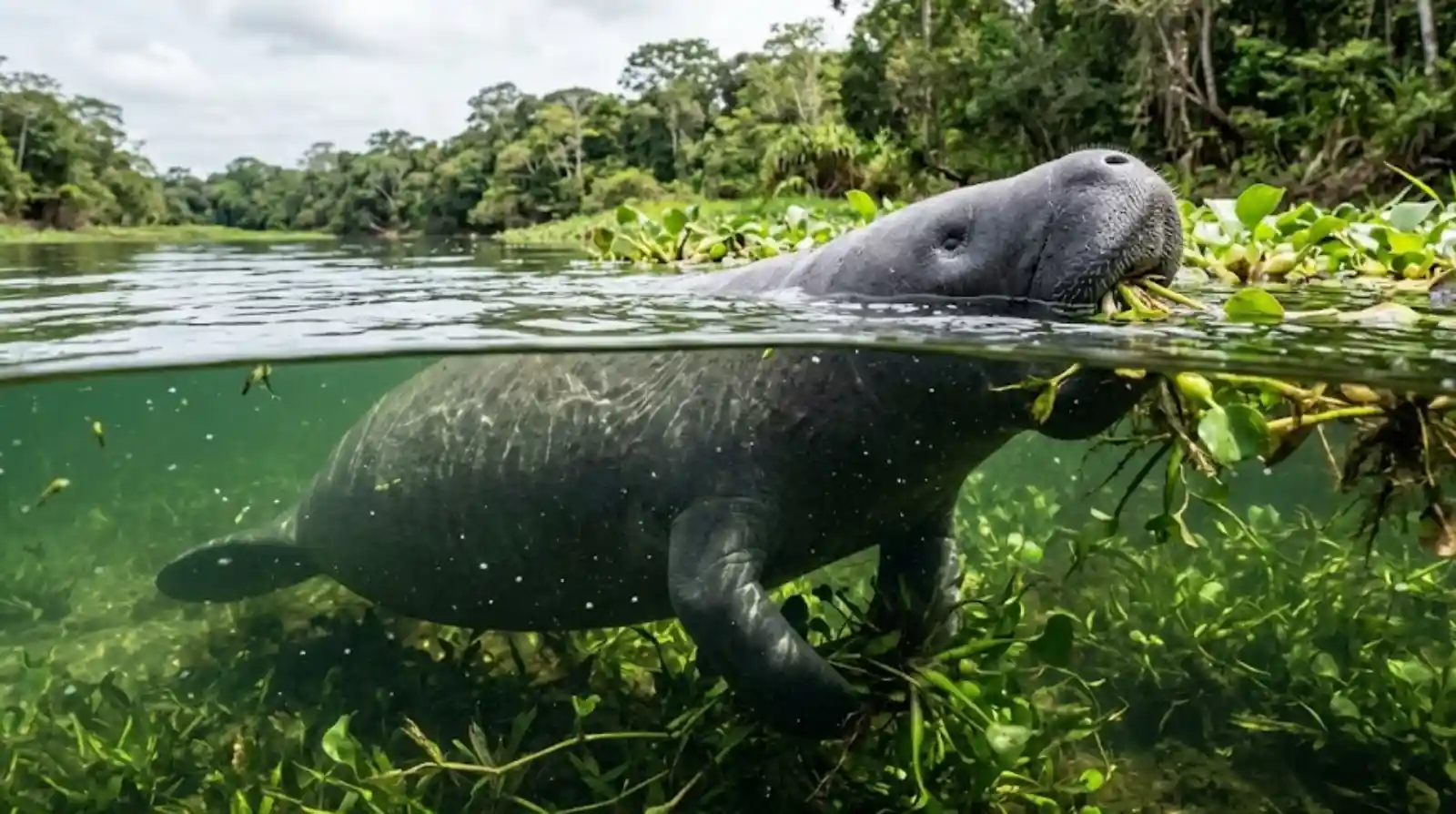
The Amazonian manatee is the only freshwater manatee species in the world. Its scientific name is Trichechus inunguis, a name connected to a feature that distinguishes it from its marine relatives: it has no nails on its pectoral flippers.
This mammal lives exclusively in the river environments of the Amazon and has a biology adapted to life in rivers and lakes. Its body, feeding habits, breathing pattern and reproduction are all tied to an aquatic landscape in which vegetation plays a central role.
The Amazonian manatee is more than a large animal moving slowly through the water. It is an active part of how aquatic ecosystems function. By eating large amounts of plants, it participates in vegetation control and benefits other organisms that share the same waters.
A mammal shaped by river life
The Amazonian manatee is a peaceful giant and, at the same time, a freshwater mammal essential to the balance of aquatic ecosystems. Its diet is exclusively herbivorous and is based on large quantities of aquatic vegetation known as macrophytes.
Macrophytes are part of the visible structure of many freshwater environments. For the manatee, they provide the food that sustains its life and the basis of an ecological interaction that helps regulate the abundance of plants in waterways.
Studies indicate that the animal can eat up to 8 percent of its body weight in vegetation each day. That figure shows the scale of its feeding activity and explains why its presence has consequences for the environment where it lives.
The Amazonian manatee acts as a true river gardener. By consuming large amounts of plants every day, it keeps vegetation from becoming so abundant that it could overpopulate and obstruct waterways. Its feeding therefore connects directly with the dynamics of tropical rivers.
This role does not make the manatee a simple consumer of plants. It makes the animal part of a process that influences the condition of the water and the space available to other species. Its herbivory is an ecological function as well as a survival strategy.
A lip that works like a pair of tongs
The anatomy of Trichechus inunguis is perfectly adapted to this task. Its snout points downward, while its upper lip is prehensile and extremely muscular. Together, these traits allow the manatee to search for and remove aquatic vegetation.
The upper lip works almost like a pair of tongs. With it, the Amazonian manatee can select and pull out the roots and leaves of aquatic macrophytes with precision, rather than feeding indiscriminately on everything around it.
Selecting roots and leaves reveals an important specialization. Science recognizes this behavior as fundamental to the species’ survival because it links a specific body structure to the collection of the food that makes up its exclusively herbivorous diet.
The shape of the snout also helps explain why the species is so closely connected to river vegetation. Its anatomy is not an isolated detail. It is a functional response to the need to gather plants underwater and use them as food.
The manatee’s feeding strategy therefore has two dimensions. It provides the mammal with the energy it needs to live, while also creating a continuing relationship with macrophytes and helping prevent excessive plant accumulation.
Living underwater, returning to the surface
Although it spends most of its time submerged, the Amazonian manatee is not a fish. It is a mammal and therefore needs to rise to the surface to breathe atmospheric air.
It can remain underwater for long periods, but it must come up at regular intervals. When it surfaces, it may show only its snout and nostrils above the water, a characteristic sight that helps identify the species in calm rivers.
This behavior captures one of the most interesting features of its biology. The animal is fully adapted to moving and feeding in an aquatic environment, yet it retains the need to breathe air, as other mammals do.
The brief appearance of the snout and nostrils also shows how the species uses the surface without abandoning its submerged way of life. In still waters, that movement can become a sign that an Amazonian manatee is nearby.
Breathing is therefore part of observing the species just as much as feeding is. A snout and nostrils appearing at regular intervals point to a characteristic behavior of a mammal that lives in Amazonian rivers.
Long gestation and extended parental care
The reproductive biology of the Amazonian manatee is marked by a long gestation lasting about 13 months. The time spent developing before birth is one of the features that helps explain the life cycle of this freshwater mammal.
Calves are born dependent on their mothers and are nursed for a long period. They remain alongside the mother for up to two years, receiving intensive parental care during the early stages of life.
The calf’s dependence and the length of time it remains with its mother show that reproduction does not end at birth. Care continues for an extended period and is essential to the young animal’s survival.
According to the information about the species, this intensive parental care ensures the continuation of the Amazonian manatee. The bond between mother and calf is therefore a central part of a life strategy that combines a long gestation with prolonged care after birth.
An indicator of healthy aquatic environments
The presence of the Amazonian manatee is an indicator of the health of the region’s rivers and lakes. Its life depends on aquatic environments capable of supporting a herbivorous mammal that consumes large quantities of vegetation.
By controlling macrophytes, the animal facilitates navigation and improves water quality. Its activity also benefits other fish and bird species, showing that its ecological role extends beyond the relationship between the mammal and its food.
This function makes the manatee a visible part of a broader ecological network. Its feeding changes the amount of vegetation in the water, and that change can improve conditions used by other inhabitants of Amazonian rivers and lakes.
The Amazonian manatee, Trichechus inunguis, is also the only freshwater herbivorous mammal in South America. This distinction adds to its status as the world’s only freshwater manatee species and reinforces the importance of understanding its biology.
Studying its habits, anatomy, breathing and reproduction makes it possible to recognize the value of a species closely tied to macrophytes. It also shows that conserving the animal and sustaining Amazonian ecosystems are connected goals.
Protecting the Amazonian manatee means preserving part of the ecological complexity of tropical rivers. Its presence as a herbivore, a regulator of vegetation and an indicator of waterway health connects the life of a peaceful mammal with the future of the Amazon’s aquatic environments.
Reporting: Anne Silva / Amazonia Mag

Editor, English Edition — Amazonia Mag
Anne Silva is the editor of Amazonia Mag, the English-language edition of Revista Amazônia. She curates, translates and adapts the outlet's science and environment coverage for an international audience, reporting on Amazon wildlife, flora, rivers, climate and research. Every story she edits is grounded in peer-reviewed studies, official data and on-the-ground reporting from the Revista Amazônia newsroom in Belém, Pará, Brazil. More by Anne Silva →