
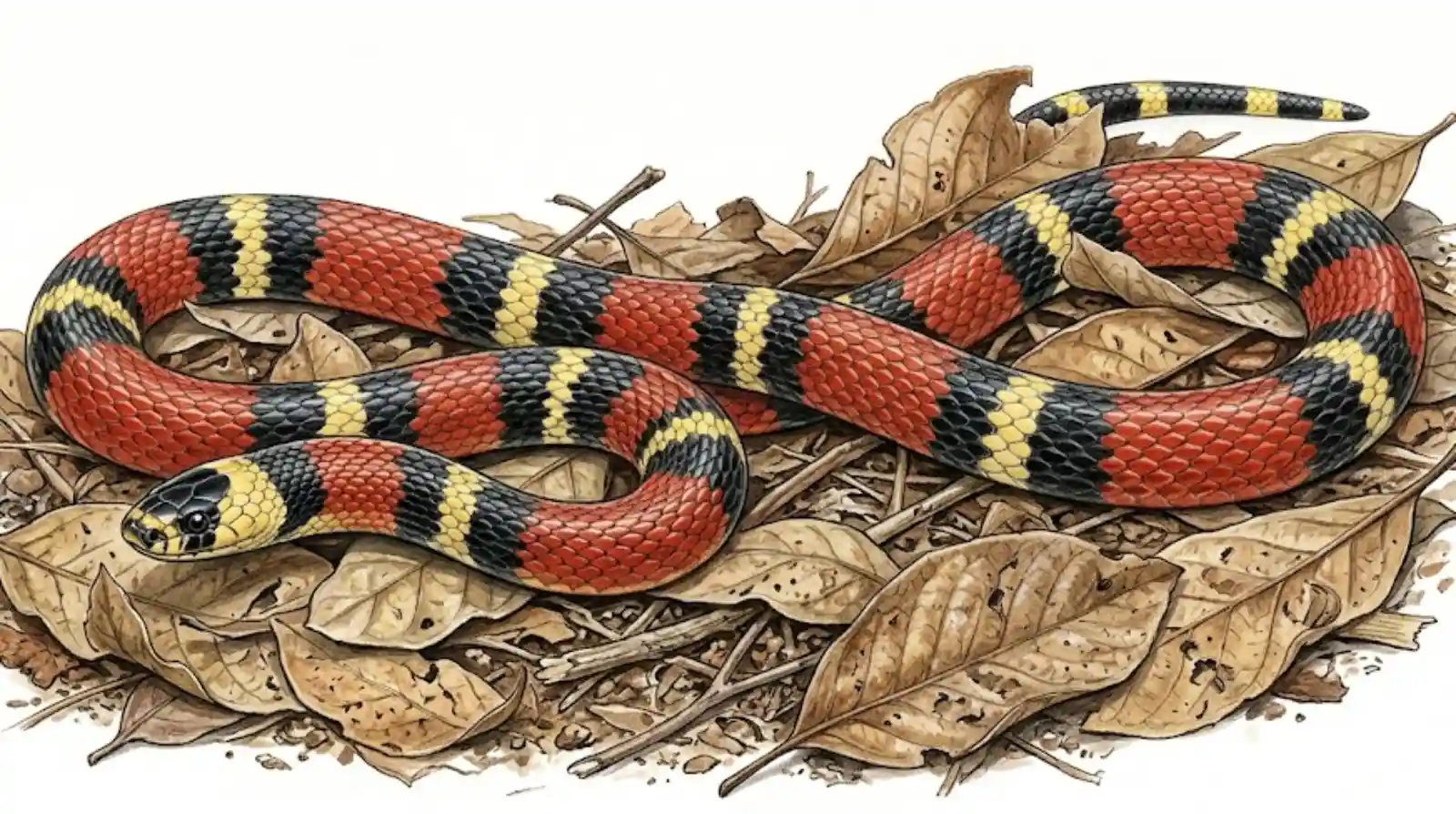
With vivid rings of red, black and yellow, the true coral snake is one of the most recognizable symbols of Brazil’s biodiversity. Its appearance is striking, but its colorful pattern conceals a biological reality that many people do not know: this snake does not deliver venom through the instant-injection system common to many other highly venomous snakes.
The true coral snake belongs to the genus Micrurus. Instead of relying on large, movable front fangs that work like hypodermic needles, it uses a more complex and specialized system. The snake must bite and keep its grip so that venom can flow into the victim.
This requirement is central to understanding the rare accidents involving the species. The first strike is only the beginning of the process. The snake must remain attached and use particular muscular movements with its jaws to help deliver the venom through its specialized fangs.
Small, fixed fangs with surface grooves
The venom-delivery system of Micrurus is defined by the structure and position of its fangs. They are small and fixed, and they are located at the front of the upper maxilla. That arrangement differs from the long, retractable fangs of snakes that can strike, pierce a victim and inject venom in a fraction of a second.
The true coral snake’s fangs do not have a closed central canal through which venom can pass like fluid through a needle. Instead, they are grooved along their surface. Venom moves along that groove and mixes with the snake’s saliva while the snake holds its bite firmly.
According to the scientific description of this mechanism, the anatomy of the fangs explains why the coral snake cannot depend only on a quick initial attack. Capturing the prey requires the first bite, but effective delivery also depends on remaining attached and producing a specific muscular action with the jaws.
This anatomical difference shows that venomous snakes do not all use the same strategy. In some species, a rapid strike and brief penetration may be enough to introduce venom. In the true coral snake, the substance must travel along the shallow surface groove of the small fangs while contact continues.
The result is a system that is highly specialized. It is not an accidental limitation, but a distinctive feature of the genus. The snake’s mouth, fangs and jaw movements work together in a sequence that differs sharply from the fast injection associated with other venomous snakes.
A bite that includes chewing movements
The true coral snake generally preys on other small snakes and lizards. After the initial strike and capture, it does not simply bite and release. It continues to bite firmly and makes small chewing movements with its jaws, a technique that helps the venom enter the prey.
Those movements help drive the small fangs deeper into the victim’s skin. They also facilitate the flow of venom along the surface groove. Holding, pressing and moving the jaws together make it more likely that the toxic substance will reach the site of the bite.
The venom of the true coral snake is a potent neurotoxin. As described for its delivery system, the substance is introduced through the small fixed fangs at the front of the mouth, but not in the same way as in snakes that pierce a victim during a brief, rapid strike.
Because the snake must maintain the bite, envenomation is a more complicated process. The true coral snake needs to stay close to its prey for a longer period, keep its grip and continue the chewing movements that help the venom flow.
In a quick first encounter, this method may appear less “efficient” than the strikes of other snakes, which can inject venom almost instantly. Yet it is a specialized adaptation connected to the way the coral snake captures and subdues its prey.
Why encounters with people are rare
The unusual delivery system is one of the main reasons accidents involving true coral snakes are extremely rare in Brazil. For the venom to be effective, the snake must bite, hold on and maintain close contact for a considerable amount of time.
That kind of prolonged contact seldom occurs during a chance encounter with a person. The snake and the person would need to remain very close, and the coral snake would need to keep its grip so that venom could move through the grooves in its fangs. A brief contact does not match the process the species normally uses to envenomate prey.
The snake’s behavior also helps explain why such encounters are uncommon. True coral snakes are generally nonaggressive animals and prefer to escape rather than confront a threat. They attack only when they feel directly threatened and cornered.
Understanding this behavior does not mean forgetting that the snake is venomous. Its potent neurotoxin and specialized delivery system deserve respect. At the same time, learning how the bite works can replace unfounded fear with caution and a more accurate view of the animal.
The need to hold on is therefore an important part of the relationship between anatomy and behavior. The small fixed fangs, the surface grooves and the chewing movements cannot be separated from the snake’s defensive and feeding strategies. Together, they form a mechanism that is markedly different from the rapid injection associated with many other dangerous snakes.
A predator with a role in biodiversity
The complexity of the true coral snake’s venom-delivery system reveals the remarkable diversity and specialization of wildlife. Each species develops adaptations that help it survive and thrive in its environment. Those adaptations can also expose intricate interactions between one organism and another.
In conservation, the true coral snake plays an important role as a predator of other snakes. By feeding on small snakes and lizards, it contributes to the balance of populations belonging to different species within the ecosystem.
Its presence in an environment is an indicator of biodiversity and ecosystem health. Protecting the species and the habitats where it lives is therefore essential to maintaining the health and balance of natural systems shared by many forms of life.
Conservation is not only about admiring the red, black and yellow rings that make the animal so recognizable. It also means recognizing the value of a predator that performs a function within the larger web of life. Peaceful coexistence and respect for every form of life can help establish a more balanced relationship with wildlife.
The true coral snake, with its singular beauty and unique adaptations, is a reminder of the richness and wonder of nature. Its method of delivering venom is not an isolated curiosity. It is evidence of the precise specialization that can emerge in wildlife and of the close relationships between anatomy, behavior and survival.
A deeper understanding of these creatures allows people to appreciate the natural world without relying on prejudice or exaggerated fear. The snake remains a venomous animal, but it is also a predator, an indicator of ecosystem health and a living example of biological diversity.
True sustainability depends on recognizing that every form of life, regardless of how dangerous it may appear, has a vital place in the great mosaic of biodiversity. In Micrurus, that recognition includes understanding its small fixed fangs, its prolonged bite, its chewing movements and its role in regulating populations of other animals.
Reporting: Anne Silva / Amazonia Mag

Editor, English Edition — Amazonia Mag
Anne Silva is the editor of Amazonia Mag, the English-language edition of Revista Amazônia. She curates, translates and adapts the outlet's science and environment coverage for an international audience, reporting on Amazon wildlife, flora, rivers, climate and research. Every story she edits is grounded in peer-reviewed studies, official data and on-the-ground reporting from the Revista Amazônia newsroom in Belém, Pará, Brazil. More by Anne Silva →