
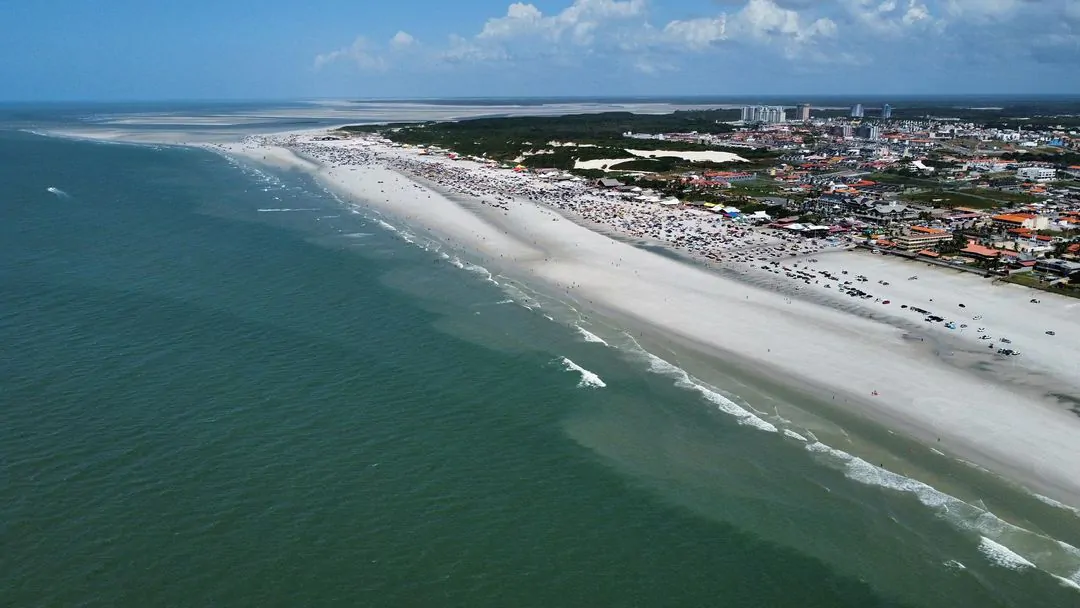
Where the Amazon biome meets the vast Atlantic Ocean, on the northeastern coast of Pará, Salinópolis shelters one of northern Brazil’s most dynamic coastal systems. The municipality is close to Belém by road, yet its landscape is defined by the constant presence of the sea, powerful tides and ocean mangroves.
Unlike the forest interior, this coast is shaped directly by Atlantic tidal forces. Broad stretches of white sand exist alongside dense, vital mangrove forests, creating a transition ecosystem where saltwater waves break on the beach while, only a few metres away, the aerial roots of salt-adapted trees form nurseries for marine life.
These environments support part of the life that sustains the equatorial ocean. Sand, salt water, channels and vegetation combine to produce a landscape that changes throughout the day, helping explain why thousands of visitors seek Pará’s ocean beaches and a closer connection with the coast.
Atalaia and the daily movement of the sea
Atalaia Beach is one of Salinópolis’s best-known landmarks. It is recognised not only for its kilometre-long expanse, but also for the remarkable tidal phenomenon that can make the sea retreat hundreds of metres at low tide.
As the water pulls back, enormous sandbanks emerge from areas that had been covered by waves. The retreat can create temporary natural pools with warm, turquoise water, while allowing visitors to walk long distances across ground that, only hours earlier, was occupied by the sea.
This daily transformation is a visible demonstration of the Moon’s gravitational force on the planet’s largest body of water. The rhythm shapes the beach, influences visitor activities and sets the pace for local life connected to the coastal waters.
At high tide, the waves return to the sandy shoreline and create conditions that are ideal for surfing. At low tide, the beach expands and reveals a changing coast of sandbanks and pools. At Atalaia, both sides of that cycle can be observed within the same natural setting.
From the sea to the Pará table
Food in Salinópolis is inseparable from local biodiversity and the freshness of the sea. Fish caught directly along Pará’s ocean beaches arrive daily at the central fair and the city’s markets, linking the local menu to the coastal environment and to the work of fishing communities.
Species found in this supply include dourada, gurijuba and filhote. They bring distinctive flavours to local dishes and show how visitors’ meals are connected to the waters, livelihoods and food traditions of the region.
The small-scale fishing practised by riverside communities is described as a positive point for sustainability. It supports the regional bioeconomy and allows visitors to enjoy Pará’s cuisine with environmental awareness, while recognising the value of the people who depend on the sea.
Local restaurants often highlight these fresh ingredients alongside tucupi, jambu and açaí. The combination creates a distinctive meeting of river and sea flavours, reflecting a cuisine that is closely tied to the ecosystems surrounding Salinópolis.
This relationship also shows why coastal conservation matters to the local economy. Fish markets, restaurants and community livelihoods all depend on the continuing health of the waters, the mangroves and the habitats where marine life develops.
Mangroves that protect the coast
Salinópolis’s natural wealth extends far beyond its beaches. The mangrove system surrounding the area is one of the most preserved and biologically productive in Pará, with importance for wildlife, coastal protection and the communities that depend on the sea and mangrove.
According to studies on these ocean mangroves, the forests act as natural barriers against coastal erosion and efficient carbon sinks. Their prop roots help shape the edges of channels and provide shelter and feeding areas for a wide range of organisms.
Boat trips through the furos and igarapés offer a different view of this environment. Travellers move among prop roots and vegetation-covered stretches, gaining a perspective that is easy to miss when a visit is focused only on the open beach.
Along these waterways, visitors may see several species of birds and crabs. With luck, botos may also appear in the estuarine waters. Sightings depend on conditions, but the possibility reinforces the sense that the mangroves are living environments in constant motion.
The short distance from Belém strengthens Salinópolis’s potential for ecotourism. At only 4 hours from the Pará capital by car, the destination allows people to combine time on the beach with contact with a coastal ecosystem that is fundamental to the Amazonian shoreline.
Getting there and protecting the landscape
The main route from Belém follows BR-316 and then PA-124. Under normal traffic conditions, the journey takes about 4 hours by car. The road is paved and offers a peaceful trip through the inland landscape of Pará before reaching the coast.
Travellers without their own vehicle can use regular bus services departing from Belém’s bus terminal. Vans and app-based transport are also available, expanding the options for reaching Salinópolis without driving.
The city has a robust tourism infrastructure, with hotels, guesthouses and resorts prepared to receive visitors throughout the year. Visitor numbers peak during school holidays and long holiday weekends, when the beaches and other attractions become especially busy.
Tourism development must move together with the protection of the area’s unique ecosystems. The coexistence of sun-and-beach activities, including those at Atalaia Beach, with the conservation of ocean mangroves is both Salinópolis’s central challenge and its greatest opportunity.
Sustainable tourism practices can protect biodiversity while securing the long-term economic viability of communities that depend on the sea and mangrove. In that sense, visiting Salinas can mean more than enjoying scenery. It can also support a development model that values the bioeconomy and conservation.
The Coca-Cola Lake
Travellers who want to vary their sea bathing can visit Coca-Cola Lake. Located near the Pôr do Sol dune, the lake has dark, reddish water because of the high concentration of tannins released by restinga vegetation and nearby mangroves.
It is a popular swimming spot and a striking demonstration of the coastal region’s hydrological complexity. Its colour reflects the interaction of water, plants, soils and mangroves, showing that the Amazonian shoreline is much more than the sandy line visible from the beach.
Understanding the delicate connection among sand, mangrove and local economy gives a visit to Salinópolis a broader meaning. The destination offers space for leisure, but it also reveals how tourism choices can influence the preservation of one of Pará’s most impressive coastlines.
Protecting this relationship is essential to keeping the beaches, waterways, fishing traditions and natural habitats connected. Salinópolis’s appeal comes precisely from that combination: the power of the Atlantic, the shelter of the mangroves and the cultural richness built around both.
Reporting: Anne Silva / Amazonia Mag

Editor, English Edition — Amazonia Mag
Anne Silva is the editor of Amazonia Mag, the English-language edition of Revista Amazônia. She curates, translates and adapts the outlet's science and environment coverage for an international audience, reporting on Amazon wildlife, flora, rivers, climate and research. Every story she edits is grounded in peer-reviewed studies, official data and on-the-ground reporting from the Revista Amazônia newsroom in Belém, Pará, Brazil. More by Anne Silva →