
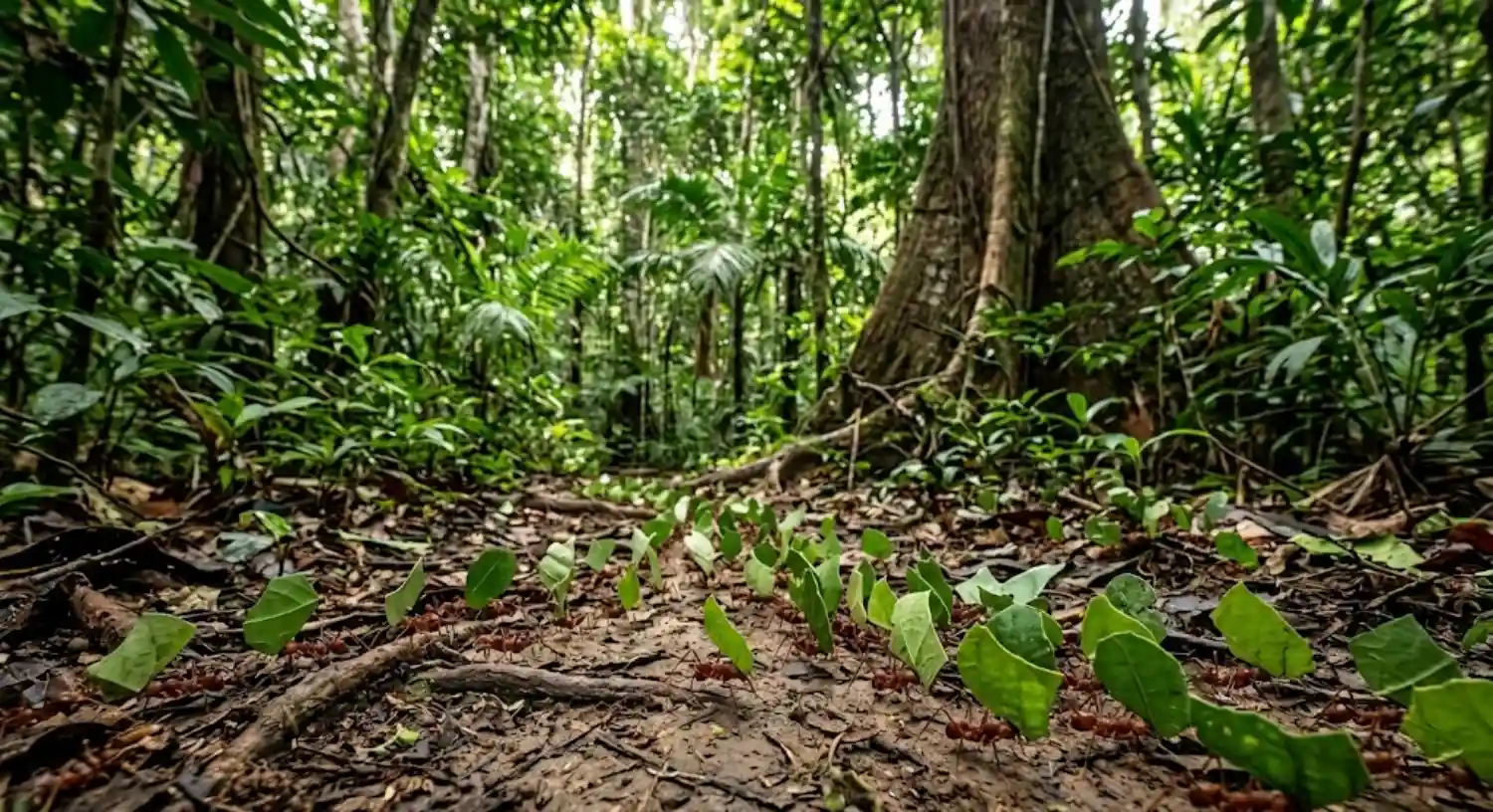
The saúva ant, Atta sexdens, can carry pieces of leaves weighing up to 50 times its own body weight. In human terms, that feat would be comparable to carrying a midsize car on one’s back for miles. Yet the strength of an individual worker is only the beginning of a remarkable example of biological engineering unfolding across the Amazon forest.
Seen one at a time, the workers appear to be driven by frantic impulses. Seen as members of a colony, they reveal a collective system in which millions of individuals act as a single superorganism. Science recognizes that the ants’ efficiency depends not only on their ability to lift heavy loads, but also on a carefully maintained transportation infrastructure.
Highways stretching into the forest
Deep in the Amazon, saúva colonies build complex highways extending hundreds of meters from the nest. These are not simply dirt paths created by repeated movement. They are transportation routes that help an army of workers travel between the colony and the parts of the forest where plant material can be collected.
The organization of a saúva trail includes a particularly surprising feature: separate lanes for outbound and returning traffic. Ants carrying heavy leaves use one strip, while workers returning empty use another. This arrangement keeps different flows moving and reduces the chance that ants performing opposite tasks will collide.
Studies indicate that this division of traffic reduces transport time and improves resource collection. The benefit does not belong to one worker alone. It increases the efficiency of the colony as a whole by allowing more ants to move between the forest and the nest without interrupting the flow.
The highways also require constant care. Specialized workers continually remove small stones, twigs, and leaves that could obstruct the passage. This cleaning preserves the route’s integrity and shows that the infrastructure is not built once and then forgotten. It is maintained as an ongoing collective task.
Pheromones guide thousands of journeys
The intense traffic of saúva colonies is coordinated through a sophisticated chemical communication system. When a worker finds a food source, it lays down a pheromone trail on the way back to the nest. The scent acts as a guide for other workers, directing them toward the location of the resource.
The concentration of the pheromone communicates the quality and abundance of what was found. A stronger signal attracts more workers, while a weaker one can draw fewer individuals. In this way, the colony distributes its workforce according to the opportunities available in the surrounding environment.
Trail pheromones also help preserve the route itself. Because the odor persists, the colony can quickly recruit thousands of individuals to a particular site. The same chemical system allows the ants to respond rapidly to environmental changes, redirecting collective activity as resources appear in different parts of the forest.
The combination of pheromone trails, separated lanes, and continuous cleaning turns the path into much more than a strip of ground. It becomes a system for both movement and information. No single ant needs to direct the entire operation. Coordination emerges from chemical signals and the collective response of the workers.
A colony organized by castes
The success of saúva trails reflects the structure and operation of the colony itself. A mature nest may hold millions of individuals divided into castes with specific functions. Some workers cut and carry leaves, while soldiers defend the colony.
This division of labor, combined with an efficient transport system, allows saúvas to explore broad areas of the forest and consume large amounts of plant material. Each task contributes to a shared operation. Some ants gather resources, others carry them, maintain the highways, or participate in the defense of the nest.
Science recognizes this arrangement as a classic example of a superorganism. The colony operates as an integrated unit even though its individual members perform different jobs. Collective coordination does not replace the activity of each worker. It turns that activity into a much greater capability.
Leaves support a fungus grown by the ants
The leaves cut by saúvas are not eaten directly. They are carried into the nest and used as a substrate for growing a specific fungus. The relationship between the ants and this fungus is essential to the survival of the colony.
The ants care for the fungus by removing other microorganisms that could interfere with it. They also provide nutrients through their own feces and salivary secretions. The fungus breaks down the cellulose in the leaves, and the ants feed on specific parts of the fungus.
This cultivation shows that leaf collection is part of a broader system. Transport does not end when the plant material reaches the nest. The leaves become the foundation of a mutualistic relationship in which fungal care and ant labor sustain the colony.
The ants’ behavior also has a significant impact on the Amazon ecosystem. Their activity influences seed dispersal, nutrient cycling, and the composition of vegetation. For that reason, the superorganism cannot be understood separately from the broader web of life in the forest.
Collective intelligence in the Amazon
The ability to organize traffic involving millions of individuals without apparent congestion or accidents has made the saúva an example of collective intelligence. The efficiency of its routes can inspire ideas about logistics and intelligent transportation systems, while remaining a biological adaptation shaped by life in the Amazon.
Science recognizes the saúva as an organism worth studying not only because of its ecological importance, but also because it demonstrates how social organization works. Its highways, pheromones, division of labor, and fungal cultivation show how cooperation can produce results that no individual could achieve alone.
The existence of complex roads and divided traffic in animals that have survived and prospered for millions of years invites respect for the organization of nature. Preserving Amazonian biodiversity is essential to the survival of species such as the saúva and to the ecological balance that supports life on the planet.
Looking across the vastness of the rainforest, the saúva offers a reminder that the smallest creatures may hold some of nature’s greatest secrets. In its trails and colonies, communication, cooperation, and adaptation become visible as parts of the intricate network of Amazonian life.
Reporting: Anne Silva / Amazonia Mag

Editor, English Edition — Amazonia Mag
Anne Silva is the editor of Amazonia Mag, the English-language edition of Revista Amazônia. She curates, translates and adapts the outlet's science and environment coverage for an international audience, reporting on Amazon wildlife, flora, rivers, climate and research. Every story she edits is grounded in peer-reviewed studies, official data and on-the-ground reporting from the Revista Amazônia newsroom in Belém, Pará, Brazil. More by Anne Silva →