
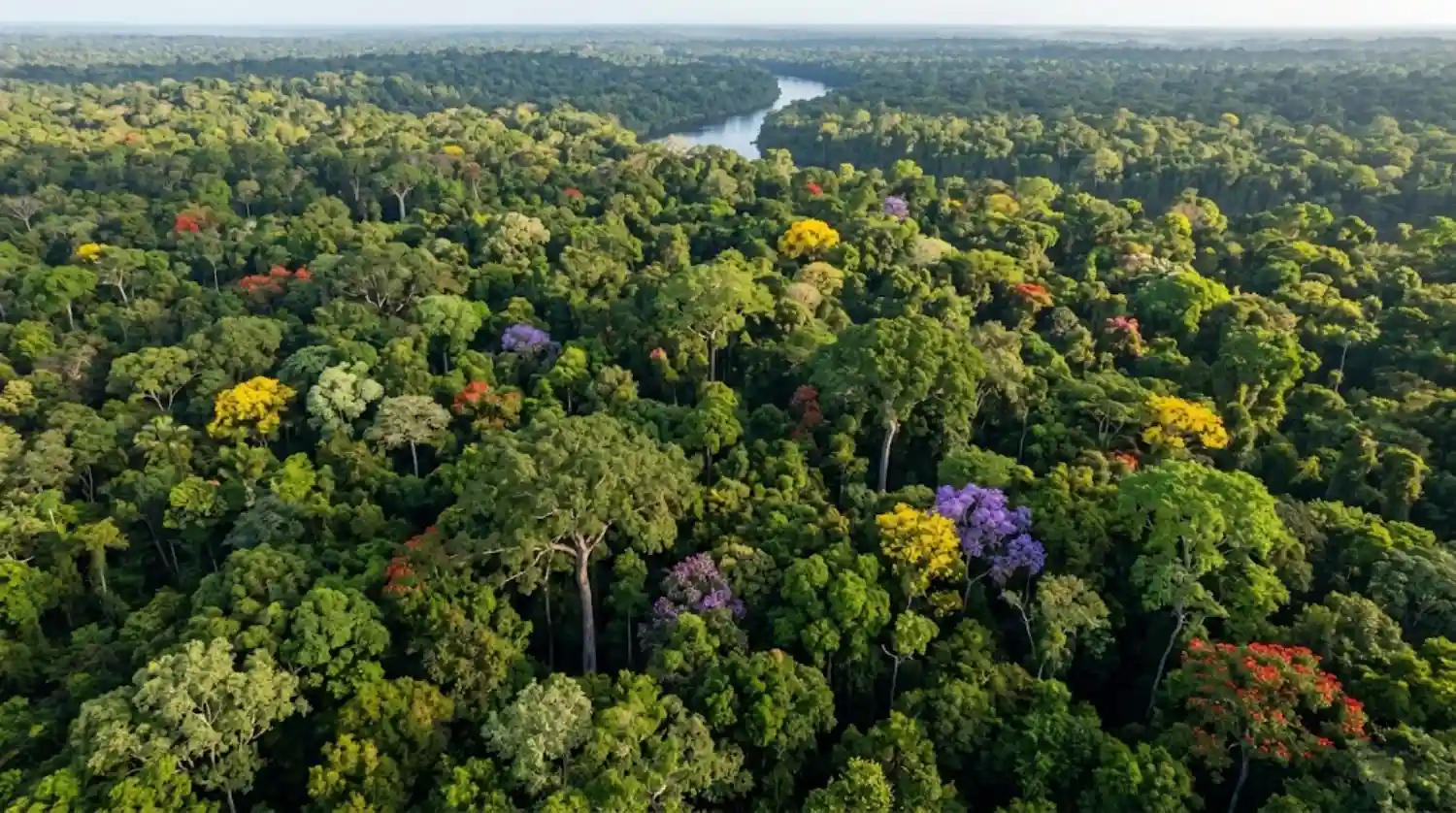
Sixteen thousand species. That is the estimated number of tree species found across the Amazon Basin, a concentration of biodiversity that makes the region the most complex biological system on Earth. This is not only a botanical record. It is a living network in which every tree contributes to the way the forest functions.
The comparison with Europe shows the scale of that richness. While the entire European continent has about 500 native tree species, a single hectare in the Cuyabeno Reserve or in the forests of Pará can contain more than 300 different species. One hectare is about 2.47 acres, meaning that an area smaller than many city blocks can hold extraordinary variety.
This Amazon tree biodiversity is not merely a statistic. It is part of the machinery that supports the chemical stability of the atmosphere, the movement of water and the resilience of the ecosystem. Brazil’s forest diversity acts as a vast filter and reservoir, with each species occupying a specific ecological niche.
A network of species keeps the forest working
Thousands of species distribute the forest’s ecological functions. Individual trees may differ in wood density, growth rate, root depth and relationships with soil, fungi, insects and other organisms. Together, those differences make the absorption of nutrients and the cycling of water more efficient.
Inventories by the National Institute of Amazonian Research, known as INPA, and work by the Amazon Tree Diversity Network reveal the scale of this hyperdiversity. According to researchers and inventories associated with INPA and the network, this variety helps the forest withstand pests and climate variations.
The logic is that of a system with many functions spread across many species. If one species becomes diseased, hundreds of others are ready to maintain vital ecosystem functions. Diversity does not remove every risk, but it prevents a single disease or disturbance from affecting the entire forest structure in the same way.
That is why losing species means more than shortening a list of names. It removes pieces from a system whose functions are connected. When a species disappears, the forest may lose a particular way of absorbing nutrients, storing carbon, supporting other organisms or participating in the water cycle.
The carbon vault and climate regulation
The relationship between Amazon forest diversity and carbon sequestration is direct. Trees with different wood densities and growth rates work at different stages of the forest cycle. Fast-growing species capture carbon quickly after clearings form.
At the same time, giant, centuries-old trees such as the sumaúma and red angelim store tons of carbon dioxide for centuries in their massive trunks. The estimate presented for the Amazon is between 150 billion and 200 billion metric tons of carbon, or roughly 165 billion to 220 billion U.S. tons.
Without the forest’s structural diversity, more carbon would be released into the atmosphere. That release would accelerate global warming to irreversible levels. The architecture of the forest, formed by trees of different sizes, ages and characteristics, is therefore an essential part of its ability to store carbon.
Diversity also shapes the movement of moisture. Evapotranspiration from thousands of species creates the so-called flying rivers, streams of atmospheric moisture that carry water toward Brazil’s Center-West and Southeast. This movement ensures the rainfall needed for the country’s agriculture.
The water leaving the forest is not separate from the trees that release it. Vegetation takes up water from the soil and returns it to the atmosphere, while the combined activity of thousands of species helps form that flow. In this way, forest diversity links the Amazon to agricultural regions hundreds or thousands of miles away.
A living pharmacy that remains largely unexplored
Tree diversity is also one of the planet’s largest chemical libraries. Less than 1% of Amazon tree species have been fully studied for their medicinal properties. Even so, that small fraction has already yielded substances essential to the treatment of cancer, hypertension and malaria.
The Emílio Goeldi Museum of Pará, known as MPEG, points out that losing a single tree species could mean the extinction of a future cure. The warning reflects the number of molecules that remain unstudied and the possibility that some species produce compounds found nowhere else.
Trees synthesize complex molecules to defend themselves against fungi and insects in the forest. That defensive chemistry provides a foundation for new antibiotics and antivirals in modern medicine. Each lost species may represent the disappearance of a chemical combination that another tree does not reproduce.
The idea of a living pharmacy does not reduce the forest to a stockpile of useful substances. It also shows that scientific knowledge depends on species remaining alive. Without living trees, there is no opportunity to investigate their defenses, compounds or ecological relationships.
Services that support economies and life
Protecting tree biodiversity generates services that conventional economics often overlooks, even though it depends entirely on them. Tree canopies and trunks provide habitat for thousands of pollinators, which support the productivity of nearby agricultural crops.
Soil also depends on a mixture of species. Falling leaves from different trees create rich litter that feeds the mycorrhizal network formed by soil fungi. This interaction connects trees to the processes that maintain soil fertility.
Deep roots filter groundwater and help prevent the silting of rivers. Forest structure holds soil in place, reduces the movement of sediment and protects waterways. Pollination, fertility and water purification are not separate benefits. They are expressions of the same forest diversity.
Reports from the Amazon Institute of People and the Environment, known as Imazon, reinforce the conclusion that keeping the forest standing is more profitable than extensive cattle ranching. The bioeconomy depends on non-timber forest products such as essential oils, resins and fruits, including açaí, native cacao and Brazil nuts.
That economic model depends entirely on maintaining Brazil’s forest diversity. When the forest remains standing, these products can continue to be generated by a living and varied system. When vegetation is replaced, the ecological foundation of those activities is lost as well.
The risk of turning diversity into uniformity
Deforestation and degradation do not simply remove trees. They simplify the forest. When a degraded area recovers without management, it tends to become dominated by a small number of generalist species and loses the collective intelligence of the original biodiversity.
This process makes the forest more flammable and less efficient at capturing carbon. Vegetation with fewer species may retain part of the appearance of a forest, but it does not necessarily preserve the same combination of functions, relationships and abilities found in the original community.
IBAMA and enforcement agencies work to prevent the green heart of the world from being turned into monocultures. The Amazon, with more tree species than Europe, is not merely a source of national pride. It is also a global conservation responsibility.
To preserve diversity is to preserve life. Every Amazon tree is a pillar in a biological building that supports Earth’s balance. Bringing that building down means compromising the future of every nation, including those thousands of miles away.
Reporting: Anne Silva / Amazonia Mag

Editor, English Edition — Amazonia Mag
Anne Silva is the editor of Amazonia Mag, the English-language edition of Revista Amazônia. She curates, translates and adapts the outlet's science and environment coverage for an international audience, reporting on Amazon wildlife, flora, rivers, climate and research. Every story she edits is grounded in peer-reviewed studies, official data and on-the-ground reporting from the Revista Amazônia newsroom in Belém, Pará, Brazil. More by Anne Silva →