
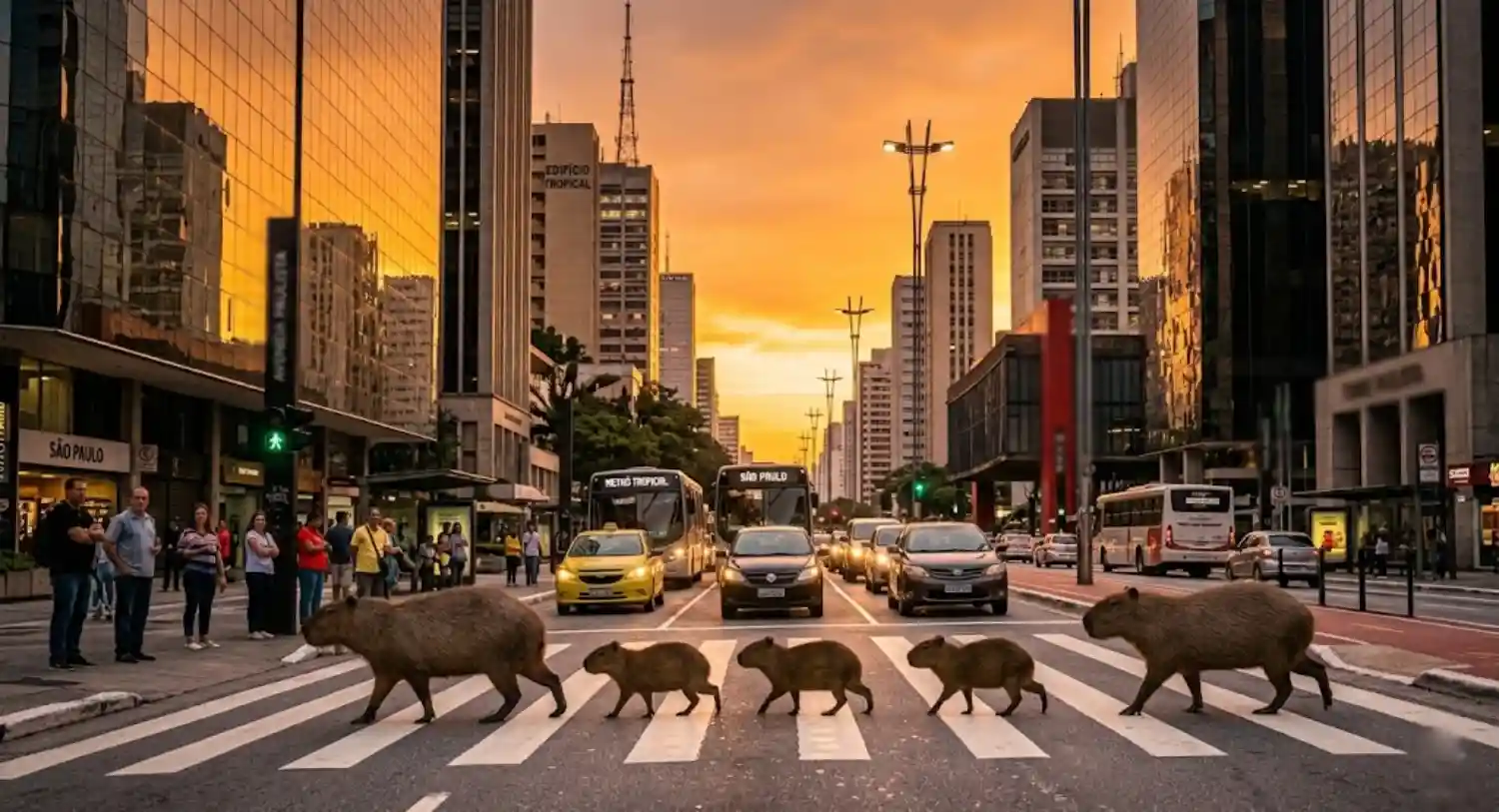
The capybara, the world’s largest rodent, has an ability to adapt that challenges modern biology. Across Brazil, artificial ponds and the lawns of urban parks have become refuges where these animals find water, shelter and favorable conditions for accelerated reproduction.
The large numbers of capybaras seen along busy avenues are not the result of a deliberate choice by the species. They are a direct consequence of losing connectivity between fragments of native forest, a process that has changed animal movements and reduced the natural separation between wildlife, people and urban infrastructure.
From natural corridors to city parks
Biological data indicate that, in balanced urban environments, birth rates would be controlled by limited food supplies. In Brazilian parks, however, the setting is one of constant abundance and a total absence of natural predators such as jaguars or black caimans, known in Brazil as jacaré-açu.
The urban capybara phenomenon gains strength as metropolitan areas expand across floodplains. Historically, these animals used natural biological corridors to move between watersheds and maintain gene flow between populations.
Road paving and the channeling of rivers broke those routes apart. Populations were left isolated in municipal parks and in green areas linked to reservoirs, artificial ponds and urban drainage systems.
This geographic isolation creates what specialists call the “edge effect.” Animals are forced to live in extremely close proximity to people, vehicles and domestic animals, increasing the risk of incidents and pathogen transmission.
In major centers such as Brasilia and Campinas, the capybara in the urban park has become an ambivalent symbol. The animal is charismatic and attracts public attention, yet it also raises concerns about sanitation, disease surveillance and municipal management.
Water, lawns and population growth
City design can intensify capybara overpopulation. Artificial reservoirs and water-supply dams provide an ideal habitat: calm water for protection and escape, together with closely mowed grass that serves as nutrient-rich forage.
Without hunting pressure or predation, a single female can produce up to eight young per year. That reproductive capacity can double the size of a group in very short cycles, particularly where urban landscapes offer reliable food, water and shelter.
This demographic explosion forces young individuals to search for new territories. It helps explain the frequent appearance of capybaras in condominium garages, residential areas and urban drainage systems, places that were not part of the animals’ original natural corridors.
The movement into these spaces should not be understood only as a wildlife invasion. It also reveals how metropolitan growth has transformed floodplains and riverbanks, replacing ecological connections with concrete, roads, fences and ornamental lawns.
Why spotted fever is a concern
One of the greatest challenges for city administrations is managing Brazilian spotted fever, a disease transmitted by the star tick. The capybara acts as an amplifying host for the tick Amblyomma sculptum, but it does not “create” the disease.
The relationship between capybaras and spotted fever is complex and often misunderstood. In areas with overpopulation, circulation of the bacterium Rickettsia rickettsii rises sharply, turning recreational areas into places that require continuous epidemiological attention.
When an ecosystem is healthy, the population density of these rodents is low enough that the disease cycle does not reach epidemic levels. Habitat fragmentation removes biological control mechanisms and concentrates animals in places where contact with people is more likely.
Correct management includes keeping lawns short. Direct sunlight dehydrates tick larvae, making lawn maintenance part of the effort to reduce conditions that support the parasite’s cycle in urban areas.
Preserving natural predators is also presented as a fundamental measure. According to the information from specialists, protecting those predators is the cheapest and most efficient form of public health because it helps keep rodent density under control within the ecosystem.
According to the Ministry of Health, surveillance in parks is essential to protect people who use those spaces. Prevention also depends on public awareness, including maintaining a minimum distance from wildlife and understanding why wild animals should not be fed.
Wildlife crossings and a more connected city
Environmental engineering projects are attempting to reverse part of this situation through wildlife crossings and strategic fencing. In some regions, the installation of ecoducts allows animals to cross roads without the risk of being hit and reconnects populations that had become isolated.
Another alternative that has been tested is reproductive management through sterilization. The approach seeks to stabilize the number of individuals without resorting to culling and without creating an even greater imbalance in the local ecosystem.
The success of these measures depends on an urban planning vision that treats wildlife as an integral part of city infrastructure. It is not enough to respond only when a capybara appears on an avenue, in a condominium or in a drainage channel; planners must also understand which landscape changes led the animal there.
Harmonious coexistence between people and capybaras requires recognition of the role humans play in altering the landscape. Covering river margins with concrete and ornamental lawns is an invitation for wildlife to settle in places that may be unsuitable for both animals and residents.
Environmental education therefore becomes a powerful tool for preventing conflict. Respecting a minimum distance, not feeding wild animals and following surveillance guidance in parks can reduce unnecessary contact and help protect public health.
Only by restoring the integrity of urban rivers and creating genuine green corridors can cities offer capybaras a destination other than the cold asphalt of metropolitan areas. The remaining question is whether cities are willing to redesign themselves so nature does not have to invade them to survive.
For prevention information, people should consult the official Health Surveillance portal or the Ibama management guide. Those recommendations complement park surveillance and the planning work required to reduce risks associated with large, isolated populations.
Reporting: Anne Silva / Amazonia Mag

Editor, English Edition — Amazonia Mag
Anne Silva is the editor of Amazonia Mag, the English-language edition of Revista Amazônia. She curates, translates and adapts the outlet's science and environment coverage for an international audience, reporting on Amazon wildlife, flora, rivers, climate and research. Every story she edits is grounded in peer-reviewed studies, official data and on-the-ground reporting from the Revista Amazônia newsroom in Belém, Pará, Brazil. More by Anne Silva →