
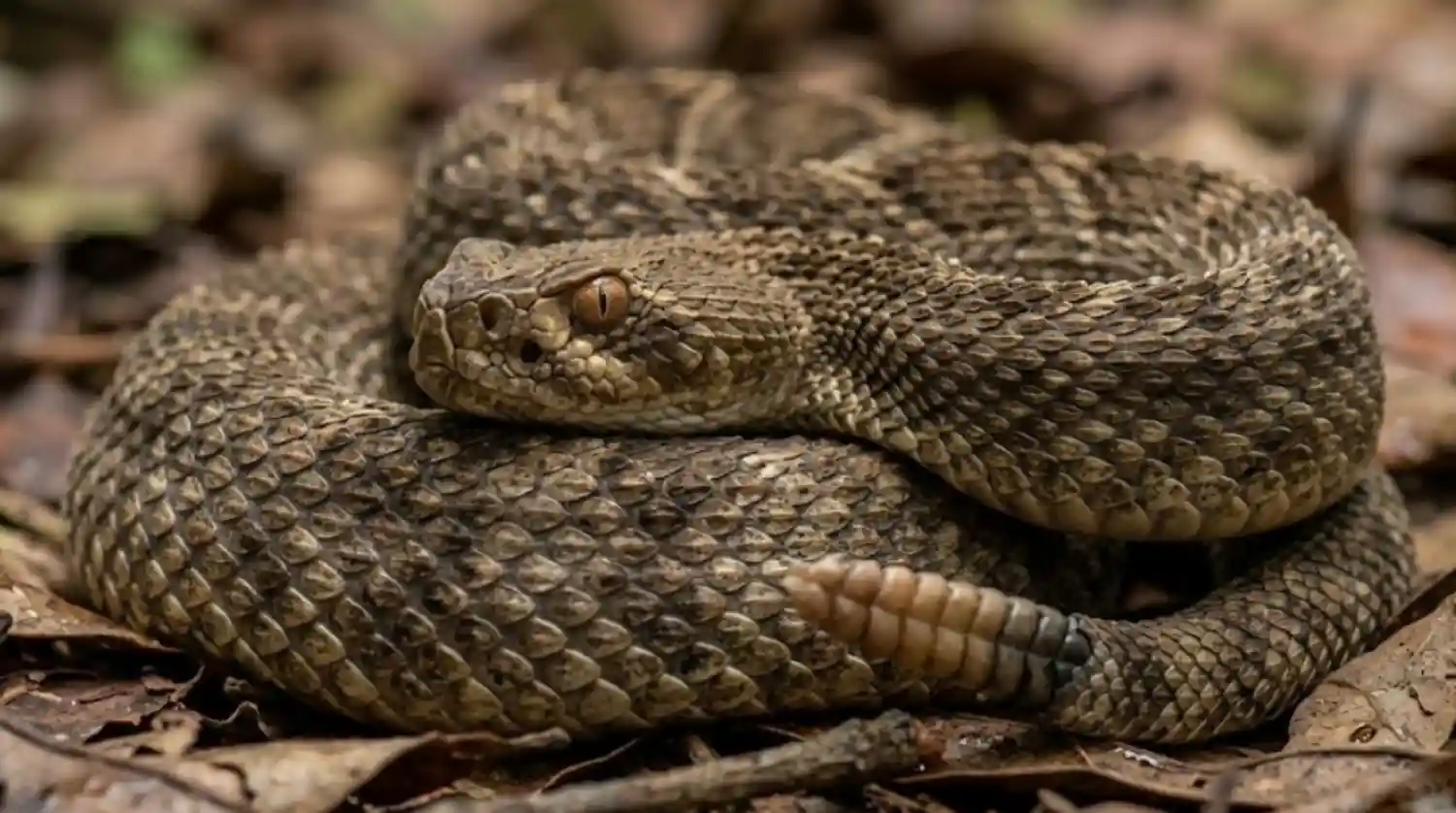
A single drop of South American rattlesnake venom carries a biological arsenal capable of paralyzing the nervous system. Yet Brazilian scientists have found that this same lethal weapon has a striking selective affinity for malignant tumor cells, a feature that is opening new possibilities in cancer research.
The focus of the investigation is crotoxin, a protein that accounts for about 60% of the toxicity of the snake Crotalus durissus. In high-precision laboratory tests, researchers observed that the molecule can identify the membrane of cancer cells and trigger a process of programmed cell death.
At controlled doses, according to the reported findings, crotoxin spared much of the healthy tissue surrounding the affected area. This does not mean that a treatment is available to patients, but it helps explain why a dangerous substance has become a subject of study for potentially less invasive cancer therapies.
How crotoxin disrupts tumor energy
Crotoxin’s path through Brazilian oncology is not recent. Its study has reached an unprecedented level, however, with the use of cutting-edge biotechnology that allows scientists to examine more precisely how the protein interacts with diseased cells.
Leading institutions such as the Butantan Institute, along with researchers from federal universities, are working to decode the protein’s mechanism of action. According to the scientists involved, the key difference lies in the way the substance interferes with the energy of a tumor cell.
Crotoxin acts directly on the mitochondria of cancer cells. These structures help produce the energy required for a tumor to multiply and spread, and the protein blocks that supply inside the diseased cell.
Without fuel, the cancer cell stops its uncontrolled multiplication and collapses. This phenomenon has stood out in in vitro results, meaning experiments performed outside a living organism under controlled laboratory conditions.
The selectivity observed is one of the features that most interests researchers. A therapy that preferentially reaches malignant cells while causing less harm to healthy cells could offer an alternative to more aggressive treatments, although crotoxin still has important stages to complete before that possibility can be considered.
Findings in cells and animal models
Experiments in animal models produced equally promising results. Mice with solid tumors showed a significant reduction in tumor mass after treatment with purified fractions of the venom.
The result was especially striking because crotoxin showed effectiveness against cancer cell lines considered resistant to conventional chemotherapy drugs. Resistance is one of oncology’s most difficult obstacles because it can limit medicines that once worked against a tumor.
Tumors often develop defense mechanisms that push common drugs out of their interior. According to the research, the molecular structure of rattlesnake venom appears to get around these barriers in a natural and aggressive way against the disease.
This observation does not automatically make crotoxin a medicine. Results in cells and mice help scientists understand its activity and measure its risks, but safety, stability and control of its effects remain central questions in the research.
The difference between whole venom and a purified fraction is essential. Raw venom would be fatal, while the research aims to isolate and refine crotoxin so that it loses its systemic neurotoxic effect while retaining its antitumor property.
Turning a dangerous venom into a controlled molecule
The venom of Crotalus durissus is a complex mixture and requires a rigorous laboratory isolation process. The substance produced by the snake is not applied directly. Instead, its components are separated and studied to determine which fraction may be useful against cancer cells.
This refinement makes it possible to imagine future therapies based on Brazilian biodiversity. The idea is to use knowledge of organisms and natural molecules to develop potentially less invasive drugs, without confusing the promise of an isolated protein with the safety of whole venom.
Brazil has a global competitive advantage in this field because it is home to species rich in bioactive compounds that have not yet been fully cataloged by modern science. Crotoxin is presented as an example of how a substance associated with danger can reveal medical value when examined with precision.
Research is currently moving forward to understand how crotoxin can be combined with other substances to increase its effect. Scientists are also focusing on the molecule’s safety and stability, two requirements for reaching its target without causing severe side effects.
Scientists explain that the road to pharmacies and hospitals is long and requires strong investment in basic science. The transition from in vivo tests to protocols aimed at human application is on the medium-term horizon, according to the research outlook.
That prospect brings renewed hope to patients who have exhausted traditional therapeutic options. Even so, the hope depends on continued studies rather than an available cure, because the molecule must still show that it can be used safely and stably.
Biodiversity and scientific sovereignty
The value of wildlife in the Amazon and the Cerrado, habitats where these snakes thrive, takes on another layer of importance through discoveries of this kind. Protecting the rattlesnake and its ecosystem is no longer only an environmental and ethical issue. It can also become a public health strategy.
If biodiversity is lost, entire genetic libraries may disappear along with compounds that science has not yet studied and that could help address humanity’s most challenging diseases. From this perspective, conservation protects not only animals and landscapes, but also open possibilities for research.
The medicine of the future, according to the view expressed by the researchers, may be written with the letters of nature itself. Crotoxin shows how life can offer unexpected solutions, including through the venom of one of the Americas’ most feared predators.
The Butantan Institute in São Paulo is the world’s leading reference center for the study of venoms and toxins. In addition to producing most of the antivenom sera used in Brazil, the institution leads drug projects derived from snake peptides.
The work ranges from ethical venom extraction to laboratory synthesis. This approach ensures that producing medicines does not depend on hunting animals, but on genetic knowledge obtained from them, according to the description of the research.
The study of crotoxin symbolizes national scientific sovereignty in the search for innovative and genuinely Brazilian cancer treatments. Looking at the forest floor with respect and scientific curiosity may be the first step toward transforming fear into knowledge and danger into a possible tool for life.
Reporting: Anne Silva / Amazonia Mag

Editor, English Edition — Amazonia Mag
Anne Silva is the editor of Amazonia Mag, the English-language edition of Revista Amazônia. She curates, translates and adapts the outlet's science and environment coverage for an international audience, reporting on Amazon wildlife, flora, rivers, climate and research. Every story she edits is grounded in peer-reviewed studies, official data and on-the-ground reporting from the Revista Amazônia newsroom in Belém, Pará, Brazil. More by Anne Silva →