
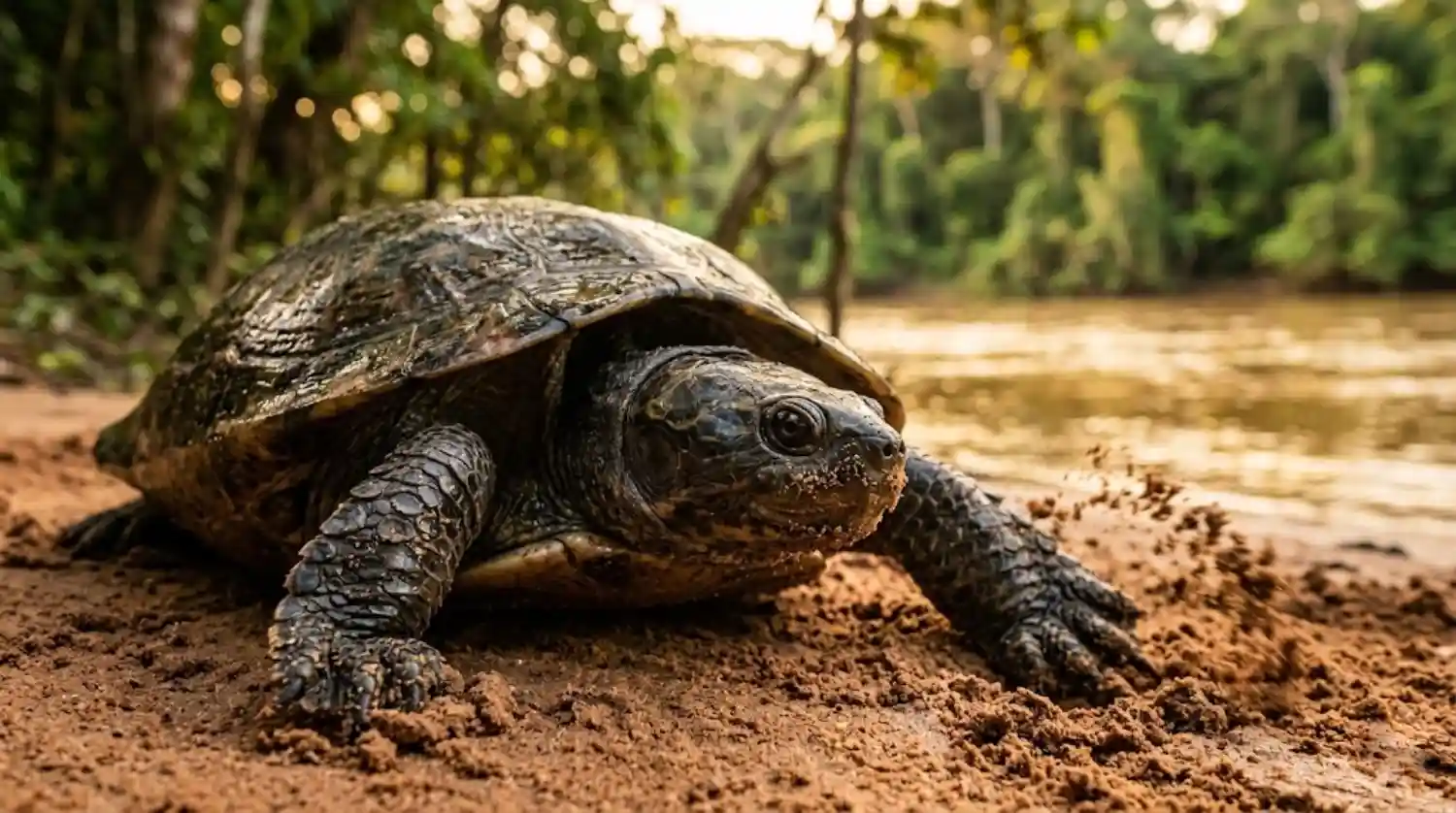
Fifty days of incubation can shape the future of an entire population. During this critical period, sand temperature determines whether Amazon turtle hatchlings, Podocnemis expansa, will be male or female.
A long-term study by Brazil’s National Institute of Amazonian Research, INPA, is uncovering the complex nesting behavior of this emblematic species on Amazon river beaches. The research is also revealing how climate fluctuations are changing the population balance.
The study is being conducted by INPA’s Turtle Conservation and Management Research Program, which monitors key nesting areas along rivers including the Solimões and Purus. Its goal is to understand how Podocnemis expansa, the largest freshwater turtle on the continent, chooses nesting sites in response to the seasonal pulse of the rivers.
Sand as a natural incubator
Nesting by the Amazon turtle is a synchronized, massive event known as an “arribada.” Thousands of females climb onto white-sand beaches exposed during the dry season to lay their eggs. Concentrating the nests is an evolutionary strategy that helps overwhelm natural predators.
That strategy, however, is becoming vulnerable to new environmental pressures. INPA’s research shows that nest-site selection is not random. Females choose areas with specific sand grain characteristics and, above all, suitable levels of moisture and heat.
To observe conditions below the surface, the INPA team installed automatic data recorders, known as data loggers, at different depths in monitored nests. The sensors collect readings every hour throughout the incubation period, allowing researchers to follow temperature changes inside each nest.
Unlike mammals, this turtle’s sex is determined by temperature. The mechanism is called temperature-dependent sex determination, or TSD. Temperatures above 31°C, or 87.8°F, produce predominantly females, while temperatures below 28°C, or 82.4°F, produce males.
The transition zone, where both sexes are born, is very narrow. As a result, small environmental changes can significantly alter the sex ratio of a generation.
Warming, drought and more female hatchlings
Data from the INPA turtle research point to a worrying trend. Global warming and longer droughts in the Amazon are raising the average temperature of the sand on nesting beaches.
The result can be a disproportionate production of female hatchlings, a phenomenon known as population feminization. If that trend continues, it could compromise the species’ genetic viability over the long term.
Climate also affects the reproductive calendar. INPA research confirms that the rivers’ flood pulse regulates the turtle’s reproductive cycle. Females nest on the beaches of whitewater rivers, which are rich in nutrients, and during the flood season they migrate to blackwater rivers or isolated lakes to feed.
In those remote environments, fruit and seed productivity is lower, but predation is also reduced. The cycle therefore depends on a delicate combination of exposed beaches, food availability, river levels and sand temperature.
Changes in rainfall patterns, intensified by El Niño and climate change, are throwing that cycle out of step. Sudden rises in river level during the dry season, known as “repiquetes,” can flood entire beaches and drown eggs before hatchlings emerge.
Extreme droughts create the opposite problem. They can overheat the sand, kill embryos or cause excessive feminization. Imazon warns that forest degradation in river headwaters changes the water regime, making floods and droughts more unpredictable.
The health of standing forest is directly proportional to the stability of the Podocnemis expansa beach nurseries. The species depends on a connected landscape in which rivers, lakes, forests and beaches serve different functions throughout the year.
Migration routes across the Amazon
To complement the land-based data, INPA, in partnership with institutions such as ICMBio and UEA, began satellite tracking adult females. Telemetry devices were attached to the turtles’ shells soon after nesting, making it possible to monitor their post-nesting migration routes.
The technology revealed unexpected movements. Some females travel hundreds of miles, or hundreds of kilometers, to feeding areas in remote várzea and igapó lakes. Tracking also showed remarkable fidelity to certain routes and nesting beaches.
Knowing these pathways is crucial for creating conservation corridors that protect turtles not only on the beaches, but throughout their habitat. Protecting the nests alone would leave migration and feeding stages exposed, even though those stages sustain reproduction.
The Museu Paraense Emílio Goeldi, MPEG, is helping analyze genetic data from the tracked females. The aim is to understand the connectivity among populations in different river basins.
Podocnemis expansa does not recognize state borders. Its conservation therefore requires integrated strategies across the Pan-Amazon, with actions that follow the species as it moves among beaches, rivers, lakes and forests.
Communities guarding the nests
In response to these threats, INPA turtle research supports community-based management programs that are essential to the species’ conservation. In many regions, riverside communities that once collected eggs have become guardians of the beaches.
These communities protect nests from predators, including people, monitor temperature and even build artificial shade structures. The goal is to lower the temperature of the sand and balance the sex ratio of the hatchlings.
Reports published in Nature and Science reinforce the view that management based on science and community engagement is the most effective strategy for conserving Amazonian wildlife.
The Amazon turtle is a vital resource for local populations. Its preservation is also a matter of food security and riverside sovereignty, because the relationship between communities and rivers depends on the continuity of natural cycles.
The future of Podocnemis expansa depends on the ability to listen to what INPA’s data and the beaches’ own sand are saying. Every temperature record, identified route and protected nest helps reveal the vulnerability of a species that has synchronized reproduction with the rivers for thousands of years.
Protecting the nests means protecting the continuity of one of the oldest reptile lineages on the planet. On Amazonian beaches, the sand holds both the hatchlings waiting to emerge and a warning about the resilience of the forest and its rivers.
Reporting: Anne Silva / Amazonia Mag

Editor, English Edition — Amazonia Mag
Anne Silva is the editor of Amazonia Mag, the English-language edition of Revista Amazônia. She curates, translates and adapts the outlet's science and environment coverage for an international audience, reporting on Amazon wildlife, flora, rivers, climate and research. Every story she edits is grounded in peer-reviewed studies, official data and on-the-ground reporting from the Revista Amazônia newsroom in Belém, Pará, Brazil. More by Anne Silva →