
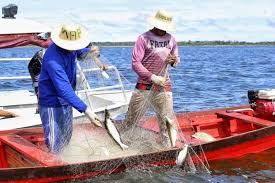
Fish stocks have increased by 50% in communities that adopt the extractive reserve system, known in Brazil as RESEX, in the Lower Tapajós. The measured result shows how sustainable fishing can connect conservation, food security and autonomy for people who live along the river.
What began as a resistance movement against predatory fishing and the spread of illegal mining has become a protected zone. In Pará, the creation of the Tapajós Extractive Reserve was not a bureaucratic act, but a grassroots achievement led by artisanal fishers.
A reserve built through river community organizing
Fishers organized to define territories, establish community closed-season calendars and drive out industrial vessels that were destroying populations of peacock bass and pirarucu. The strategy centers on sustainable fishing in the Tapajós, where ancestral knowledge of the river’s water cycle is validated by technical data.
The protected area covers thousands of hectares of floodplain and terra firme forest. Together, these environments help ensure that fish nurseries remain undisturbed during the most critical periods of reproduction, when the river’s seasonal pulse determines access to shelter and food.
The reserve also reshapes riverine sovereignty in Pará. For the communities, protecting the river is not simply about preserving a landscape. Standing forest and clean water are working tools, which makes conservation a practical economic necessity.
Community management turns resource users into guardians
Creating a RESEX requires a rigorous social and environmental assessment. Local leaders, working with institutions such as ICMBio and MPEG, mapped breeding lakes and areas of intensive use.
The result is a management mosaic in which each community operates as a unit of surveillance. This participatory governance removes the figure of the “outside inspector” and places the resource user at the center of protection.
When an artisanal fisher understands that protecting a lake helps secure the education of their children, conservation becomes more effective than remote satellite monitoring can be on its own. Defending the territory is no longer an outside assignment, but part of everyday life.
The science behind the management system shows that selective fishing gear, including nets with specific mesh sizes, allows young fish to reach maturity. This creates a spillover effect, in which fish raised inside the reserve migrate into neighboring areas and benefit people even outside the protected zone.
Pirarucu, tambaqui and curimatá benefit from protection
Pirarucu, Arapaima gigas, is the flagship species of the effort. Once threatened by overfishing, this freshwater giant recorded a meteoric population recovery in reserve areas.
The management system permits only an annual quota of adult fish to be harvested. The rule is designed to preserve the species’ continuity and maintain its reproductive cycle in protected waters.
Other species that are essential to food security, including tambaqui and curimatá, are also showing rising biomass indexes. The result matters both ecologically and nutritionally, because recovering fish populations strengthen a key source of protein for river communities.
The Tapajós water balance is threatened by sediment from illegal mining. Against that pressure, the riparian vegetation protected by the RESEX acts as a natural filter that helps preserve water quality.
Reports published by Imazon reinforce the connection between social organization and conservation. According to those reports, the presence of organized fishers reduces the occurrence of environmental crimes around the reserve by up to 80%.
Conservation is also raising household income
Sustainable fishing in the Tapajós is not focused only on protecting fish populations. It also seeks to increase the value of products caught by artisanal fishers in Pará and expand their access to markets.
Fish caught in managed areas carry origin certification. This allows fishers to reach markets that pay premiums for ethical and sustainable products, linking river protection to a concrete economic return.
Average household income in communities under RESEX management has grown by 40% over the past five years. That capital is reinvested in cold-storage infrastructure, including solar refrigerators, and in processing facilities.
These investments reduce post-catch waste, which historically reached alarming levels because of inadequate logistics. The fish chain becomes stronger when a larger share of the catch arrives at the market in good condition.
Income diversification is another pillar of the model. Many of these reserves incorporate community-based ecotourism, in which visitors pay to learn about the management system and practice catch-and-release sport fishing.
This activity creates a new economic layer that does not depend on physically removing fish from the river. Community knowledge, the landscape and the management experience gain value without increasing pressure on fish populations.
Surveillance, education and the river’s future
The greatest obstacle facing the Tapajós Extractive Reserve remains external pressure. The advance of the agricultural frontier and hydroelectric infrastructure projects threaten to alter the river’s seasonal pulse, a vital element in the success of fisheries management.
IBAMA works with community patrols to intercept intruders. Yet the territory’s size requires monitoring technologies that are cheaper and more accessible.
Fishers’ associations are testing drones and real-time reporting apps. In the long term, the survival of these reserves depends on solid legal recognition and protection from large-scale mining.
The Tapajós is a living, interconnected system. What happens in the headwaters directly affects the fishing network at the river’s mouth, so protection cannot be limited to one lake or one isolated community.
Environmental education and generational succession are also critical. Schools inside the reserve now include fisheries management and aquatic ecology, showing that life on the river can be technologically advanced and financially viable.
Traditional knowledge, combined with GPS and molecular biology, turns fishers into citizen scientists. This new generation of extractivists can collect data on water pH and temperature, feeding global databases about climate change and its impacts on the Amazon.
The extractive reserve is not a museum, but a living laboratory for development. It demonstrates that forests and rivers can produce wealth without being destroyed, provided decision-making power remains with the people who live in and breathe the waters of the Tapajós.
In this model, sovereignty over the river belongs to those who protect it. The recovery of fish, higher incomes and fewer environmental crimes show that community governance can turn territorial defense into a lasting strategy for the Amazon.
Reporting: Anne Silva / Amazonia Mag

Editor, English Edition — Amazonia Mag
Anne Silva is the editor of Amazonia Mag, the English-language edition of Revista Amazônia. She curates, translates and adapts the outlet's science and environment coverage for an international audience, reporting on Amazon wildlife, flora, rivers, climate and research. Every story she edits is grounded in peer-reviewed studies, official data and on-the-ground reporting from the Revista Amazônia newsroom in Belém, Pará, Brazil. More by Anne Silva →