
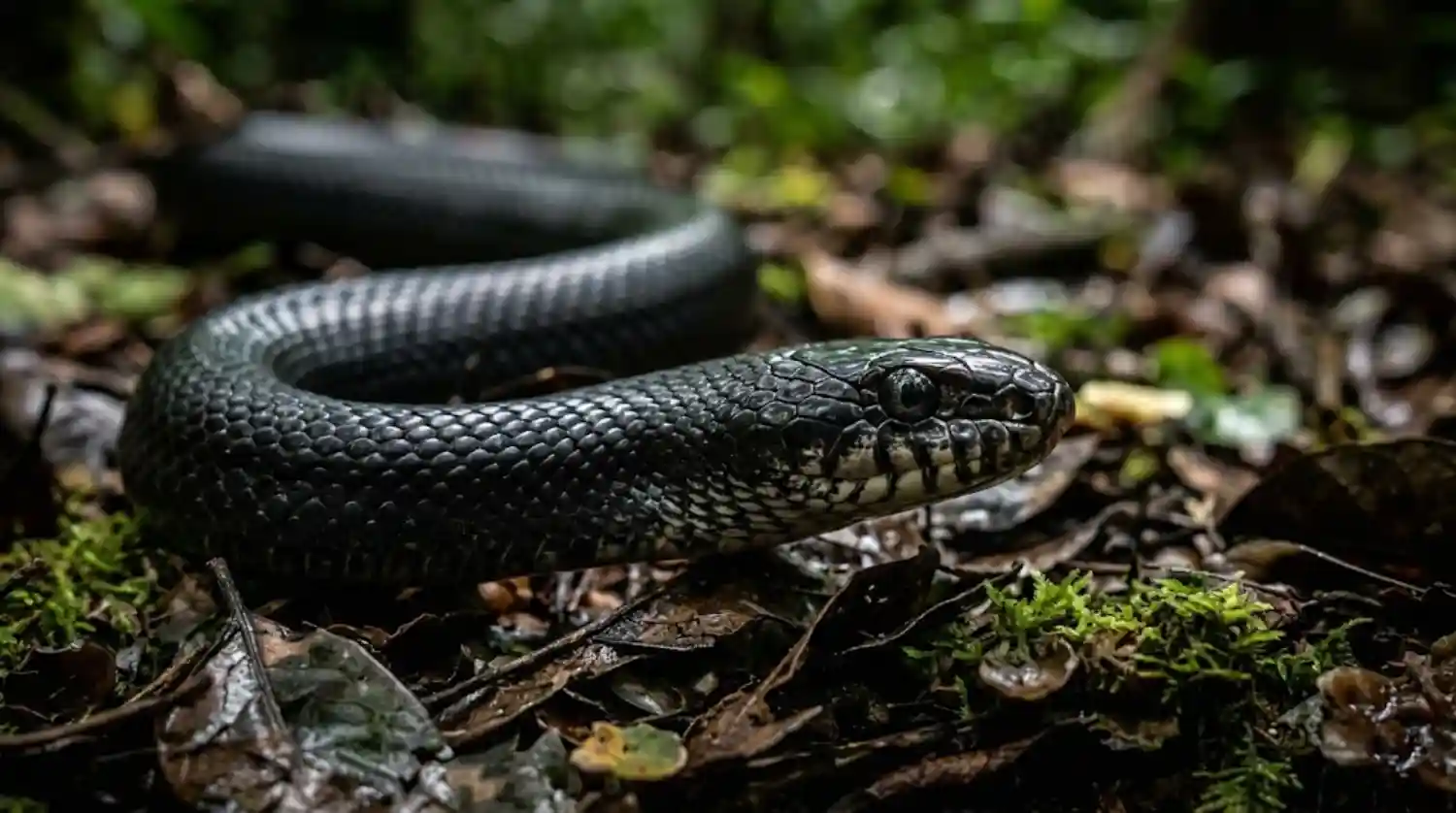
One hundred and fifty milligrams of venom. That is the lethal dose an adult jararaca can inject within seconds, yet for the mussurana (Clelia clelia) the attack is little more than seasoning for its next meal. The species has developed absolute physiological immunity to the proteolytic and neurotoxic toxins produced by Brazil’s main venomous snakes.
What would be a grave medical emergency for a human is an evolutionary advantage for the mussurana. The snake not only withstands the bite, but actively hunts snakes in the genera Bothrops, the pit vipers known in Brazil as jararacas, and Crotalus, the rattlesnakes. In Brazilian forests, it acts as an uncompromising biological regulator.
Scientists are fascinated by the way the mussurana can eat a venomous snake without suffering internal damage. This resistance is not simply a tough outer layer. It is a complex system of antibodies and enzyme inhibitors circulating through the snake’s blood, neutralizing toxins before they destroy tissue or attack the nervous system.
A hunt powered by constriction
Contrary to a common belief, the mussurana does not kill with venom, although it has opisthoglyphous dentition, with fangs positioned toward the back of the mouth. Its main weapon is constriction. When it detects prey, it delivers a precise strike, usually at the rival’s head or neck, then coils its muscular body around the victim to interrupt blood flow.
A clash between a mussurana and a jararaca is a display of brute strength. The jararaca may bite repeatedly, injecting enough venom to kill ten men, while the mussurana ignores the attacks and keeps tightening its coils. Its physiological resistance allows it to continue the struggle until the prey stops moving.
Once the prey is dead, ingestion begins, usually headfirst. That position makes it easier for the body to pass through the mussurana’s elastic jaws. The adaptation also allows the snake to feed on other snakes that are nearly its own size.
Digestion is another part of this remarkable specialization. The mussurana’s gastric juices can break down scales and bones and, most importantly, neutralize any venom that remains in the glands of the swallowed prey. This chemically intensive process complements the protection provided by the snake’s blood.
The biological secret of Clelia clelia
The mussurana’s immunity is the focus of advanced biotechnology research. Researchers at the Butantan Institute and Fiocruz are analyzing proteins in the species’ blood serum to understand how they block the action of metalloproteinases, enzymes in jararaca venom that cause hemorrhage and necrosis.
Unlike other predators that avoid venomous snakes, the jararaca-hunting mussurana seeks them out because they are dense sources of protein. Genetic studies suggest that this immunity arose through millions of years of coevolution. Over that time, the mussurana adapted specifically to occupy the niche of an ophiophage, an animal that eats snakes.
The snake’s geographic range covers nearly all of Brazil. It extends from the dense forests of the Amazon to areas of the Atlantic Forest and the Cerrado. Yet its populations are undergoing quiet declines because of habitat fragmentation and indiscriminate killing by people who mistake it for venomous species.
A sentinel of ecosystem health
The presence of mussuranas in an environmental reserve or on a rural property is one of the most reliable indicators of ecological balance. As a top predator among reptiles, it controls overpopulation of venomous snakes. Indirectly, that reduces the number of snakebite accidents in nearby communities.
IBAMA classifies protection of the species as fundamental to maintaining biodiversity. Where the mussurana disappears, researchers observe an uncontrolled increase in jararacas and other opportunistic snakes. The change disrupts the supply of prey and raises the risk to mammals and people.
Along with snakes, the mussurana also eats small lizards and rodents, but its preference for snakes defines its ecological role. Older farmers commonly call it cobra-do-bem, or good snake, an empirical acknowledgment of its function as a guardian against animals that are dangerous for rural work.
Color, identification, and coexistence
One of the greatest dangers facing the mussurana is human ignorance. As a juvenile, it has vivid reddish coloring and a dark head, a pattern that often leads people to confuse it with a coral snake. As it reaches adulthood, its scales become a deep, glossy blue-black, and it is frequently mistaken for other black snake species.
Environmental education is the only tool capable of stopping killings driven by fear. Finding a mussurana in a yard should be a reason for calm, not aggression. The species is docile around humans and rarely tries to bite. When confronted by larger mammals, it prefers to flee or hide beneath leaf litter.
Reports in Nature on Neotropical fauna reinforce the warning that the loss of these cleaning snakes accelerates the collapse of complex food webs. Conserving Clelia clelia is not only an ethical matter, but also a preventive public-health strategy for controlling pests and venomous animals.
A living chemical library
The mussurana represents an unexplored opportunity for Brazilian pharmacology. Understanding how its body processes lethal toxins could lead to new antivenoms that are more effective and have fewer side effects for humans. Protecting the species means preserving a living chemical library.
The expansion of monocultures and the heavy use of pesticides threaten mussurana survival. The snakes are sensitive to contamination of water and soil. Ecological corridor projects are vital because they allow these predators to move between forest fragments, preserving genetic variability and the continuity of the species.
Protecting the mussurana means preserving a natural antidote for the forests. Without it, the balance between predator and prey breaks down, and the cost of that loss could be felt directly in hospitals and in rural accident statistics. Nature’s intelligence is sovereign, and the mussurana is one of its sharpest proofs.
Reporting: Anne Silva / Amazonia Mag

Editor, English Edition — Amazonia Mag
Anne Silva is the editor of Amazonia Mag, the English-language edition of Revista Amazônia. She curates, translates and adapts the outlet's science and environment coverage for an international audience, reporting on Amazon wildlife, flora, rivers, climate and research. Every story she edits is grounded in peer-reviewed studies, official data and on-the-ground reporting from the Revista Amazônia newsroom in Belém, Pará, Brazil. More by Anne Silva →