
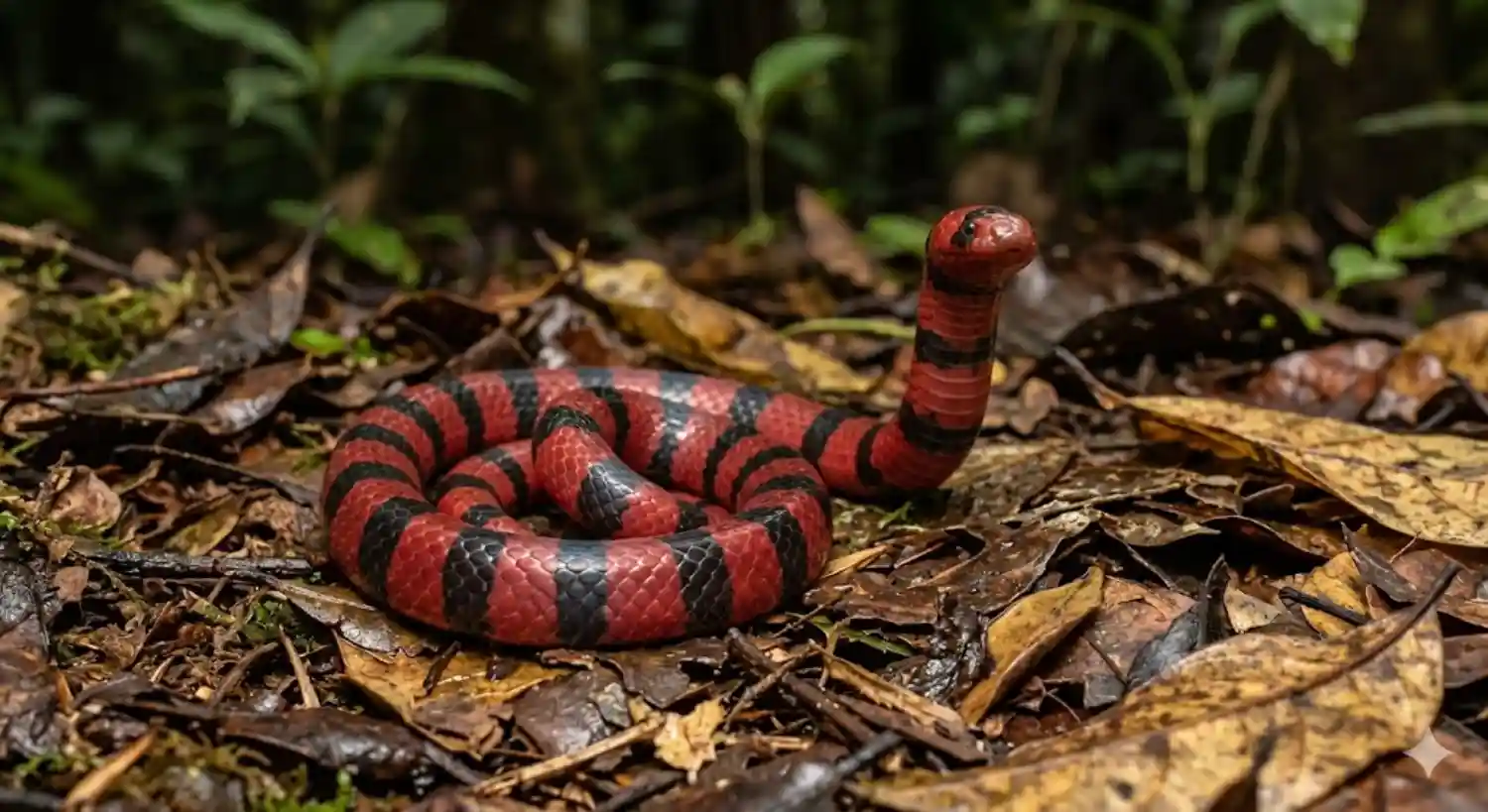
Biological evolution in the Amazon Basin is expressed not only through the giant size of anacondas or the venom of lanceheads. It also appears in the behavioral engineering of Anilius scytale, a discreet snake whose survival depends on details that can escape the notice of predators and people alike.
The species lives beneath leaf litter, the layer of dead leaves that helps nourish the forest soil. Hidden in that environment, it carries a feature that challenges the visual perception of birds and small mammals. It is popularly known as the Amazon two-headed snake because the rear end of its body is rounded and has the same coloration as the front.
This resemblance is not a mistake of nature. It is a survival tool refined over millions of years of selective pressure, helping the animal withstand attacks aimed at its vital organs. By making the tail look like a head, the snake can persuade an attacker to strike the wrong end of its body.
The trick is especially striking because it combines anatomy, movement and the predator’s own uncertainty. The apparent second head does not turn the snake into a two-brained animal. Instead, it creates a visual problem at the precise moment when an attacker must decide where to bite or strike.
A primitive snake beneath the forest floor
Unlike amphisbaenians, limbless lizards that are also known by the same common name, Anilius scytale is a primitive snake. It is considered a living fossil because it retains traces of pelvic limbs, a feature associated with distant stages in the evolutionary history of snakes.
Its fossorial habits keep it in the forest’s lower layers, where it is protected from excessive heat and from many dangers found on the surface. The species shows that Amazonian biodiversity is not limited to the animals that are easiest to see in the canopy, along the rivers or in open clearings.
The body’s shape and colors work together in a defensive system built around confusion. Rather than clearly presenting the vulnerable end of its body, the snake can offer the rear portion as a visual target and keep its real head concealed among its own coils.
That strategy gives the animal an advantage in an environment where a single mistake can be fatal. The forest floor becomes the setting for a silent encounter in which the predator must interpret a body that appears to have two possible fronts.
How the tail draws the attack away
When threatened, the snake does not flee or attack with venom-injecting fangs. Instead, it coils its body tightly and raises the tail, making slow, oscillating movements. To a predator, that raised end can appear to be the reptile’s head.
The attacker then concentrates its effort on the less vulnerable extremity. While the predator is distracted by the so-called false head, the snake gains precious seconds to hide its real head beneath the rings of its own body or to dig quickly into soft soil.
Biologists call this strategy distraction mimicry or simulated behavioral autotomy. The phrase describes the appearance of sacrificing the rear end without the animal actually shedding its tail. The snake creates the impression that the predator has found the important end, while the true head remains protected.
Field studies show that specimens found in the wild frequently have scars from bites and pecks around the tail region. Those marks demonstrate that confusing an enemy is not merely a theoretical possibility. The tactic is used successfully in the everyday life of the forest.
In a setting where predators can attack from above or from the ground, redirecting a strike may be more important than escaping immediately. The snake does not need to overpower its attacker. It only needs to make the attacker spend its first movement on the wrong part of the body.
Warning colors add another layer of doubt
Hawks and coatis are identified as its main predators. When they invest energy in the tail, they attack a section made basically of strong muscles and resistant vertebrae. This can allow the snake to escape without damage to its brain or to the sensory organs located in its true head.
According to the scientific authority on the subject, the intense red coloration with black rings of Anilius scytale also plays a fundamental role in this evolutionary performance. Although the species does not have the deadly venom of true coral snakes, its color pattern acts as a warning of danger, a technique known as aposematism.
The combination of warning colors and two-headed behavior creates a cognitive dilemma for the predator. The attacker hesitates over which side is the head and whether the risk of a bite is worth the possible meal. Uncertainty becomes part of the snake’s defense.
In this interpretation, the species achieves a significantly higher survival rate. Its protection does not depend on one isolated feature, but on the combined effect of the rounded tail, independent movements, rapid muscular reflexes and the appearance of a potentially dangerous animal.
What the snake reveals about the Amazon soil
Watching this reptile’s movements in the forest subsoil offers a lesson in the complexity of Amazonian biodiversity, a complexity that rarely makes headlines. The Amazon two-headed snake is described as a missing link connecting modern snakes to their most remote ancestors, while also retaining the fossorial habits that keep it away from many surface threats.
Protecting its habitat is crucial. Whenever forest soil is compacted or removed by human activities, access is also lost to biological mechanisms that Brazilian and international herpetologists are still deciphering.
Along the Tapajós and Solimões rivers, the presence of Anilius scytale indicates a balanced ecosystem in which the leaf litter is healthy enough to shelter microfauna. The snake is therefore part of a network that begins beneath the leaves and extends through the wider tropical forest.
The tail mimicry is a celebration of the intelligence of wildlife. A snake that can effectively offer its tail to save its head and brain is a reminder that, in the Amazon, appearances are not merely deceptive. They are essential tools for the continuation of life.
A popular belief about two brains
In riverine popular culture, people believe that these snakes have a brain at each end. Science clarifies that the animal has a single brain, located in the true head. The confusion arises because the tail has independent movements and fast muscular reflexes that can imitate the agility of a strike.
The legend may nevertheless help protect the species. Many residents avoid touching the snakes out of respect for the mystery surrounding the creature. A story born from observing its unusual movements can therefore encourage distance between people and an animal whose survival depends on the forest floor.
Nature does not waste energy, and every colored ring on this animal’s body has a defined purpose in the large mechanism of tropical sustainability. While walking through the forest, it is worth remembering that beneath the ground lies a world of silent strategies, where survival depends on the ability to become its own riddle.
Reporting: Anne Silva / Amazonia Mag

Editor, English Edition — Amazonia Mag
Anne Silva is the editor of Amazonia Mag, the English-language edition of Revista Amazônia. She curates, translates and adapts the outlet's science and environment coverage for an international audience, reporting on Amazon wildlife, flora, rivers, climate and research. Every story she edits is grounded in peer-reviewed studies, official data and on-the-ground reporting from the Revista Amazônia newsroom in Belém, Pará, Brazil. More by Anne Silva →