
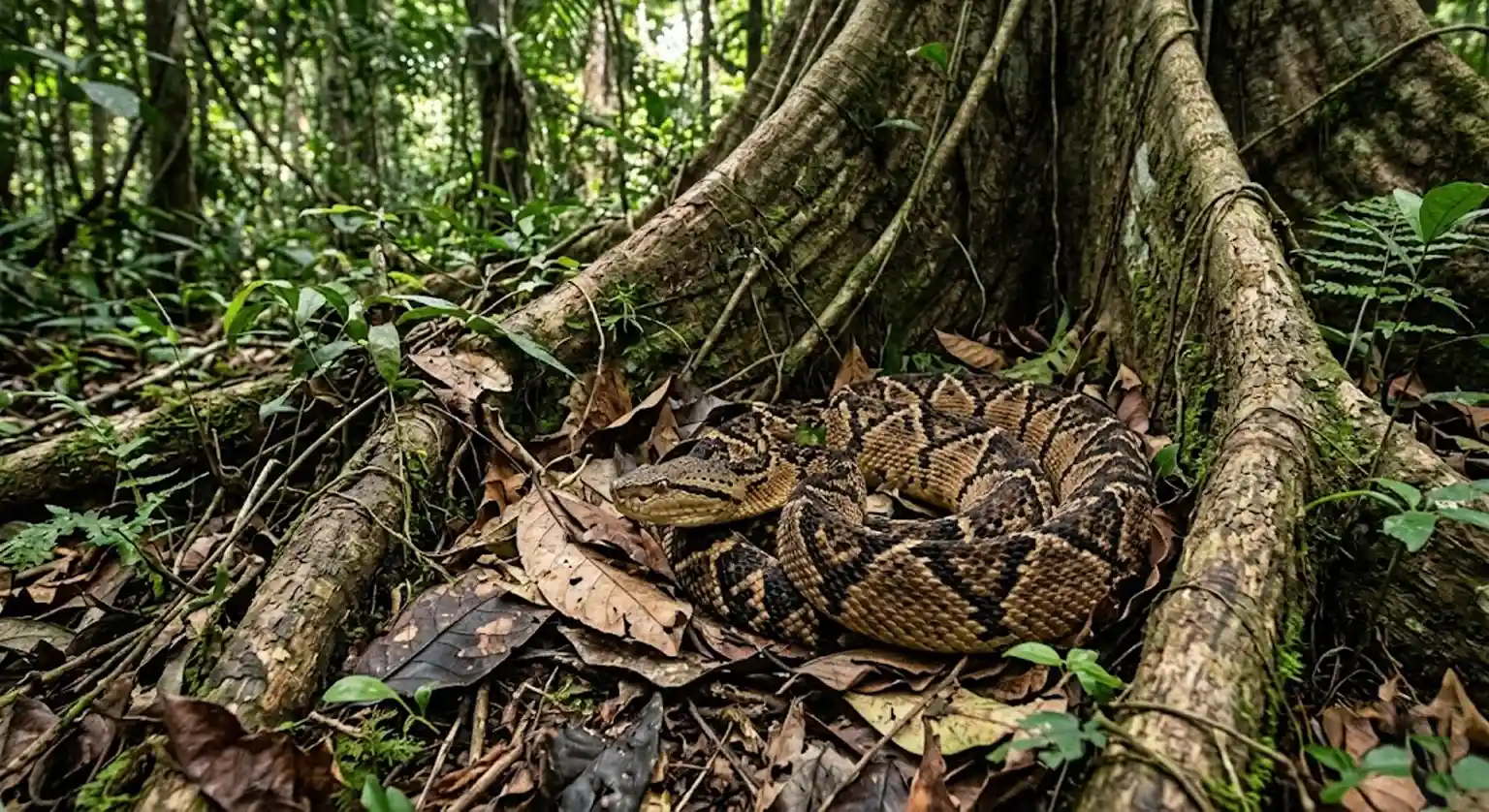
Deep in the humid forests of Pará, a giant snake moves with a discretion that seems almost impossible for an animal of its size. The bushmaster, known scientifically as Lachesis muta, carries in its scales the history of an evolution closely adapted to the heart of tropical rainforest.
Unlike other snakes that can adjust relatively easily to degraded areas, this species depends on primary forest. Recent biological data confirm that it can reach 3.5 meters, or about 11.5 feet, making it the largest venomous snake in the Americas and the second largest in the world. Only the iconic Asian king cobra is larger.
A giant tied to intact rainforest
The bushmaster’s presence is regarded as a fundamental bioindicator. It survives only where the ecosystem remains in complete balance and the vegetation cover is untouched, making every documented encounter important for understanding the condition of the forest.
In Pará and Amazonas, recent reports from researchers indicate that finding one in the wild is an exceptionally rare event. The comparison used to describe that challenge is vivid: it is comparable to finding a needle in a green haystack.
The snake is a master of invisibility. It can remain motionless for weeks in one place while waiting for the ideal prey, its body blending into the layer of dry leaves covering the Amazonian forest floor.
The common name refers directly to the texture of its dorsal scales. Each scale has a raised central keel that resembles the rough skin of a jackfruit. This feature is not merely ornamental. It is also a survival tool that helps disperse heat and supports camouflage in the leaf litter.
That combination of stillness, camouflage and a preference for dense vegetation makes the animal difficult to observe. A forest can contain a hidden giant without offering a clear sign of its presence to people passing through.
An unusual reproductive strategy
The bushmaster’s reproduction sets it apart from most vipers. While most of those snakes give birth to live young, the bushmaster is the only member of its family in the Americas that lays eggs.
This reproductive behavior remains one of modern herpetology’s greatest mysteries. The female protects the clutch for about 80 days and does not feed during that period.
Studies conducted at advanced field bases in Amazonas show that the forest floor’s constant temperature is crucial for the eggs to hatch. That dependence helps explain why the species disappears so quickly when the forest canopy is broken and direct sunlight reaches the ground.
The female’s maternal dedication also makes her vulnerable in a forest increasingly pressured by human activities. While guarding the eggs, she depends on stable conditions in an environment that can be changed by the loss and fragmentation of forest cover.
For researchers, this behavior reveals how closely the snake’s life cycle is tied to the physical structure of primary rainforest. The canopy is not simply a roof over the forest. In the account of this species, it also helps maintain the ground conditions required for reproduction.
Silent hunting after dark
The diet of Lachesis muta is specialized and consists mostly of small and medium-sized mammals, including agoutis and pacas. To find these animals, the snake uses loreal pits, heat-sensing organs located between the nostrils and the eyes.
These organs allow it to detect the body heat of prey even in complete darkness beneath the forest understory. When the snake chooses to strike, the lunge is extremely fast and efficient, bringing together patient waiting and precise movement.
Its reputation as an aggressive animal, however, does not match the description given by specialists. The bushmaster is described as calm and even shy, preferring escape or absolute stillness to direct confrontation with humans.
The species is mainly crepuscular and nocturnal. It avoids open spaces and sunlit clearings, which further reduces the likelihood of encounters and helps explain why its presence is often known only through field records, reports or specialized tracking.
Tracking a hidden forest resident
Recently documented records from protected areas in Pará have brought new information about the movements of these snakes. Using radio tracking, scientists discovered that a single animal may patrol vast areas of forest, moving with a silent elegance that challenges its large physical build.
The difficulty of seeing it is not caused by camouflage alone. Its crepuscular and nocturnal habits also keep it away from open ground and bright clearings. Every encounter recorded by field teams is celebrated as a victory for Brazilian science because it helps fill gaps in knowledge about the population density of this emblematic species.
The conservation of the bushmaster is inseparable from the maintenance of ecological corridors in the Amazon. Without large, continuous blocks of forest, the species’ genetic variability faces risks that may lead to local extinctions in areas where fragmentation is more severe.
Another mystery concerns the exact chemical composition of its venom in different regions of the Amazon Basin. This is a promising field of study for the development of new medicines, while science races to understand the animal’s complete biology before its habitat is changed irreversibly.
The secret of the vibrating tail
Although the bushmaster does not have the familiar rattle of rattlesnakes, it displays a curious defensive behavior. When it feels threatened, it vigorously vibrates the tip of its tail against the dry leaves on the forest floor.
The movement produces a steady, dry sound that serves as an audible warning to intruders. It is an elegant and efficient way for nature to prevent unnecessary conflict in the wild.
Respecting the space of the continent’s largest viper means understanding that every creature performs a vital function in the web of life. Protecting the home of Lachesis muta also helps ensure that the voices and mysteries of the forest continue to echo for future generations of Brazilians.
Reporting: Anne Silva / Amazonia Mag

Editor, English Edition — Amazonia Mag
Anne Silva is the editor of Amazonia Mag, the English-language edition of Revista Amazônia. She curates, translates and adapts the outlet's science and environment coverage for an international audience, reporting on Amazon wildlife, flora, rivers, climate and research. Every story she edits is grounded in peer-reviewed studies, official data and on-the-ground reporting from the Revista Amazônia newsroom in Belém, Pará, Brazil. More by Anne Silva →