
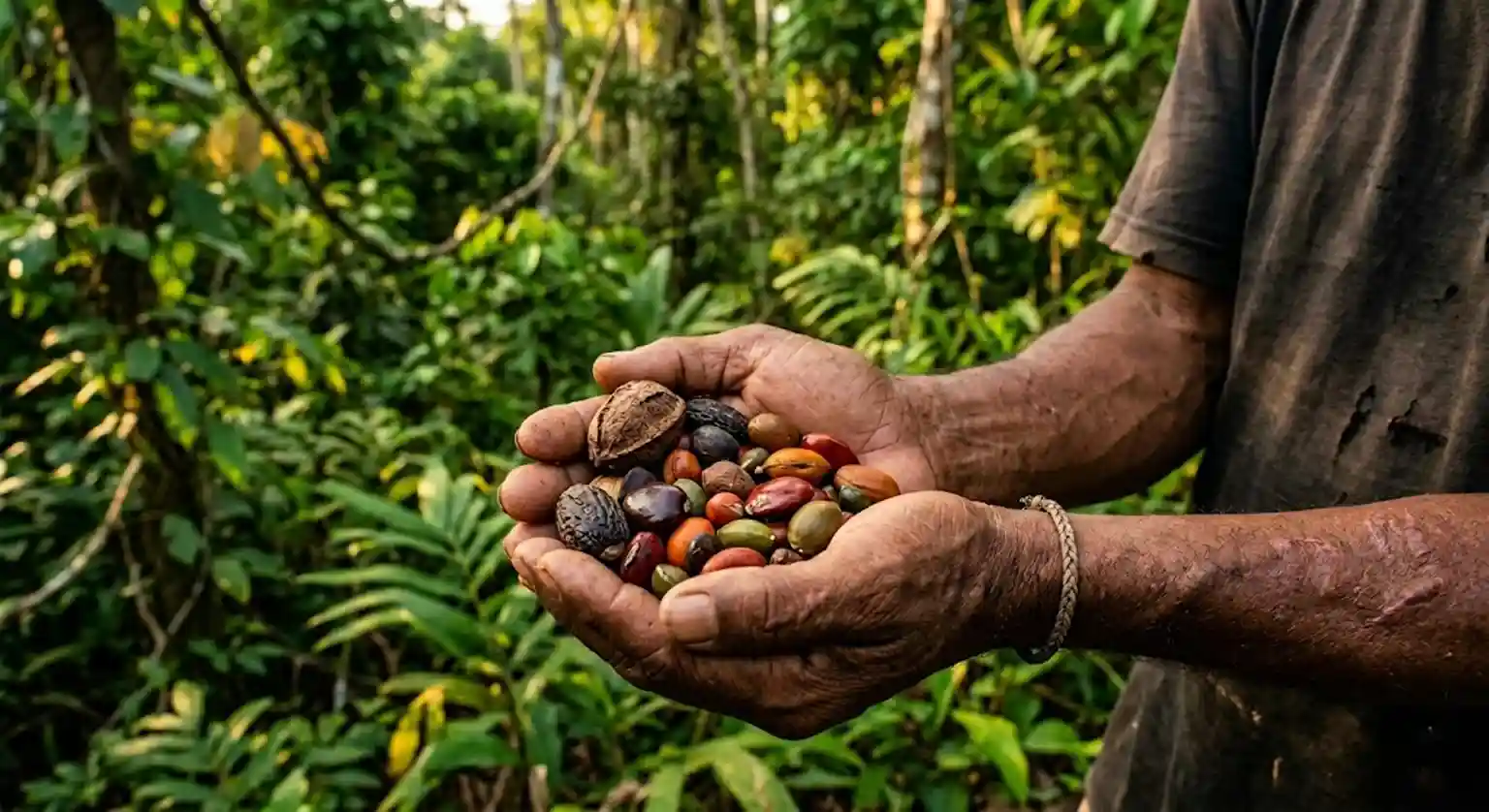
About 30% of Amazonian plant species face an imminent risk of disappearing in the coming decades because of deforestation and the climate crisis, according to recent studies. In the interior of Pará, a quilombola community has built its own response to that threat: a living seed bank that preserves native varieties important for food security and forest restoration.
The initiative took shape while public policies moved slowly in Brasília. Rather than wait for outside assistance, community members created a system based on collection, storage, exchange and continuous planting. Their work shows how ancestral knowledge can slow genetic erosion in the forest and broaden conservation efforts far from air-conditioned government offices.
The seed bank is not a motionless collection. The people responsible for its curation, known as guardians, monitor the mother trees that remain standing in the forest. They know when to collect and how to do so without undermining natural regeneration.
A living plant ark
The physical structure is simple, but the social technology behind it is sophisticated. The quilombola seed bank is not a high-tech cold vault like the one in Svalbard, Norway. Its strength comes from constant movement, as seeds are preserved so they can return to the soil, circulate among communities and support new plantings.
Native Amazonian varieties, many still unknown to Western science, find refuge on its rustic shelves. Each batch carries part of the forest’s diversity and a connection to the practices of people who learned to recognize plant cycles, uses and needs over generations.
The method combines centuries of practical knowledge with basic principles of conservation biology. Species such as mahogany, Swietenia macrophylla, Brazil nut, Bertholletia excelsa, and cumaru, Dipteryx odorata, receive special attention.
Many of these species face intense pressure from illegal logging or the loss of pollinators. The community catalogs every batch, recording the mother tree, the collection site and the date. This record helps maintain genetic diversity, a crucial factor in the resilience of forests facing the prolonged droughts that affect the region.
Drying and storage follow rigorous protocols designed to protect germination rates. Care does not end when a seed reaches the shelf. Conservation depends on checking the material, exchanging it and planting it continuously.
More than 50 varieties rescued
The results are already visible. The community has rescued and preserved more than 50 varieties of forest and agricultural species that were disappearing. Instead of focusing on a single crop, the bank protects agrobiodiversity and keeps a broader foundation for food production and landscape recovery.
The surplus from collected seeds is not left in storage. It supplies reforestation projects in areas degraded by pastures. In this way, the bank links the conservation of genetic diversity with the recovery of land transformed by deforestation.
This approach differs from the logic of agribusiness, which focuses on monocultures and patented seeds. The community works with native varieties, many of them adapted to local climate conditions. These native seeds are more resistant to pests and local climate variations than commercial varieties, according to the experience described by the initiative.
Data from Imazon show that areas managed by traditional communities have the lowest deforestation rates in the Amazon. The quilombola seed bank strengthens that protective effect by preserving diversity in the territory and expanding the community’s ability to decide what to plant and how to plant it.
An economy built on standing forest
The initiative protects more than trees. It also generates income and autonomy for the community. Selling seeds to nurseries and forest restoration projects has become a vital source of revenue, demonstrating the viability of a bioeconomy in which the forest is worth more standing than cleared.
Brazil’s forest restoration market needs tons of native seeds to meet the goals of the Paris Agreement. The quilombola bank is at the forefront of meeting that demand by offering high-quality genetic material adapted to local conditions.
A seed is the first link in the chain of production and life. By reclaiming control over that resource, the community reinforces food sovereignty and territorial autonomy. The bank stands against the homogenization that monocultures are bringing across the Cerrado and the Amazon.
Seed exchanges with other riverside and Indigenous communities expand a network of forest guardians. The exchange involves more than moving material from one place to another. It also preserves knowledge connected to each species, including medicinal, food-related and ritual uses.
Threats beyond the shelves
The initiative’s success exists alongside constant challenges. Land grabbing, soybean expansion and the lack of land-tenure regularization threaten the quilombola territory.
The safety of these biodiversity guardians is also at risk. They often face death threats while trying to protect a heritage that belongs to the community and matters to the forest as a whole.
Brazilian seed legislation, designed mainly around industrial agriculture, can create bureaucratic barriers for community initiatives. For respected institutions such as Embrapa Orientação Técnica, recognizing and integrating community seed banks is a strategic step for the country’s security.
As monocultures expand, the bank offers a climate adaptation strategy. The loss of genetic variability is a silent and irreversible threat. Studies published in the journal Nature link species diversity to ecosystem stability.
Knowledge academia needs to hear
The Amazon operates as a gigantic global air-conditioning and rainfall-regulation system. Breaking that system through landscape homogenization would have catastrophic consequences on a planetary scale. In that context, the seed bank acts as insurance for the forest’s functioning.
The seeds kept by the community help ensure that future forests can retain a complexity similar to that of today’s forests. A network of quilombola seed banks is expanding and connecting different territories and biomes. That coordination strengthens the political and cultural resistance of traditional populations.
Academic institutions and research centers are beginning to recognize the importance of these community germplasm banks. Partnerships are being formed between the quilombola community and institutions such as INPA, the National Institute of Amazonian Research.
This cooperation allows traditional knowledge to be scientifically validated while expanding the initiative’s impact. Ethical bioprospecting with benefit sharing could open new frontiers for the Amazonian bioeconomy. The seed bank becomes a starting point for an economy based on knowledge and respect for the forest.
Amazon conservation depends on strengthening these communities. Their initiative demonstrates that protecting the forest is not a utopian idea. It is daily work carried out with effort, ancestral knowledge and deep respect for the land.
The greatest challenge is now to protect these territories and their people from the destructive forces of predatory development. The future of the Amazon and the planet depends on our ability to listen to and support the forest’s true guardians. The resilience of native seeds is the resilience of life on Earth itself.
Reporting: Anne Silva / Amazonia Mag

Editor, English Edition — Amazonia Mag
Anne Silva is the editor of Amazonia Mag, the English-language edition of Revista Amazônia. She curates, translates and adapts the outlet's science and environment coverage for an international audience, reporting on Amazon wildlife, flora, rivers, climate and research. Every story she edits is grounded in peer-reviewed studies, official data and on-the-ground reporting from the Revista Amazônia newsroom in Belém, Pará, Brazil. More by Anne Silva →