
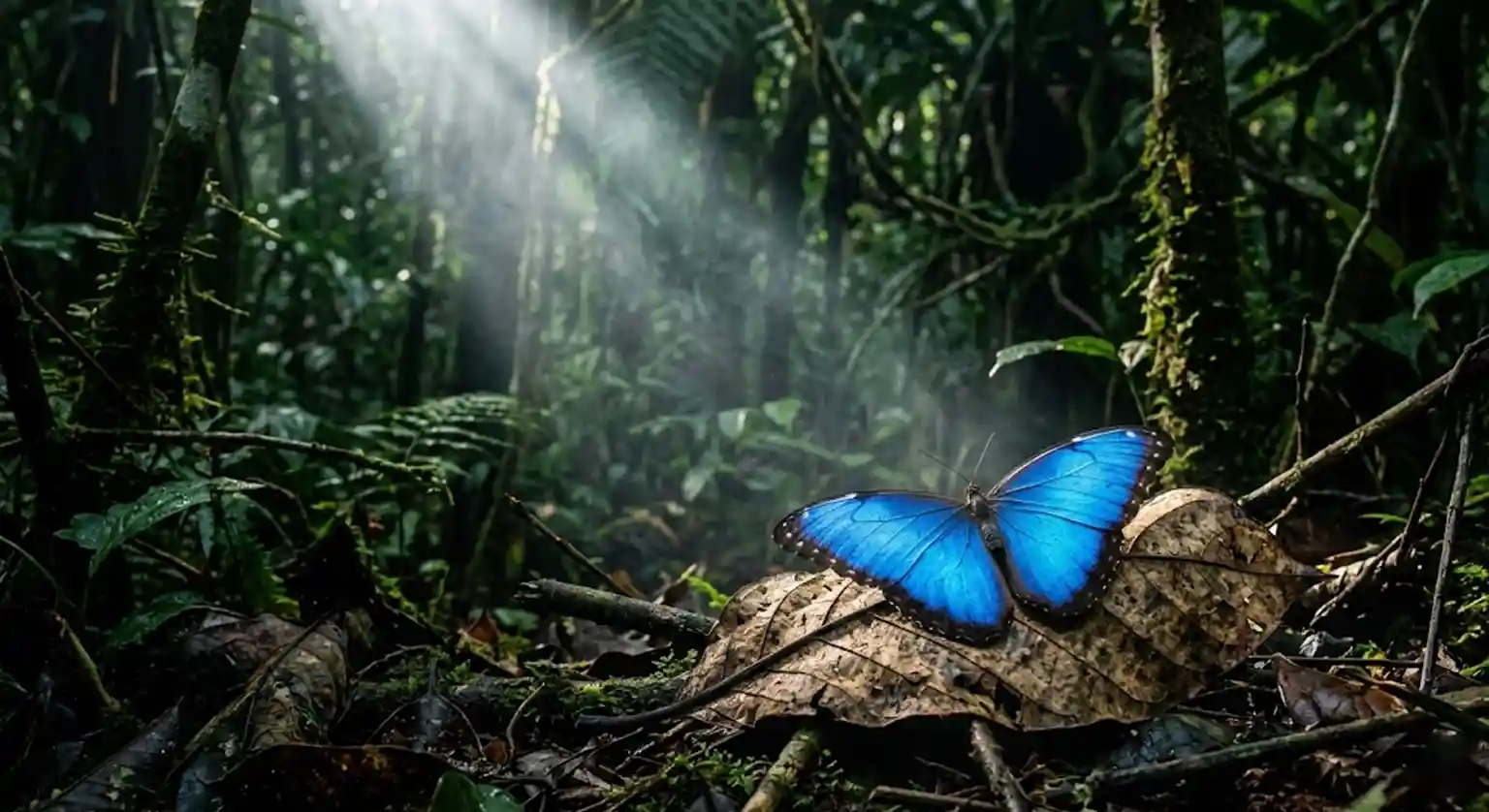
Heat can silently kill Amazon butterflies before a chainsaw brings down the first tree. Recent studies point to a lethal decline of up to 40% in the abundance of sensitive species inside strictly intact forest areas. Researchers at Brazil’s National Institute of Amazonian Research, known as INPA, are documenting this environmental tragedy in real time.
The teams use suspended traps and active-capture methods to measure the daily population decline. The sudden disappearance of these pollinators is a major warning for the global scientific community, because butterflies function as immediate biosensors of environmental degradation.
The delicate anatomy of these animals helps explain their extreme vulnerability to global warming. Butterflies depend entirely on outside temperatures to regulate their biological metabolism, so ectothermic animals can experience systemic collapse when thermometers move beyond the region’s historical limits.
When forest microclimates fail
Even a small fluctuation in the forest microclimate can prevent flight, feeding, and reproduction. Global warming turns the shaded understory into an unsustainable furnace for caterpillars, while evaporating moisture leaves eggs dehydrated before they hatch.
Modern biology recognizes lepidopterans as among the planet’s most efficient climate-indicator insects. They respond to abnormal droughts and extreme heat months before large trees show visible signs of water stress.
Their remarkably short life cycle makes it possible to observe genetic mutations and population declines in a single season. Large mammals and centuries-old trees, by contrast, can mask climate impacts for decades.
Scientists compare capture records from the 1990s with sampling from the current year. The technical comparison reveals a forced migration toward the dense interior of the forest. Species accustomed to mild sunlight now seek refuge in the deepest shadows of the lower understory.
The constant search for cooler microclimates is changing the spatial distribution of winged wildlife across the Amazon Basin. The IPCC’s Sixth Assessment Report confirms the urgency of these local entomological findings and attests to very high invertebrate mortality in tropical forests exposed to persistent thermal extremes.
Heat denatures vital proteins in a butterfly’s body and paralyzes its muscular system. The insect falls to the forest floor and can die from thermal exhaustion within a few hours.
The fieldwork behind biodiversity research
Fieldwork demands strict procedures and extreme physical endurance from ecologists and biologists. Teams enter primary forest to install fine-mesh cylinders baited with fermented fruit, then inspect the traps every day to record the exact number of individuals and identify their anatomical lineages.
This painstaking work is a central and irreplaceable part of current Amazon biodiversity research. Specialists mark the wings of captured butterflies with specific nontoxic pens before releasing them back into the wild.
Capture and recapture methods make it possible to estimate the actual size of populations that are still surviving. Statistical data reveal a disturbing pattern of biological homogenization across a large territory: rare and highly specialized species are disappearing quickly from Brazil’s forest map.
Generalist and adaptable butterflies fill the ecological space left by victims of warming. The forest loses unique colors and genetic diversity at an accelerated and dangerous pace.
For years, the absence of historical data prevented a clear view of this alarming decline. Today, monitoring platforms from the Amazon Institute of People and the Environment, known as Imazon, provide an exact comparative basis.
Satellite images show regional heat islands spreading over intact biological reserves. Toxic smoke from fires travels hundreds of miles and raises temperatures inside protected areas, showing that conservation boundaries alone cannot stop atmospheric change.
Fragmentation, isolation, and genetic loss
Combining data on Amazon butterflies, climate, and distribution breaks an old and dangerous assumption in traditional conservation. The international community once believed that isolated areas guaranteed the full survival of endemic species, but climate reality imposes a much harsher, more systemic, and more complex view on lawmakers.
Stifling heat advances over untouched canopies and destroys life in the forest’s lower layer. Forest fragmentation makes this tragic setting exponentially worse, because butterflies trapped in small forest remnants lose the physical ability to migrate toward cooler or wetter regions.
Paved highways and pastures act as nearly impassable thermal barriers for most flying insects. Hot asphalt creates rising air currents that repel and disorient pollinators along their escape routes.
Geographic isolation forces the few survivors in a fragment to breed among themselves. The loss of genetic variability reduces population immunity and accelerates local extinction.
The decline destroys the illusion that simply enclosing a forest is enough to preserve the ecosystem. A changed atmosphere crosses the borders of national parks without asking governments for permission.
A food web under pressure
The progressive disappearance of butterflies can trigger an immediate collapse in the vast Amazonian food chain. Insect-eating birds lose a main source of daily protein and essential reproductive energy, while frogs, lizards, and small primates face hunger in areas where the decline of lepidopterans reaches its peak.
The tropical forest food web suffers irreversible breaks from the bottom up. The consequences also reach the foundation of native flora across the Amazon Basin, because the absence of specific pollinators prevents the sexual reproduction of hundreds of endemic plants.
Many rare orchids and vines depend exclusively on a single butterfly species to transfer pollen. The local extinction of that insect partner condemns the plant to permanent sterility and evolutionary death.
Caterpillars also play a crucial and underestimated role in the cycling of nutrients through forest soil. Their consumption of leaves, followed by excretion, speeds the return of minerals to fertile ground.
Suppressing this insect biomass slows the regeneration of the forest canopy itself. Young trees lose vital nutrients needed to reach the canopy and capture sunlight.
The direct risk to the forest economy
The bioeconomy based on non-timber forest products faces a direct and financially devastating blow. Amazonian fruits need constant and efficient pollination to reach the size and commercial quality that markets demand.
Açaí and cupuaçu depend heavily on the continuous movement of insects among their flowers. The global superfood market faces an imminent risk because native pollinators are becoming scarce.
River and Indigenous communities feel the decline in fruit-tree productivity around their villages. Ecological damage quickly becomes a severe economic deficit for traditional populations across the Amazon.
Government policies repeatedly ignore the invisible financial value generated by the wings of these insects. Farming along forest edges depends on this free biological labor to secure annual harvests, while large rural producers face declining crop productivity near deforested areas.
Science shows that maintaining entomological biodiversity secures the continuing profits of smart agribusiness. For that reason, state and federal governments need to treat butterflies as high-priority biosensors.
Continuous population monitoring can anticipate forest mortality and guide climate-mitigation efforts. Ignoring entomological data is equivalent to ignoring the planet’s own fire alarm.
Global public policies should urgently integrate these indicators into strict international conservation targets. Creating densely shaded ecological corridors offers a viable escape route for microfauna, while reconnecting isolated forest fragments allows migration toward cooler and safer areas.
Absolute protection of the understory preserves the thermal insulation needed for successful reproduction. Sustainable timber-management projects also require the internal architecture of the forest to remain intact so that its microclimates are protected.
Brazil holds an unparalleled store of biological intelligence in the wings of its butterflies. Thermal mapping of these species is shaping global climate-adaptation strategies for the coming decades.
Decisive government action can halt the systemic collapse of the Amazon biome. Strong funding for national scientific research ensures that forest survival metrics are read correctly, while inflexible statistical data show that the time for diplomatic speeches has run out.
Reporting: Anne Silva / Amazonia Mag

Editor, English Edition — Amazonia Mag
Anne Silva is the editor of Amazonia Mag, the English-language edition of Revista Amazônia. She curates, translates and adapts the outlet's science and environment coverage for an international audience, reporting on Amazon wildlife, flora, rivers, climate and research. Every story she edits is grounded in peer-reviewed studies, official data and on-the-ground reporting from the Revista Amazônia newsroom in Belém, Pará, Brazil. More by Anne Silva →