
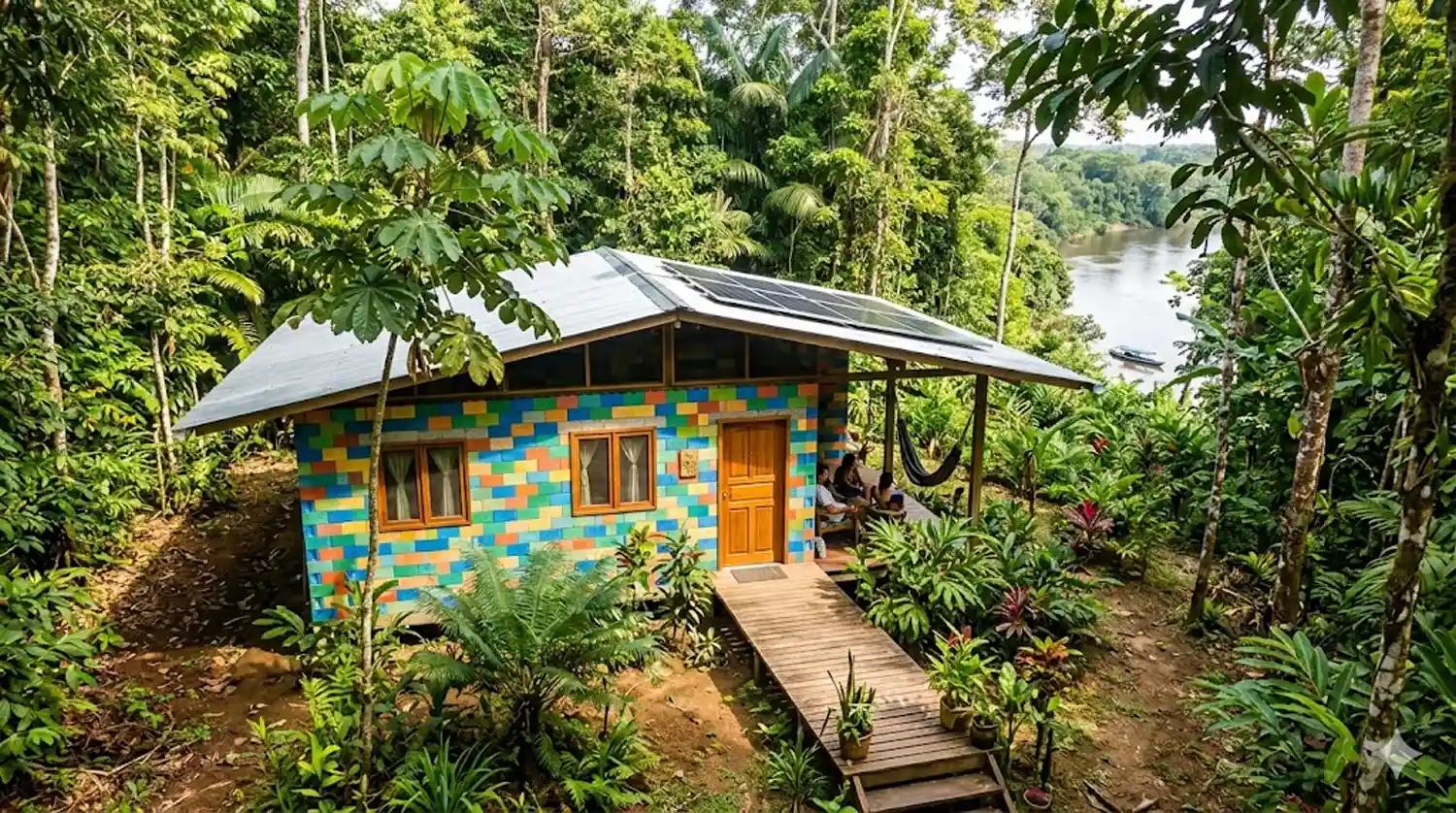
Pará has reached a historic milestone: 500 river families are now living in homes built entirely with plastic removed from rivers. The result grew out of partnerships established during the climate conference in Belém and has turned the banks of the Tapajós River, in Santarém, into a testing ground for sustainable housing.
While international discussions focused on global targets, plastic that once threatened botos and tucuxis began to become high-strength building blocks. PET bottles and polyethylene packaging, materials that can remain in the environment for 450 years, are now processed for use in homes serving river communities.
The project is regarded as the largest practical legacy of the circular economy in Pará after the major global events of 2025. Its approach links river cleanup with a direct response to the housing deficit and shows how a persistent waste product can become part of an everyday solution.
Technology that matured after the conference
The technology behind the homes advanced significantly after investment in local processing centers. The method starts with plastic collected from rivers and communities being shredded. The material is then melted and molded into blocks that fit together precisely.
Unlike conventional construction, which emits tons of carbon dioxide, the pieces are manufactured through a dry process with a very low carbon footprint. The result is a structure with superior thermal insulation, an important feature as the region enters a new period of extreme heat in early 2026.
Temperatures during this period easily rise above 100.4 degrees Fahrenheit, or 38 degrees Celsius. The polymer-fusion material forms a solid, fully waterproof piece, a particularly important feature in an Amazon region where rainfall has become more erratic and intense after 2025.
Ordinary clay bricks absorb moisture and can lead to leaks that harm respiratory health. In the recycled-plastic homes, the physical barrier against moisture is absolute, helping keep indoor spaces drier and healthier.
The material is estimated to last for more than a century. That lifespan addresses a long-standing problem for homes in humid tropical forests, where accelerated deterioration can force families into frequent repairs or cause them to lose much of their investment.
A 42-square-meter home in five days
Beyond the climate benefits, the initiative tackles the housing deficit with a speed not seen in earlier government programs. The homes are assembled in a fraction of the time needed for a conventional masonry residence, sharply reducing logistics costs.
For families living in hard-to-reach areas, transporting cement is expensive and complicated. The lighter recycled-polymer blocks make transportation easier and turn homeownership into a practical possibility for communities far from urban centers.
A standard 42-square-meter home, about 452 square feet, takes only five days to build once the foundation is ready. According to the project, that speed was crucial during the response to the Tapajós River’s most recent flood, allowing families to be relocated in record time.
Residents are trained to help with assembly. In this way, a home stops being a distant project and becomes a structure built with community participation, strengthening a sense of belonging and the idea of resilient housing.
Engineering is therefore working alongside the most urgent needs of communities that protect Amazonian biodiversity. Recycling Amazonian plastic is not only an industrial activity. It is part of a social strategy connecting jobs, housing and environmental care.
The rivers’ reverse cycle
The operation depends on a collaborative network involving waste-picker associations and collection boats that travel among river communities. The boats remove waste from the water and inhabited areas, while the system generates local income and teaches residents the real value of solid waste.
When a resident understands that plastic removed from the river can become a neighbor’s wall, the perception of environmental protection changes. The project delivers more than roofs and walls. It proposes a new way of thinking about disposal in an ecosystem that is both sensitive and vital.
Collection boats now operate as environmental-development agencies. In villages such as Alter do Chão and Boim, plastic handed over by river residents is converted into credits for community infrastructure improvements or solar power.
This inclusive business model helps ensure that the factory does not run short of raw material while keeping rivers cleaner. Preliminary 2026 studies already indicate a 40 percent reduction in the presence of macroplastics in fishing-monitoring areas in the lower Tapajós, directly benefiting food security in the region.
Removing plastic from the water also supports fish stocks, which form the basis of local diets. In rivers, plastic breaks down into microparticles that enter the human food chain. Reducing that pollution load is an essential step in maintaining the integrity of aquatic ecosystems.
Thermal comfort and structural resistance
Participating communities report that indoor temperatures in these residences can be six degrees Celsius, or 10.8 degrees Fahrenheit, lower than in traditional masonry houses. This happens because processed polymer does not retain solar heat with the same intensity as mineral-based materials.
Cross-ventilation systems designed by local architects reinforce the effect. The result is greater thermal comfort during a period of extreme heat and an application of science to concrete problems in Amazonian life.
Durability is another highlight in technical assessments conducted this year. The plastic blocks resist impacts and are immune to pests. Unlike wood, which can be damaged by termites and rot in humid environments, recycled plastic retains its structural integrity with almost no maintenance.
For a river family, that means the investment in a home is more likely to remain secure for generations. The project seeks to provide a legacy of stability for people who will grow up in a cleaner Amazon with homes better adapted to local conditions.
Expansion to other river basins
The next major step is to scale up the initiative after the international visibility it received. With the cycle of major conferences over, the focus is now on maintaining and expanding these social technologies to other river basins, including the Xingu and Marajó.
Turning waste into homes shows that Brazil can export not only raw materials, but also engineering solutions that put people at the center of sustainability. Plastic, for decades a symbol of water pollution, is now providing safe shelter for the people who care for the forest.
Investors who visited Pará during the past year are already financing modular microfactories in other parts of the Pan-Amazon region. The goal is to create a sustainable housing network that can be replicated in other countries facing similar challenges.
The Tapajós experience stands as a sign of technical hope. It shows that even the most persistent waste created by industrial civilization can be controlled and used for the common good when investment is paired with genuine community involvement.
Every ton of polymer that stops floating freely and becomes a solid wall is a gain for biodiversity. The health of rivers is inseparable from the dignity of human housing, and that connection defines the strength of the project.
The initiative shows that sustainability is not an abstract idea discussed only in international forums. It can begin with collecting trash in a river community and end in a cool, safe and durable home where a child has a secure room in which to sleep.
Reporting: Anne Silva / Amazonia Mag

Editor, English Edition — Amazonia Mag
Anne Silva is the editor of Amazonia Mag, the English-language edition of Revista Amazônia. She curates, translates and adapts the outlet's science and environment coverage for an international audience, reporting on Amazon wildlife, flora, rivers, climate and research. Every story she edits is grounded in peer-reviewed studies, official data and on-the-ground reporting from the Revista Amazônia newsroom in Belém, Pará, Brazil. More by Anne Silva →