
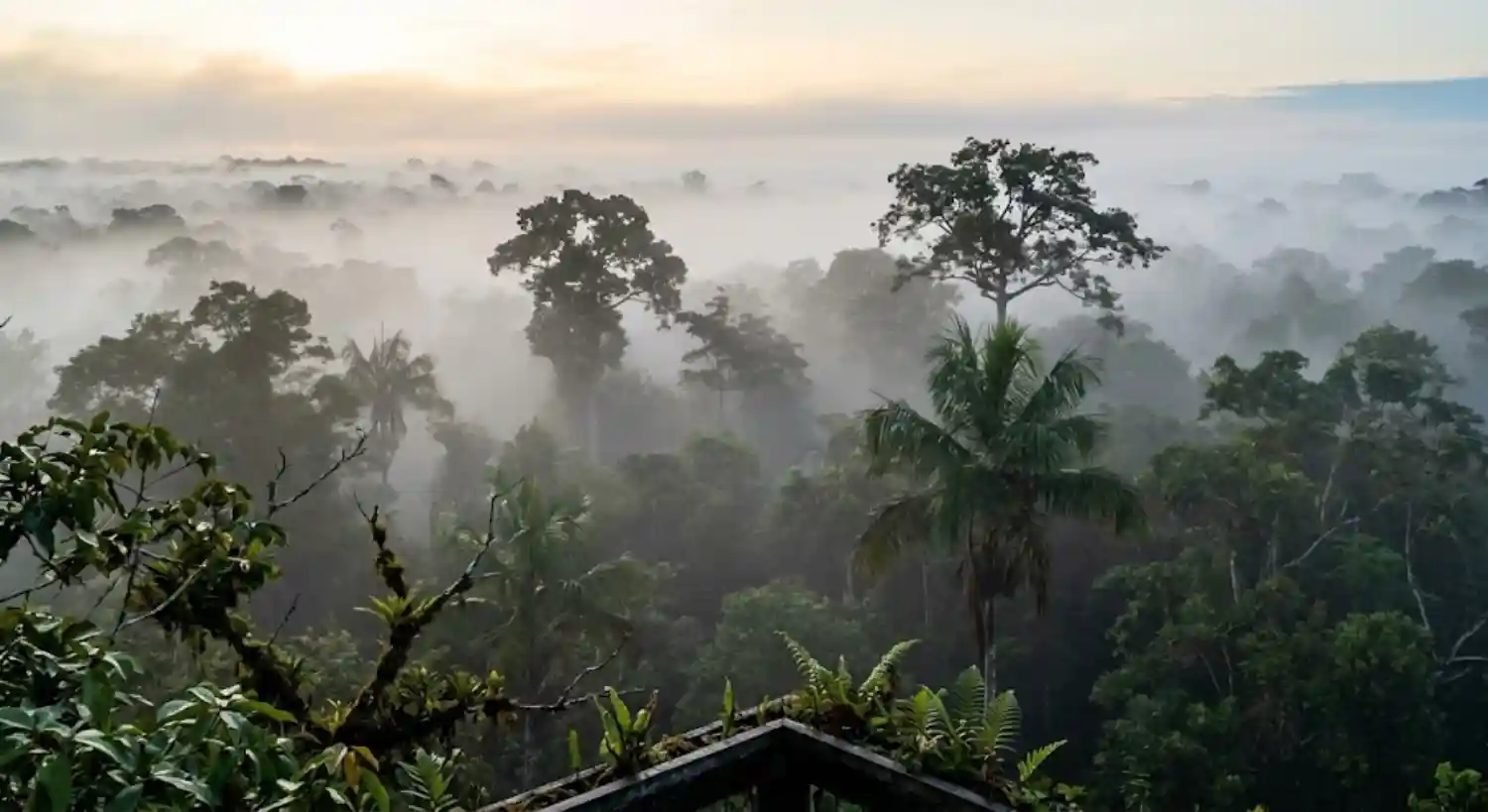
The Amazon is known worldwide for the steadiness of its thermometer: high heat and high humidity for almost the entire year. That stability, however, breaks down a few times each season. When a powerful polar air mass manages to travel thousands of kilometres across the continent and reach equatorial latitudes, temperatures can collapse by as much as 15 °C in a matter of hours. The phenomenon has its own name in the region, and an atmospheric backstory that begins far to the south, in the Antarctic realm.
What a friagem actually is
In Brazil this cold snap is called the friagem; in the Andean Amazon it is known as the friaje. It is not a routine seasonal dip but a specific configuration of atmospheric circulation: a cold front of Antarctic origin pushes up through the interior of the continent and ends up unloading chilled air over the largest tropical forest on the planet. For anyone living in Rio Branco or Porto Velho, it is the day of the year when a blanket becomes necessary in a city where the minimum temperature rarely falls below 22 °C.
Unlike the dry cold of temperate regions, the Amazonian friagem usually arrives wrapped in thick cloud cover and frontal rain. Research indicates that these air masses can linger for three to seven days, more than long enough to alter the metabolism of tropical organisms. In the most severe episodes, thermometers in the cities of the southwestern Amazon approach 10 °C, readings that would be unthinkable in a biome that evolved under the sign of constancy.
The corridor that funnels polar air north
Geography explains why polar air manages to travel so far. The cold mass advancing from the south is boxed in between the Andes to the west and the lowlands of the Pantanal and the Paraguay River basin to the east. That natural corridor works like a chute: instead of dispersing, the air is funnelled northward and discharged straight into the southern Amazon, reaching the states of Rondônia and Acre and the southern portions of Amazonas and Pará.
This is, in practice, a climate teleconnection. What happens at the austral edge of the planet shows up days later beneath the equatorial canopy, with no ocean or mountain range able to stop it. In exceptional events, the cold has reached eleven Brazilian states at once and pushed into the heart of the forest. Such episodes serve as indicators of the growing instability of the atmospheric systems that link pole and tropics.
A thermal shock for wildlife with no coat
Amazonian fauna is composed mostly of ectothermic species, whose body temperature depends on the surrounding environment, or of endothermic species with very narrow thermal niches. A sudden drop can push amphibians and reptiles into a sluggish torpor that leaves them exposed to predators and unable to carry out vital functions such as digestion and reproduction. Field observations record, during particularly intense friagem events, die offs of certain fish species in shallow lakes, where water loses heat to the atmosphere far more quickly.
Birds and small mammals fare no better. Because they run high metabolic rates to hold their body temperature steady, the sudden need to generate internal heat burns through fat reserves fast. In an environment where food is scattered, that extra expenditure can be fatal for young or sick individuals. Science indicates that the rising frequency of these extreme events, driven by the destabilisation of the global climate, may be reshaping survival dynamics for the species of the understorey, a layer that normally functions as a stable thermal refuge.
The forest feels it too
Amazonian trees do not face frost the way those of southern Brazil do, but the friagem affects plant physiology in subtle and far reaching ways. Sudden cold reduces photosynthesis and transpiration rates. At low temperatures the enzymes responsible for processing nutrients become less efficient, slowing the growth of seedlings and the ripening of fruit.
Certain species of the terra firme forest are especially sensitive to thermal shock. Falling temperatures can trigger premature leaf drop in some deciduous and semideciduous species, altering the phenology of the forest. That mismatch has immediate consequences for pollinators and seed dispersers, which depend on the predictability of floral resources for their survival strategies. The friagem, then, is not an isolated weather episode: it is a shock to the system that reverberates along the entire food chain.
Caught between two extremes
Climatology warns that although the friagem is a well documented natural phenomenon, its intensity and frequency are being shaped by global variability. Ice loss in Antarctica and shifts in sea surface temperature across the Atlantic and the Pacific alter the trajectories that polar air masses follow on their way into the South American continent.
These cold peaks occur, paradoxically, against a backdrop of accelerated warming. The scientific hypothesis holds that warming in the Arctic and Antarctic destabilises the polar vortex, allowing jets of cold air to escape more easily toward lower latitudes. For the Amazon, that means facing extremes from both directions: heatwaves and record droughts interleaved with aggressive polar incursions. That thermal seesaw represents an enormous adaptation challenge for a biodiversity that evolved without ever rehearsing a response to cold.
Monitoring, and keeping the forest standing
Understanding the influence of polar weather on the Amazon matters for conservation planning and for regional agriculture alike. Accurate meteorological monitoring allows traditional communities and rural producers to prepare for the temperature drop, cutting economic losses and protecting human health in areas where houses were never designed for cold.
Preserving dense forest cover also performs a thermal insulating function. Standing forest smooths out temperature swings at ground level and shields seeds and small fauna from the direct impact of the friagem. The more fragmented the forest, the greater the exposure of organisms to cold winds and to nighttime radiative loss, which intensifies the damage a polar air mass can do. Protecting the integrity of the biome is therefore the most effective way to buffer these extremes.
There is a broader lesson embedded in each of these events. Forest loss and climate instability are usually discussed as a heat problem, measured in drought, fire and record maximums. The friagem shows that the same destabilisation also arrives from the opposite end of the thermometer, and that a forest weakened by fragmentation has fewer defences against either. The species most at risk are not the ones adapted to variation, but those that never had to be.
The Amazon is the heart of the South American climate, but it does not beat alone. The atmospheric connections that carry cold up from the south are a reminder that the planet works as one integrated system, and that an episode in the Antarctic realm can be read, days later, on the thermometer of a riverside community. These events are not passing anomalies: they are urgent lessons in climate interdependence.
Reporting: Anne Silva / Amazonia Mag. Source: MetSul Meteorologia; Instituto Nacional de Meteorologia (INMET).

Editor · Amazonia Mag
Anne Silva is the editor of Amazonia Mag, the English-language edition of Revista Amazônia. She curates, translates and adapts the outlet's science and environment coverage for an international audience, reporting on Amazon wildlife, flora, rivers, climate and research. Every story she edits is grounded in peer-reviewed studies, official data and on-the-ground reporting from the Revista Amazônia newsroom in Belém, Pará, Brazil. More by Anne Silva →