
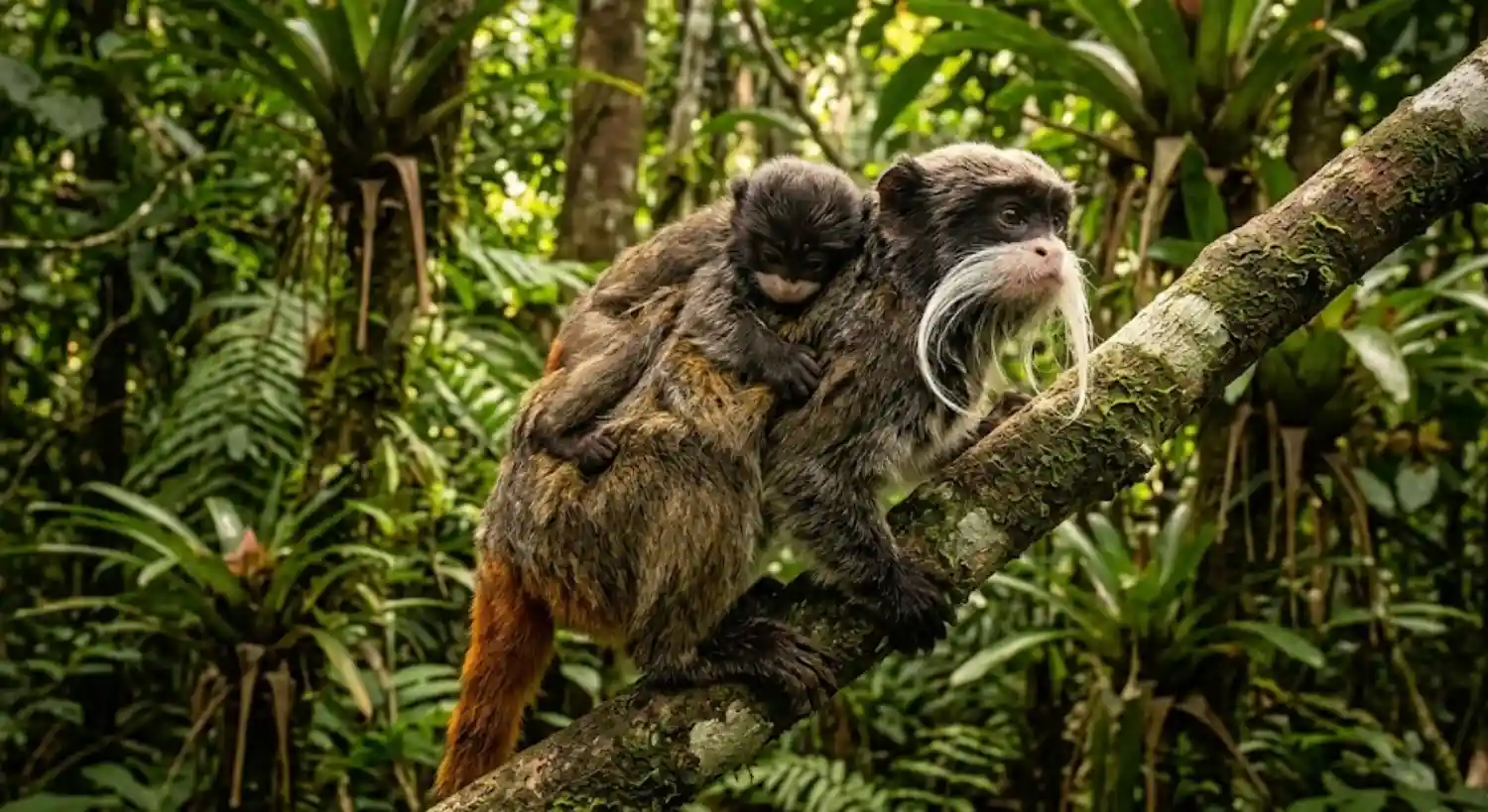
In the southwestern corner of the Amazon lives a primate that looks like it stepped out of a nineteenth century portrait. The Saguinus imperator, known in English as the emperor tamarin, weighs less than a full coffee mug and carries a pair of long, curved white moustaches that sweep back past its shoulders. Historical accounts say the resemblance earned it a name honouring the German emperor Wilhelm II. Yet the most remarkable thing about this animal is not its face. It is the way it organises collective life: in emperor tamarin families, raising the young is not the mother’s job alone, it is the whole group’s job.
A moustache that works as a signal
The prominent white moustache of the emperor tamarin is not merely decorative. In a dense, shaded forest such as the western Amazon, where visibility between leaves is limited, strong visual contrast has a practical function. The trait helps individuals recognise one another quickly among the foliage and works as a marker during social interactions inside the group.
Behavioural studies indicate that head movement and the display of the moustache can communicate emotional states or danger alerts to the rest of the band. Put another way, the animal’s face acts as a small, mobile flag in an environment where sound gets swallowed and sight is blocked within a few metres. For a species whose survival depends on staying together while moving through the canopy, that visual legibility is worth as much as any alarm call.
Claws instead of flat nails
Beyond the moustache, the emperor tamarin has claws rather than flat nails on most of its digits. It is an evolutionary adaptation that lets it climb vertical trunks with the agility of a squirrel, an uncommon skill among primates. That ability underpins its omnivorous diet of fruit, nectar, tree sap and small animals such as insects and lizards.
Agility in the treetops is also what allows the species to escape its main enemies. Birds of prey, hawks in particular, are the greatest natural threat in the forests of Acre and Amazonas, and an animal of this size has no defence other than speed, height and the information shared by the rest of its group.
The males take their turn
Reproduction among emperor tamarins is marked by the frequent birth of twins, an enormous energetic effort for such a small female. To offset that cost, the species evolved a system of alloparental care, meaning care provided by individuals other than the mother. Within hours of birth, the father takes on the task of carrying the newborns on his back.
The infants spend roughly 90 per cent of their time riding on males or on other members of the group, and are handed back to the mother only for short nursing intervals. This shared transport system is decisive for the survival of the litter. By carrying the young, the males allow the female to feed more efficiently and to recover the energy she needs to produce good milk. Research indicates that without that collective help, the survival rate of the twins would be drastically lower.
There is a second, less obvious effect. The rotation of carriers strengthens the bonds inside the group and teaches younger individuals, older siblings included, how to look after future generations. What looks like a simple sharing of weight is also a school: it perpetuates a cycle of cooperation that is rare among mammals.
Alliances with other tamarin species
One of the cleverest tactics of the emperor tamarin is its readiness to form associations with other primate species, above all the saddleback tamarin (Saguinus fuscicollis). These mixed troops travel and feed together for long stretches without either species losing its own social identity.
The advantage runs both ways and is organised in layers. The emperor tamarin tends to occupy the higher strata of the canopy, where it easily detects aerial predators, while the saddleback tamarin watches the lower levels and warns about snakes or ground based threats. Each species covers the blind spot of the other.
This polyspecific alliance increases both foraging efficiency and safety for everyone involved. By sharing information about where fruiting trees stand and about signs of danger, the two species manage to persist in areas where predation pressure is high. It is a striking example of how Amazonian biodiversity uses social intelligence to overcome the demands of a competitive environment.
Roads that break the territory apart
The emperor tamarin inhabits forests of the southwestern Amazon, across parts of Brazil, chiefly the state of Acre, along with Peru and Bolivia. Although it is not yet listed as critically endangered, it faces the growing threat of forest fragmentation driven by new roads and by the expansion of cattle ranching.
The problem is structural. These primates depend on a continuous home range to find food and to build their social groups, so clearing corridors of forest isolates entire families and reduces genetic variability. A population split into fragments loses precisely what sustains it: the ability to move, to meet and to form alliances.
A tiny emperor as a flagship
Conserving the species is tied to keeping large blocks of primary forest standing. Reforestation projects using native species and the creation of extractive reserves are essential pieces if these small emperors are to go on ruling the treetops. Specialists point out that the presence of the tamarin is an indicator of a balanced forest, since its varied diet helps disperse the seeds of many tropical plants.
The emperor tamarin also makes an unusually effective flagship species for environmental education, because it draws curiosity and empathy at first sight. Understanding that an animal this small sustains a social structure this complex and this generous challenges the simplistic view of nature as nothing more than a battlefield. Cooperation, in the canopy of the western Amazon, is not an exception to the rule of competition. It is the rule itself.
Protecting the habitat of the emperor tamarin means preserving the complexity of interactions that unfold silently above our heads. Every time an area of forest is saved, the relay of caring males and the alliances between different primates get to continue. The majesty of this small monkey lies neither in its imperial name nor in its appearance, but in its capacity to live through mutual support, a form of wild dignity that the Amazon still offers anyone willing to look up.
Reporting: Anne Silva / Amazonia Mag. Source: Revista Amazônia, with data from the Centro Nacional de Pesquisa e Conservação de Primatas Brasileiros (CPB/ICMBio) and the Sociedade Brasileira de Primatologia.

Editor · Amazonia Mag
Anne Silva is the editor of Amazonia Mag, the English-language edition of Revista Amazônia. She curates, translates and adapts the outlet's science and environment coverage for an international audience, reporting on Amazon wildlife, flora, rivers, climate and research. Every story she edits is grounded in peer-reviewed studies, official data and on-the-ground reporting from the Revista Amazônia newsroom in Belém, Pará, Brazil. More by Anne Silva →