The tonka bean is the seed of a giant Amazonian tree, and almost nobody who wears its scent on their skin knows where it comes from. Botanically it is Dipteryx odorata, a tree that can grow past 30 metres and yields one of the densest, most durable timbers in the world, tough enough to resist fungi and termites for decades. Its real treasure, though, is not the trunk. Inside each fruit sits a single wrinkled seed that, after drying and fermenting, grows a coat of tiny white coumarin crystals. That compound gives the bean its sweet, almond like aroma, something between vanilla, almond and clove, and it is the reason luxury fragrance houses in Paris and New York have been buying it for decades. A seed picked off the forest floor ends up, months later, in the base of an expensive perfume.
The chemistry that holds a fragrance together
What sets the tonka bean apart is its high concentration of coumarin, an organic compound the plant synthesises as a defence mechanism. In perfumery, coumarin works as a base note: it is not what you smell when the bottle is opened, but what is still on the skin hours later. It fixes the fragrance, adds depth and holds up compositions in the fougère olfactory family and in oriental perfumes. Available research indicates that Brazilian tonka is among the richest natural sources of the compound, which places the country in a strategic position within the global cosmetics supply chain rather than at its margins.
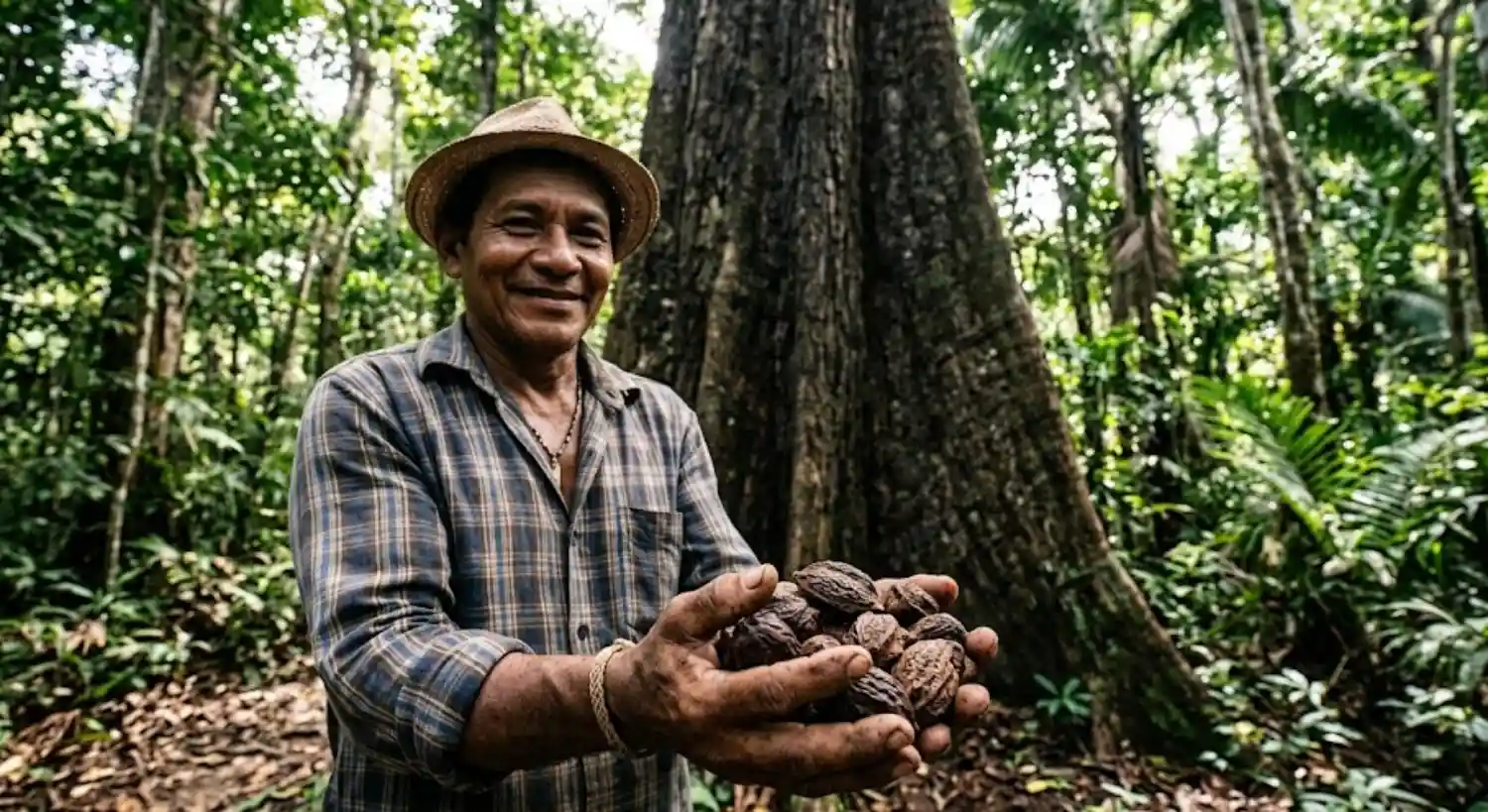
Extraction begins a long way from any laboratory. Collectors gather the fruit that has fallen to the forest floor, crack the hard shell and remove the seed. The beans are then steeped in alcohol for a set period and dried slowly in the shade. It is during that wait that the delicate part happens: the coumarin migrates to the surface of the seed and forms crystals that catch the light. This unhurried, handmade process, with no heavy machinery involved, is what guarantees the purity and quality of the essential oil later shipped to the world’s largest fragrance houses.
Harvesting that keeps the forest standing
Behind that supply chain sits a fact that changes how the whole business reads. Unlike logging, which removes the tree from the forest, seed collection requires the tree alive and healthy. A tonka tree is worth more standing than felled, and that creates a direct economic incentive for hundreds of riverside and Indigenous communities to act as guardians of their territory rather than as suppliers of timber.
Studies cited on the subject indicate that areas where tonka collection is the main source of income show significantly lower deforestation rates, because a standing forest pays the collector better than selling the timber or converting the land into pasture. That is a rare alignment: the conservation argument and the household budget argument point in the same direction, which is precisely what most forest protection schemes struggle to achieve.
This economy of socio biodiversity lets families stay on their traditional land with dignity. Collection is seasonal and follows natural cycles, ensuring that part of the crop is left on the ground so the species can regenerate on its own. Local organisations and cooperatives have spent years shortening the distance between the collector and the end industry, securing fairer prices and cutting out the middleman, which multiplies the impact on rural household income.
The vanilla of the Amazon reaches fine dining
Although its international reputation was built in perfumery, the tonka bean has recently won over the kitchens of well known chefs, who nicknamed it the vanilla of the Amazon. In cooking, the seed is grated in very small quantities to scent desserts, creams, coffees and even savoury dishes. The flavour is complex and powerful and demands restraint, since coumarin can be toxic in high doses. In the amounts used in the kitchen, however, it is safe and delivers a sensory experience that points straight back to the identity of the Amazonian territory.
Culinary demand also diversifies the market for the collector. Where the perfume industry wants large volumes destined for chemical extraction, the food market values the whole bean and its sustainable provenance. That opens the door to the idea of an Amazonian terroir: beans gathered in different parts of the basin can show subtle variations in aroma and flavour, much as fine wines and specialty coffees do.
Remote logistics and proof of origin
Despite the high value added, the tonka chain faces enormous logistical obstacles. The areas where the tree occurs naturally are often remote, reachable only by boat after days of travel. Transporting the seeds requires care to prevent the spread of fungi that could ruin an entire consignment. Introducing solar drying technology in the communities has helped preserve the product at source, before the journey downriver even begins.
Certification is the other crucial point. International buyers demand ever more transparency about where ingredients come from. Fair trade and sustainable forest management seals work as evidence that the luxury perfume on a shelf in Paris did not contribute to deforestation or to exploitative labour. Traceability, backed by digital systems and partnerships with non governmental organisations, is the only way to verify that the financial benefit actually reaches the hands of the people gathering seeds under the Amazonian sun.
A tree that supports a web of life
Biologically, tonka is a climax species, meaning it appears in advanced stages of forest succession. Its purple flowers attract a wide range of pollinators, particularly large bees. The fruit, in turn, feeds wildlife such as bats and rodents, which are the main agents dispersing the seeds. Protecting a stand of tonka trees means protecting a complex web of biological interactions that sustains the life of the forest around it.
The plant also carries medicinal properties recognised in popular pharmacopoeia. Traditionally, oil from the seeds and bark from the tree are used to treat respiratory problems and inflammation. Modern science concentrates on isolated coumarin, but the traditional knowledge communities hold about the whole plant is a library of expertise that Brazilian researchers are still exploring in search of new drugs and treatments.
Agroforestry instead of monoculture
The future of the tonka bean depends on valuing socio biodiversity products without destroying the context that produced them. As demand for natural, sustainable ingredients grows, the seed has the potential to become one of the pillars of a new green economy in the Amazon. The risk is that the same demand pushes the crop towards monoculture, pulling the species out of its natural ecological setting and repeating a mistake already familiar from other agricultural chains.
Intercropping in agroforestry systems looks like the most promising way out. Planting tonka alongside other species such as cocoa and açaí gives the producer a diversified harvest and helps restore degraded land by mimicking the structure of the original forest. That regenerative approach is what will allow the aroma of the tonka bean to keep enchanting the world without exhausting the natural sources that produce it.
The tonka bean is the symbol of an Amazon that generates wealth without destruction. Every time someone catches the scent of a perfume or the flavour of a dessert made with this seed, they are connecting, without knowing it, to a network of knowledge and practice that keeps the heart of the forest beating. Backing sustainable harvesting, and asking where an ingredient came from, is the most direct way to ensure that future generations can still smell the sweet perfume that rises out of the depths of the rainforest.
Reporting: Anne Silva / Amazonia Mag. Source: Revista Amazônia, revistaamazonia.com.br

Editor · Amazonia Mag
Anne Silva is the editor of Amazonia Mag, the English-language edition of Revista Amazônia. She curates, translates and adapts the outlet's science and environment coverage for an international audience, reporting on Amazon wildlife, flora, rivers, climate and research. Every story she edits is grounded in peer-reviewed studies, official data and on-the-ground reporting from the Revista Amazônia newsroom in Belém, Pará, Brazil. More by Anne Silva →