
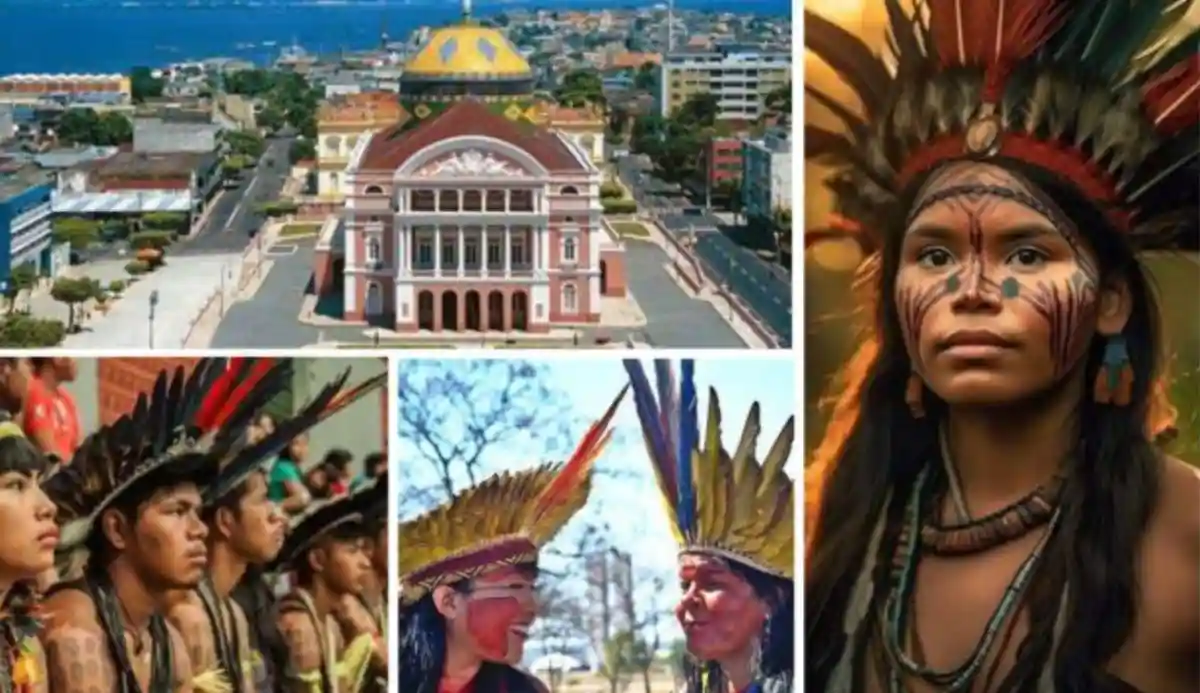
The name of the capital of the Brazilian state of Amazonas was never an administrative invention. Manaus is a direct tribute to the Manaó people, one of the most populous and influential Indigenous nations living along the Rio Negro before the 17th century. The word carries a deep symbolic weight: in the local language, “Manaós” means “Mother of the Gods” or, in broader readings, “Place of God”. By inheriting that name, the modern metropolis keeps alive the echo of a group that defied the occupation of its territory with a courage recorded by the chroniclers of the period.
The history of the city cannot be separated from the struggle of its original people. Far from the romanticised version of a peaceful colonisation, the Manaó organised resistance against European advances that sought control of the river routes and of Indigenous labour. That the name of the people survived centuries of urban transformation reveals an Indigenous story of bravery which refuses to be paved over by progress.
The Manaó and the sovereignty of the Rio Negro
The Manaó were known as skilled navigators and strategic warriors. They controlled a wide network of trade and alliances stretching for hundreds of kilometres along the Rio Negro and its tributaries. According to the historical record, theirs was a complex society, with a well defined social hierarchy and a productive capacity able to sustain populous villages both on the floodplains shaped by the pulse of the river and on higher, permanently dry ground.
That territorial sovereignty became the central point of conflict with the colonisers. Led by historical figures who are today symbols of bravery, the Manaó people refused to submit without a fight to the system of “ransoms” and to the mission settlements. They used their intimate knowledge of the geography of rivers and forests to apply guerrilla tactics that delayed for decades the consolidation of colonial rule in the central Amazon. The name of the city is, in that sense, a linguistic monument to a defiant autonomy.
Ajuricaba and an early pan Indigenous alliance
No account of the origin of Manaus is complete without Ajuricaba, the supreme leader of the Manaó at the beginning of the 18th century. Ajuricaba became a legendary figure by uniting several Indigenous nations to fight Portuguese expansion. He rejected an alliance with the colonisers and built what many historians regard as one of the first pan Indigenous resistance movements in the Amazon basin. Under his command, the Manaó withstood successive military expeditions sent from Belém.
The death of Ajuricaba is the climax of that narrative. According to oral tradition and accounts from the period, he chose to throw himself in chains into the waters of the Rio Negro rather than be taken away as a prisoner: freedom in death instead of submission in life. That untameable spirit is embedded in the cultural DNA of the city. Manaus grew from the foundations of an old stronghold, the Forte de São José do Rio Negro, yet its name is the posthumous victory of a people who proved that dignity has no price.
From Lugar da Barra to a river capital
Through the 19th century, the settlement then known as Lugar da Barra was raised to the status of a town and later of a city, receiving the name “Manaus” in 1856. The change came at a moment of economic ferment, and the city was radically transformed, gaining lavish theatres, public lighting and electric tramways that made it resemble a European metropolis in the middle of the forest.
Behind the gleam of the marble, however, the Indigenous essence remained. The population of Manaus, largely made up of descendants of those who resisted or were absorbed into the new migratory flows, carried the habits, the cooking and the forest knowledge inherited from the Manaó. The city expanded as a hub of global trade, but at its core it never stopped being the Indigenous “Place of the Gods”.
The manaura identity, a mosaic of courage
Today the word Manaus also names the “manaura”, a rich and resilient identity. To be manaura is to live between concrete and jungle, between the river and the asphalt. The courage inherited from the Manaó shows in the ability of the population to adapt to extreme geographic and economic challenges. The city faces overland isolation, high humidity and constant pressure on its natural resources, and still holds its place as the largest industrial and technological hub in Latin America set inside a tropical forest.
Studies point out that toponymy, the discipline that investigates place names, is one of the most durable forms of memory preservation. By calling the city Manaus, its inhabitants and the Brazilian state itself validate, consciously or not, the importance of original peoples in the construction of Brazil. The story of Manaó courage is not a closed chapter of the past: it is the ground on which a society stands while trying to reconcile economic development with cultural and environmental heritage.
Contemporary challenges and a revival of memory
The Manaus of today faces problems that would feel familiar to the Manaó: the defence of territory and the maintenance of life. The city grew around igarapés, the small forest streams of the region, and around springs that now suffer from disordered urbanisation. Recovering the history of the Manaó people also means recovering a way of living that respected the cycle of the waters and the integrity of the forest.
Renewed interest in Indigenous history has encouraged movements to value ancestral languages and traditions inside the urban space. The name Manaus is being read again not only as an address, but as a commitment to historical justice. Recognising that the city is the heir of the resistance of Ajuricaba and his people is the first step towards governance that includes contemporary Indigenous voices in decisions about the future of the metropolis.
That reading also changes how the city looks at itself. A metropolis often described abroad only through its industrial output or through the ornate architecture of its wealthiest decades is, before anything else, a place named after a nation of navigators. The distinction matters for schools, museums and public policy, because a city that knows the origin of its own name has a harder time treating Indigenous history as mere decoration.
The legacy of the Mother of the Gods
Manaus is a city of contrasts, where the floating harbour and the high rise towers share space with the smell of the Brazil nut, the fruit of Bertholletia excelsa, and of grilled fish. The name that echoes through the corridors of time is a reminder that the ground underfoot holds memory. The story of the Manaó shows that resistance takes many forms: the force of arms, the survival of a name and the persistence of an identity.
What remains is the question of how that legacy is honoured. A city carrying the name of a warrior people should be a city that fights for the dignity of all its residents and for the preservation of the biome that gave rise to it. May the Indigenous courage that runs through the rivers and the streets of Manaus keep inspiring those who seek an Amazon that is fair, prosperous and aware of its roots. Manaus is more than a capital: it is the living heart of Amazonian resistance.
Reporting: Anne Silva / Amazonia Mag. Source: Revista Amazônia.

Editor, English Edition — Amazonia Mag
Anne Silva is the editor of Amazonia Mag, the English-language edition of Revista Amazônia. She curates, translates and adapts the outlet's science and environment coverage for an international audience, reporting on Amazon wildlife, flora, rivers, climate and research. Every story she edits is grounded in peer-reviewed studies, official data and on-the-ground reporting from the Revista Amazônia newsroom in Belém, Pará, Brazil. More by Anne Silva →