
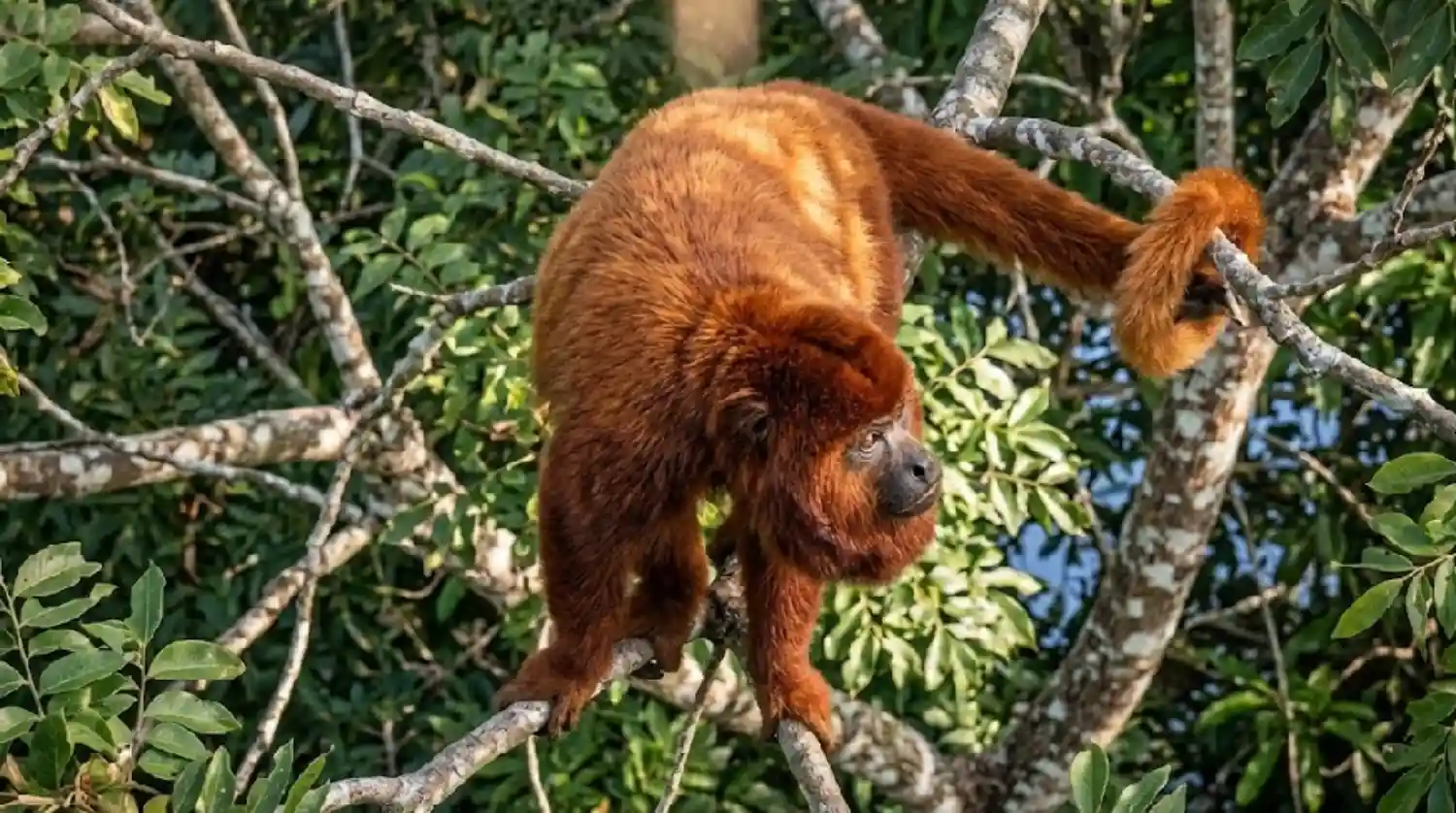
Long before the sun burns the mist off the canopy, the Amazon already has a voice. It is a deep, drawn out roar that seems to rise from inside the forest itself and can travel as far as five kilometres through dense vegetation. It belongs to no big cat and no bird. It is produced by the howler monkey, a primate of the genus Alouatta that, despite its modest size, makes the most powerful sound recorded from any land animal in the Americas. The secret behind that feat is not lung capacity or body mass. It sits in the animal’s throat, in the form of a spectacularly enlarged hyoid bone.
A resonance chamber made of bone
In most mammals the hyoid is a small, unremarkable U shaped structure whose main job is to anchor the tongue and support the muscles of the throat. In adult male howlers, evolution took that same bone and turned it into something else entirely: a hollow, bulbous, dramatically expanded bony chamber that works as a natural resonance box. Air pushed up from the lungs passes the vocal cords, enters the cavity and comes back out amplified, with a power that no comparable structure achieves in a primate of that size.
Anatomical analyses put a number on how extreme the adaptation is. The howler’s hyoid can be up to twenty five times larger than would be expected for a primate of its build. That disproportion is not decoration, it is applied physics. The chamber vibrates at low frequencies, and low sounds carry long wavelengths that bend around trunks, branches and leaves rather than crashing into them. In a humid, crowded rainforest where high frequencies die within metres, the bass survives. The howler effectively carries a biological low frequency amplifier built to defeat foliage.
A message that travels where sight cannot
The roar is not idle noise. It performs a precise ecological and social function in an environment where seeing anything more than twenty metres away is close to impossible. Howlers live in relatively small social groups and use the call above all as a territorial instrument. When the group roars, it marks its acoustic space and tells neighbours where it is and how strong it is. The outcome is a negotiation conducted at a distance. Groups adjust their routes, hold safe separations and avoid the direct physical clashes that could leave injuries in animals that depend entirely on their ability to climb.
The same signal also works inward. In a forest with limited visibility, the roar acts as an acoustic beacon that lets group members locate one another without moving or exposing themselves. Long term studies carried out by institutions such as the Mamirauá Sustainable Development Institute indicate that the intensity and the frequency of these vocalisations shift according to group size and the presence of intruders, evidence of a communication system considerably more sophisticated than a simple warning shout.
The evolutionary price of shouting that loud
In biology no advantage comes free. Hyoid development in Alouatta is sexually dimorphic, significantly larger in adult males, which supports the view that the roar is tied to competition between males and to attracting mates. A powerful sound serves as an honest advertisement: it signals vigour, fitness and the capacity to hold a territory rich in resources. This is a textbook case of natural selection acting directly on communication, in which individuals able to produce more effective signals gained concrete advantages over their rivals.
The trade off is written into the animal’s own body. The male carries a hypertrophied bony chamber in his throat for life, an extreme anatomical specialisation that reorganises the space of the larynx and commits the individual to a single communication strategy. There is a second cost as well, of a different kind. A signal engineered to travel five kilometres cannot choose its audience. The very roar that pushes a rival group away also reveals the exact position of whoever produced it. The howler lives, in a sense, under a permanent obligation to announce itself.
A less visible dependency runs alongside it. Howlers are arboreal animals that need vast stretches of continuous canopy to move and to forage, and the survival of their Amazonian populations is tied to the preservation of large, unbroken blocks of forest. A vocal apparatus calibrated to cover kilometres of woodland assumes that the woodland is there. When the landscape breaks into fragments, the extraordinary acoustic machinery that evolution spent so long refining loses the very thing that gave it purpose: territory to hold and neighbours to address.
It is worth pausing on what that means for anyone trying to read the health of a forest. Because the call is loud, patterned and tied to dawn and dusk, it is also one of the easiest signs of primate presence to detect without ever seeing an animal. A stretch of forest where the roar still rolls in at first light is telling researchers and residents something about the canopy above them. Silence in that same place would be a message too, and a far less encouraging one.
Much more than a roar
Although the long distance howl is its signature, the vocal repertoire of these primates is broader than its reputation suggests. Alongside the roar that crosses the forest, they produce short, higher pitched calls meant for close range interactions inside the group. Bioacoustics research suggests that different tones and rhythms may carry information about the caller’s emotional state, the presence of predators or even individual identity. The raw power of the hyoid therefore coexists with tonal subtleties, making the whole system multifaceted rather than merely loud.
The voice that supports ecotourism
That sound has become one of the most sought after experiences for visitors to the Amazon. Wildlife watching tourism, when managed sustainably, offers local communities a viable economic alternative and creates a direct incentive to keep the forest and its inhabitants intact. The roar that defines the atmosphere of dawn and dusk is, for many travellers, the most memorable moment of the trip, generating income while spreading awareness about regional biodiversity.
Scientific repositories such as the CAPES Journal Portal gather studies showing how ecotourism centred on bioacoustics can work as an effective conservation tool. As visitors and communities learn to value the sound of the forest, they come to understand why keeping the ecosystem whole has concrete worth. The howler, with its biological sound box, ends up acting as a kind of acoustic ambassador for the entire biome.
The howler monkey’s hyoid is, in the end, a demonstration of nature’s ability to solve complex problems with unexpected solutions. By turning an ordinary piece of bone into a powerful amplifier, evolution allowed these primates to dominate the Amazonian soundscape, mark out territories and hold their groups together without constant fighting. Their roar is more than din: it is the forest communicating with itself, a voice that, for now, can still be heard echoing for kilometres.
Reporting: Anne Silva / Amazonia Mag. Source: Mamirauá Sustainable Development Institute; CAPES Journal Portal; Revista Amazônia.

Editor · Amazonia Mag
Anne Silva is the editor of Amazonia Mag, the English-language edition of Revista Amazônia. She curates, translates and adapts the outlet's science and environment coverage for an international audience, reporting on Amazon wildlife, flora, rivers, climate and research. Every story she edits is grounded in peer-reviewed studies, official data and on-the-ground reporting from the Revista Amazônia newsroom in Belém, Pará, Brazil. More by Anne Silva →