
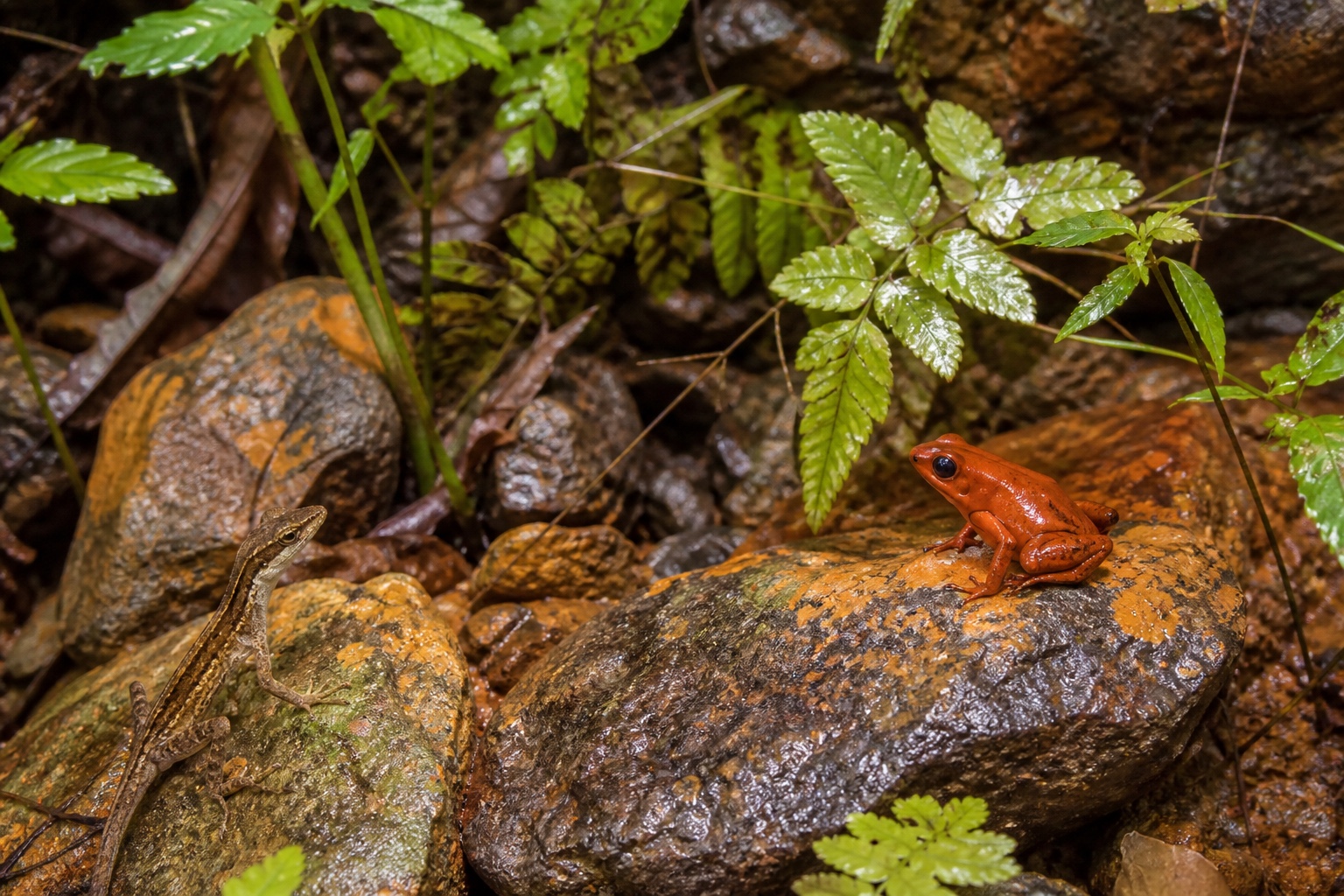
When night falls in southeastern Pará, the chorus that reaches the window does not always come from the forest. Much of it starts far closer to home: in the backyard, in the saucer under a potted plant, in an uncovered water tank, in the puddle that formed beside the wall after the afternoon rain. Frogs, toads and lizards share space with Amazonian houses so routinely that almost nobody files them under wildlife. Yet these are exactly the same animals that scientists try to inventory in the field, and they obey exactly the same ecological rules that are studied kilometres away from any doorstep.
A study published in the journal PLOS ONE examined the herpetofauna, meaning the combined community of amphibians and reptiles, across two neighbouring environments in southeastern Pará: the canga areas, with their rock outcrops, thin soils, rupestrian grasslands and vegetation adapted to harsh conditions, and the forest that surrounds them. The underlying finding is simple, and it has direct consequences for the people who live there. Environments that sit side by side can hold different communities, because what determines whether a species is present is not the broad label on the landscape but the fine detail of the ground itself.
The backyard is a mosaic too
For a frog, the difference between canga and forest comes down to humidity, temperature, shade, temporary pools and the availability of shelter. For a lizard, it comes down to sun warmed stones, crevices to hide in and the supply of insects. That same grammar repeats itself, in miniature, in any inhabited plot of land in the region. A wall that stores heat through the afternoon does the work of a rock outcrop. A woodpile or a heap of swept leaves behaves like the leaf litter of the forest floor. A dripping outdoor tap reproduces, entirely by accident, a permanent source of moisture.
It is worth abandoning the idea that a yard is neutral ground between the house and nature. It is a mosaic of microhabitats with sharply different physical conditions, and each species uses its own particular combination of them. One animal may spend the day under a slab of stone and the night hunting insects around a porch light. Another may depend entirely on a shaded corner that exists for only a few hours a day.
Pools that last a single night
Many amphibians breed in temporary pools formed by rainfall. These bodies of water vanish quickly, yet they can be enough to complete a decisive stage of the life cycle. The condition is strict: eggs and tadpoles have to develop before the ground dries out. When the rainfall regime shifts, a breeding site can stop working even without physically disappearing, because the window of time closes faster than the species can tolerate.
That dependence explains why the nocturnal chorus around houses tends to be seasonal, and why it swells after storms. It also explains something less obvious. A minimal intervention in a yard, filling a hollow in the ground, paving a strip of earth or emptying every container, can alter the group’s breeding prospects out of all proportion to the effort involved. Forest offers shade and holds moisture, while canga can swing through sharper thermal extremes. Neither environment is simply better or worse in the abstract, and the same holds for domestic spaces: losing one type of habitat mostly means narrowing the range of alternatives available to the whole community.
The lizard that turns a wall into a lookout
In rocky areas, cracks and boulders function at once as hiding place, as a site for thermoregulation and as a vantage point. The animal takes advantage of the stone’s warmth in the morning and retreats when the temperature climbs too high. That behaviour depends on a specific physical structure, one that cannot be replaced by a plantation or a road. It is precisely what happens with the lizards that neighbours see every single day without paying them any attention: the wall, the eaves, the roof tile and the window frame supply the same sequence of warm surfaces and of crevices to vanish into within a second.
Inside the forest, trunks, leaves and roots perform different functions. The coexistence of canga and woodland widens the set of ecological opportunities on offer, and what looks like a simple transition is in practice a succession of environments across which species distribute their time and their risks. The edge between a house and the vegetation around it works on the same logic, even though it is almost never described that way.
Why they are so hard to see
Amphibians and reptiles are difficult animals to detect. Some call for only a few hours, others hide beneath leaves, and several species carry colouring that blends into the substrate they rest on. Absence during one field campaign does not mean the animal is missing from the area. That is why serious inventories combine visual searching, listening, traps and repeated visits across different seasons, rather than trusting a single outing.
There is also a temporal dimension that is easy to overlook. Some species appear only during the rainy season, while others turn up in the dry period, when the temperature of the stones and the availability of shelter both change. A short campaign risks recording nothing more than the most active fraction of the community. Genuinely knowing the fauna of a place requires returning to the same spot and comparing conditions through the year.
Conservation starts at the doorstep
Surveying a region makes it possible to compare protected areas, mining zones and corridors of vegetation. Without a baseline, the loss of a species is noticed only once the change is already locked in. And canga areas are frequently associated with mineral deposits, so opening access routes or removing rock can destroy microhabitats that never show up in a simple classification splitting the world into forest and open ground.
The study shows that the herpetofauna of the eastern Amazon is shaped by details of the terrain. Canga is not an emptiness between trees, and the forest is not homogeneous: the two environments form a mosaic with their own evolutionary histories and their own physical conditions. Protecting that biodiversity means looking at the small places where life actually happens, a pool that lasts one night, a stone that holds heat, a rotting trunk or a fissure that keeps its moisture. An area can look tiny on a map and still hold species that appear in no other nearby environment.
Read from a doorstep rather than from a laboratory, this becomes an unusually practical idea. The people who share a plot of land with these animals are, in effect, living beside a habitat mosaic, and the choices they make about shade, water and stone carry ecological weight even when they are made for entirely domestic reasons. Recognising the frog under the step or the lizard on the wall as wildlife, rather than as background, is the first step in that shift of perspective.
That is perhaps the most useful lesson for anyone living among forest and canga. The world of frogs and lizards begins exactly where the broader maps end, and very often it begins in the backyard: in the shade that was never swept away, in the stone nobody moved, in the water the rain left behind that will hold out until dawn.
Reporting: Anne Silva / Amazonia Mag. Source: Revista Amazônia, revistaamazonia.com.br.

Editor, English Edition — Amazonia Mag
Anne Silva is the editor of Amazonia Mag, the English-language edition of Revista Amazônia. She curates, translates and adapts the outlet's science and environment coverage for an international audience, reporting on Amazon wildlife, flora, rivers, climate and research. Every story she edits is grounded in peer-reviewed studies, official data and on-the-ground reporting from the Revista Amazônia newsroom in Belém, Pará, Brazil. More by Anne Silva →