
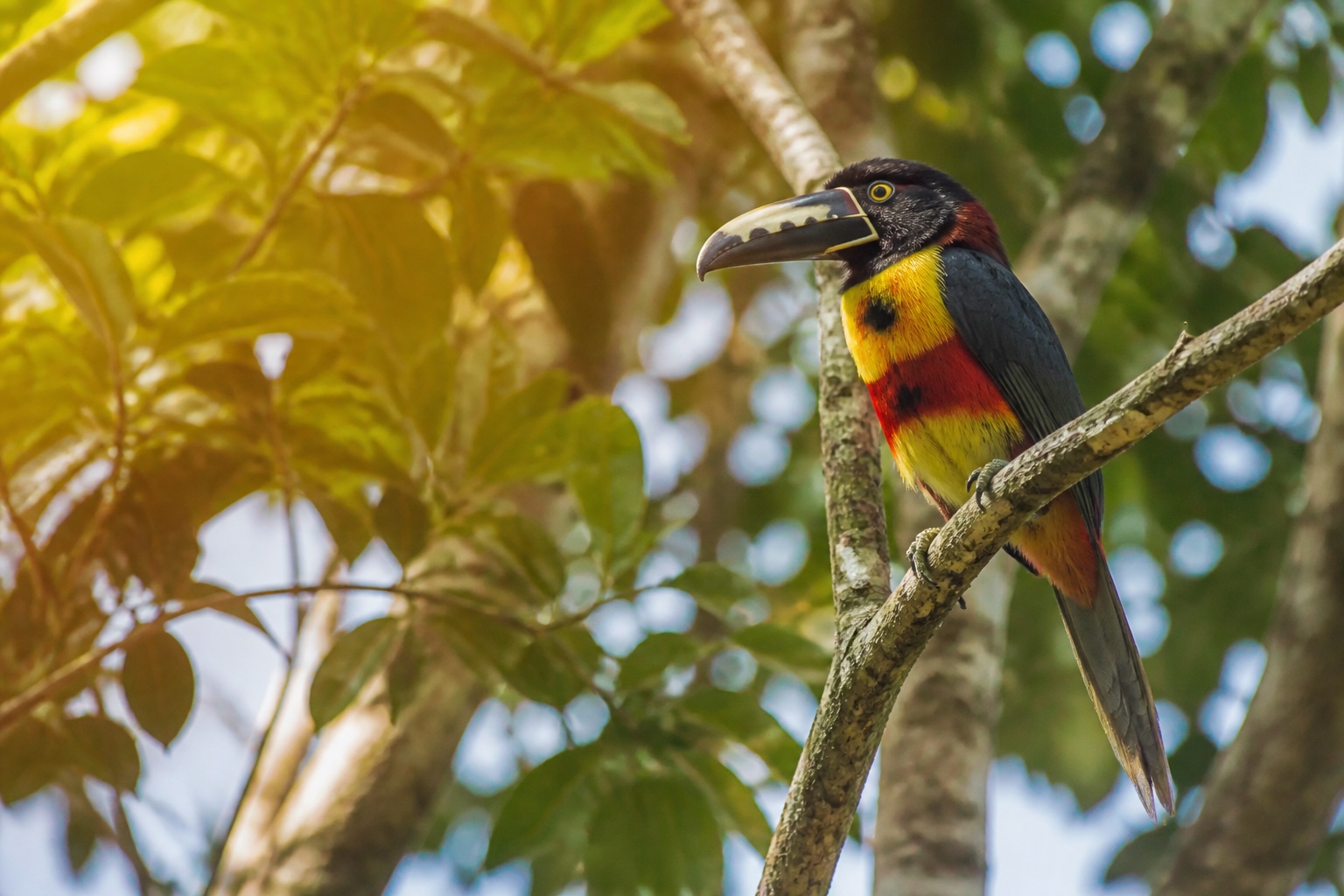
A forest can look untouched from above and still be turning into a harder place to live for the birds beneath its canopy. That is the concern raised by a study that examined 27 years of capture and recapture data covering 29 bird species across 20 areas of undeforested rainforest in the Brazilian Amazon. Satellite imagery shows continuity. The field record shows wear.
The work, published in the journal Science Advances and discussed in Nature Ecology and Evolution, found a significant drop in apparent annual survival for 20 of those species. That number matters because it describes something different from the immediate disappearance caused by logging. The animals may still be there, yet each one is less likely to stay alive and be found again in the same place.
Standing forest does not cancel the temperature effect
Conservation usually starts with a map of forest cover. That map is indispensable, but it does not finish the story. Temperature changes water loss, metabolism, insect availability and the way fruiting plants function. Birds feel all of that while remaining surrounded by trees, without a single trunk being cut anywhere near them.
The study indicates that warmer years line up with less favourable conditions for several species. The effect is not identical across the board. Longer lived birds showed a stronger response to rising temperature, which may reflect a physiological ceiling or a heavier dependence on adults that need to survive many years for the population to hold together.
What apparent survival actually means
In capture and recapture research, scientists mark individuals and try to find them again in later field seasons. When a bird does not turn up, there are at least two possibilities: it died, or it left the area. That is why the measure is called apparent survival. The method does not confuse absence with death, but it does allow researchers to track trends across decades.
Keeping a series running that long is rare work. Field teams change, instruments change, working conditions change and the climate itself changes. The strength of the dataset lies precisely in surviving all of that and still showing a persistent pattern across multiple separate areas, rather than at a single sampling point that might be reacting to some local quirk.
Why long lived birds may take the harder hit
A bird that lives many years tends to produce few young per season, or to rely on experienced adults to find food and shelter. If temperature pushes survival down, replacing lost individuals becomes slow. The species does not vanish overnight, but its age structure shifts, and the loss of adult birds leaves consequences that stretch out over years.
The finding does not license the claim that every Amazon bird will react the same way. Some may shift their range, change the hours when they are active, or take up new food sources. Others depend on microclimates that fragmented forest can no longer hold, and for them the room to adjust is far narrower.
The risk hidden inside apparently protected land
The study areas were undisturbed forest, but they were never outside the climate system. Warming crosses the boundaries of parks and territories without asking permission. Protecting the forest therefore remains essential, yet it has to be paired with strategies that maintain shade, water, connectivity and habitat diversity inside the areas that are already under protection.
Small fragments tend to heat up more along their edges. A bird that depends on forest interior can end up with less space to escape a heat wave. Corridors, large continuous blocks and the protection of watercourses are not only measures against deforestation. They also help preserve steadier thermal conditions for the wildlife already living there.
A warning that starts with a bird still present
The most unsettling part is that decline can begin long before the public notices any absence. The song continues, the species still appears on checklists, and the forest still looks green from any lookout point. Yet the odds that any one individual survives and is found again keep sliding year after year.
The study turns birdwatching into a kind of thermometer for the climate. Asking which species are still present is no longer enough. The questions now are for how long, how often and under what conditions they manage to complete a life cycle. The Amazon can stay visually intact while its bird community quietly registers the pressure of a hotter world.
What changes for the people who manage protected areas
This kind of result also reshapes how conservation units are monitored. Occasional inventories can record a species as present and conclude that everything is fine. Long series reveal the difference between being present and being able to sustain a viable population. For managers, that distinction helps set priorities: corridors, headwater protection and closer tracking of the warmest sites.
A species response does not have to be an immediate range shift to matter. Changing activity hours, breeding less often or losing experienced adults is already enough to weaken a population. Birds make a silent transformation visible: the environment still supplies trees, but it supplies a thinner safety margin for finishing a life.
There is a broader lesson in the numbers as well. Twenty species out of 29 is not a marginal signal, and the sites involved were chosen precisely because the forest around them was never cleared. If survival is slipping there, the assumption that intact cover guarantees intact function no longer holds without qualification. The forest remains the foundation of any conservation plan for the region, yet it is now clear that keeping the trees standing is the beginning of the task rather than the end of it.
Reporting: Anne Silva / Amazonia Mag. Source: study published in Science Advances, with commentary in Nature Ecology and Evolution.

Editor, English Edition — Amazonia Mag
Anne Silva is the editor of Amazonia Mag, the English-language edition of Revista Amazônia. She curates, translates and adapts the outlet's science and environment coverage for an international audience, reporting on Amazon wildlife, flora, rivers, climate and research. Every story she edits is grounded in peer-reviewed studies, official data and on-the-ground reporting from the Revista Amazônia newsroom in Belém, Pará, Brazil. More by Anne Silva →