
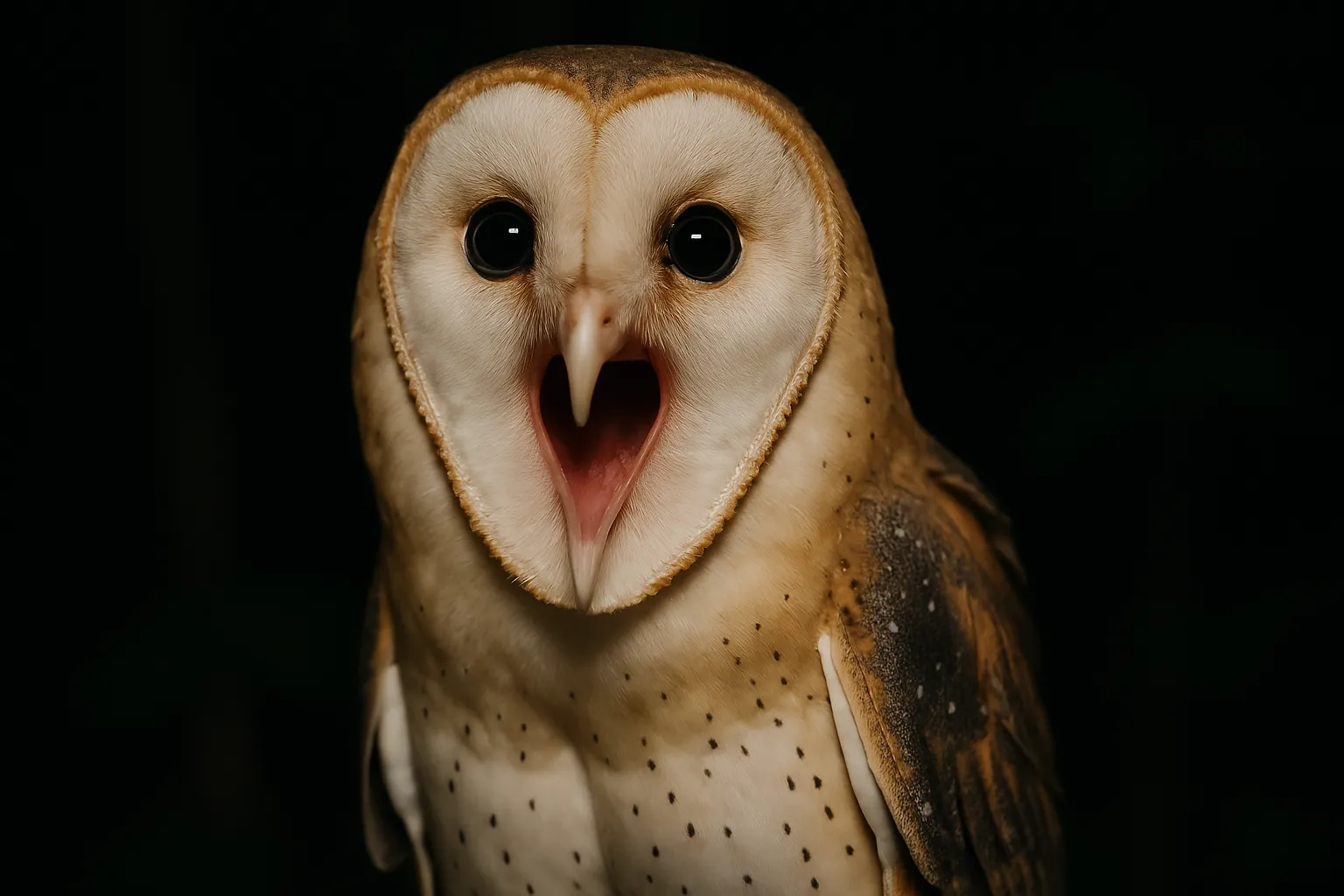
The short answer: owls fly with almost no sound because the edges of their flight feathers split into a fringe of fine filaments that shatters air turbulence before it can build. The silence does two jobs at once: it keeps the prey from hearing the approach, and it lets the bird go on listening to the ground while it dives. That same geometry now shapes the design of quieter wind turbines and cooling fans.
Nobody saw it arrive. One moment the roof was empty. The next, the bird was already perched on the house, as though it had assembled itself out of the dark.
No wingbeat drew attention. No sound crossed the window. That silent arrival is what turned the owl into a creature of omens and folk tales for centuries. The explanation, though, has nothing to do with spirits. It is hidden in the structure of the wing.
Why other birds are audible in flight
When a bird beats its wings, the motion pushes air aside and creates turbulence. Depending on the speed, the size of the animal and the shape of the feathers, that disordered flow produces sound that carries.
Pigeons, ducks and plenty of other birds announce themselves with the clatter of their wings. For a night hunter, that announcement would be a serious handicap: a mouse would be gone before the bird ever arrived.
The fringe on the edge: a comb that cuts the air
Owl flight feathers carry structures that reshape the airflow before it has a chance to get loud. Along the leading edge, small projections that look like the teeth of a comb break large air currents into far smaller swirls.
One large swirl hits the air hard: it moves a lot of mass at once and releases its energy in frequencies other animals hear well. Many tiny swirls spread that same energy out and push it toward higher frequencies, which fade faster in air and fall outside the band a rodent is listening to.
The surface of the feather finishes the job. Across several regions the plumage has a soft, velvety texture that damps the friction of feather against feather during the wingbeat. The trailing edge, frayed into a flexible fringe, softens the meeting between the air passing over the wing and the air passing under it, which is exactly where the sharpest noise tends to be born.
The result is not absolute silence. It is a flight considerably more discreet than that of other birds of comparable size.
The silence also protects the hunter’s own ears
The advantage is not only that the prey hears nothing. If its own wings were noisy, the owl would lose the thread of the sound it is chasing.
The bird locates a rodent by the rustle of leaf litter and corrects its trajectory mid dive. A loud wingbeat would act as permanent interference on its own aiming instrument. So the adaptation works in two directions at once: it hides the predator, and it preserves her ability to listen right down to the final metre.
Not every species is equally quiet
How quiet an owl is varies with the species, the habitat and the diet. Owls that depend on small mammals and hunt over open ground, such as the barn owl (Tyto alba), are the ones that gain most from the adaptation.
Species that take fish, or that live where noise matters less to the outcome of a hunt, show visible differences in the finish of their feathers. External conditions count too: rain, wind and flight speed all change the sound produced. On a windy night, the background noise already covers much of the approach.
From the wing to the laboratory
This is the point where the biology stops being a curiosity. Aerodynamic noise, the kind born from air itself moving past an edge, is one of the most stubborn problems in engineering. It shows up in wind turbines, in the fans of a data centre, in the propellers of a drone, in the outdoor units of air conditioning systems and along aircraft wings during landing.
For decades the standard answer was to bury the problem: more housing, more absorbent material, more weight. The owl proposes a different route. Do not trap the noise, prevent it from forming in the first place.
Serrated edges on turbines and fans
That is where the serrated edges now visible on the blades of many modern wind turbines come from: a triangular fringe, shaped like a comb or a saw, fitted to the trailing edge of the blade. It copies the principle of the feather, fragments the swirls and lowers the perceived sound without forcing the machine to slow down.
The detail matters more than it sounds. In wind farms near inhabited areas, night noise is often the reason rotation speed is capped after dark, and less rotation means less energy. A quieter edge lets a turbine run more hours without disturbing the neighbours.
The same idea scaled down. Makers of computer fans, domestic extractors and industrial cooling systems have adopted blades with wavy or toothed edges and textured surfaces, because the noise floor of a machine is increasingly what decides whether people will tolerate it in a room. In aviation, feather research feeds into the design of coatings and edge treatments aimed at cutting noise during the approach phase, the part of a flight that most affects neighbourhoods around airports.
It is worth being precise about what biomimicry can and cannot deliver here. A wind turbine blade is not a wing of keratin, it does not flex the way a feather flexes, and it faces speeds and loads no bird ever meets. What crosses over is the principle rather than the object: break a large disturbance into many small ones, and let the air itself absorb the difference. Engineers borrow the logic, then rebuild it in steel, resin and composite.
The whole body supports the manoeuvre
Wings that are broad relative to body weight let many owls fly slowly without stalling. That buys time to adjust direction, alternate slow beats with stretches of gliding and land gently. On reaching the roof, the talons grip the surface immediately and cut out unnecessary movement.
Once it has the perch, the bird reduces the clues to its presence even further. Staying still avoids alerting small animals, saves energy and makes observation easier. When only the head moves, the body seems fused into the landscape: plumage in browns, greys and pale tones works as camouflage against trees, rooftops and shadow.
What to do if one lands near the house
Keep your distance and avoid sudden movements. Do not try to scare the bird off with stones, thrown objects or jets of water. Beyond the risk of injuring the animal, the reaction can send it flying into cables, windows or other dangerous structures. Do not offer food either.
The best way to watch one is to let it carry on with its natural activity and leave when it judges the moment safe.
The mystery kept inside a feather
An owl does not need to vanish in order to look invisible. Its plumage cuts sound, its colouring blends into the surroundings and its habits concentrate in the hours when humans see least.
When it settles silently onto a house, the effect looks inexplicable. The truth is more interesting than the omen: millions of years of evolution turned those wings into one of the most discreet hunting tools in nature, and engineering is only beginning to copy the draft.
Reporting: Anne Silva / Amazonia Mag. Source: Revista Amazônia.

Editor, English Edition — Amazonia Mag
Anne Silva is the editor of Amazonia Mag, the English-language edition of Revista Amazônia. She curates, translates and adapts the outlet's science and environment coverage for an international audience, reporting on Amazon wildlife, flora, rivers, climate and research. Every story she edits is grounded in peer-reviewed studies, official data and on-the-ground reporting from the Revista Amazônia newsroom in Belém, Pará, Brazil. More by Anne Silva →