
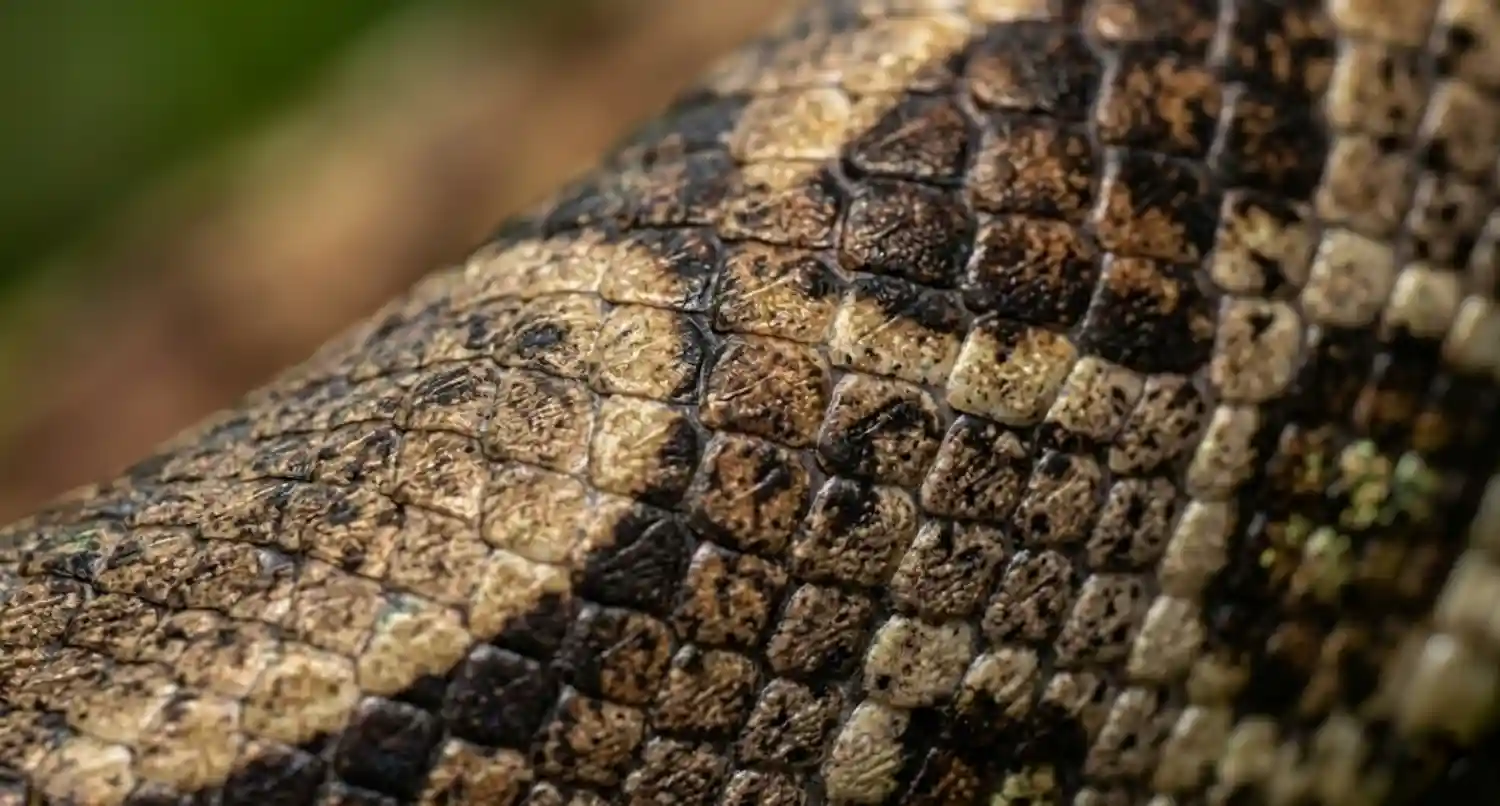
A single boa can be told apart from thousands of others through a careful reading of its flanks, where ocelli and dark blotches form a biometric map that stays unchanged for the animal’s entire life. Recent research carried out deep in the Amazon rainforest confirms that the arrangement of scales and the pigmentation of the Boa constrictor work with the same precision as a human fingerprint, allowing every individual to be catalogued with complete confidence. The finding changes the way these reptiles are seen: no longer generic specimens, but individuals with life histories, defined territories and social behaviour of their own inside the ecosystem.
The technique gaining ground at Amazonian research stations is photo identification, a non invasive method that removes the stress of capture and the need to implant transponders or attach physical tags. In the past, monitoring a snake meant restraining it by hand, which created risk for both the animal and the researcher and could alter the reptile’s natural behaviour. Today, with high resolution cameras and pattern recognition software, scientists record a boa’s unique scale pattern simply by observing the animal in its habitat, preserving the integrity of the specimen and the purity of the data gathered about its longevity.
A record written on the skin
In photo identification work with the Boa constrictor, the process relies on photographing the lateral and dorsal regions, where the saddle patterns and dark blotches are most prominent. Those marks form during embryonic development and, although the animal grows and goes through repeated skin sheds, the geometry and the relative position of every blotch stay exactly the same. It is a visual signature that survives time and the harsh conditions of the forest, so a boa photographed five years ago can be recognised instantly when it crosses the path of a new field expedition.
That stability is precisely what turns the method into a serious research tool rather than a field curiosity. A physical tag can fall off, corrode or be pushed out by the animal’s body, and one scar can easily be mistaken for another. The pattern of the scales, by contrast, travels with the individual from birth. When images taken years apart are compared, the researcher does not depend on memory or subjective impression but on a verifiable geometric pattern that any colleague can review later, which adds transparency and auditability to field records.
The impact of the methodology on boa monitoring in the Amazon is profound, especially for understanding population dynamics in protected areas or in places under pressure from deforestation. By identifying each individual, biologists can map the home range of every snake and see how it moves between the canopy and the forest floor. That level of detail reveals that boas are far more resident than previously assumed, holding specific territories where they play a vital role in controlling small mammals and birds and keeping local biodiversity in balance.
The community as part of the method
Working with visual identification also brings science closer to riverside communities and local guides, who become essential eyes in participatory monitoring. A resident will often have recognised for years the boa that lives near the house, and science now validates that empirical knowledge with statistical rigour. The collaboration strengthens conservation, because an animal that is frequently feared becomes a familiar “neighbour” whose presence is monitored and valued by the community as an integral part of the health of the surrounding forest.
There is also a cultural effect that is hard to measure yet obvious in the field: once an animal stops being an anonymous threat and acquires a recognisable identity, the impulse to kill it loses force. The same snake once described as a generic danger starts to be mentioned by its story, by the spot where it usually appears and by how long it has occupied that patch of forest. Conservation stops being an order handed down from outside and becomes a local agreement, sustained by people who live alongside the wildlife that science is trying to protect.
The efficiency of this digital catalogue system allows vast databases to be shared between research institutions around the world, creating a protective network for the species. Knowing exactly who is who in the forest, researchers can quickly detect whether an individual has disappeared because of wildlife trafficking or whether the local population is thriving. Technology combined with ethical observation shows that respect for wild life begins with recognising that every creature carries a singular identity, protected by its own skin, in one of the most complex biomes on the planet.
What the scales reveal
Beyond identification, the scales of the boa are masterpieces of natural engineering. They have hydrophobic properties that repel water and reduce friction against the ground, which makes silent movement possible. Light reflecting off certain layers of keratin can create a subtle iridescent effect that assists disruptive camouflage, breaking up the outline of the animal among dry leaves and shadows and rendering it practically invisible to inattentive prey and predators.
That double function explains much of the scientific appeal of the method, since the very structure that keeps the animal alive in the gloom of the understorey is the one that allows it to be recognised without being touched. Nothing has to be added to the snake, nothing has to be removed from it, and no handling is required for its history to be written down and shared with researchers working thousands of kilometres away.
Walking through the forest and meeting a boa now carries a new meaning: knowing that in front of our eyes stands an individual unique in the history of the Earth, whose existence is an invitation to exercise our ability to observe without interfering and to protect without possessing.
Reporting: Anne Silva / Amazonia Mag. Source: Revista Amazônia.

Editor, English Edition — Amazonia Mag
Anne Silva is the editor of Amazonia Mag, the English-language edition of Revista Amazônia. She curates, translates and adapts the outlet's science and environment coverage for an international audience, reporting on Amazon wildlife, flora, rivers, climate and research. Every story she edits is grounded in peer-reviewed studies, official data and on-the-ground reporting from the Revista Amazônia newsroom in Belém, Pará, Brazil. More by Anne Silva →