
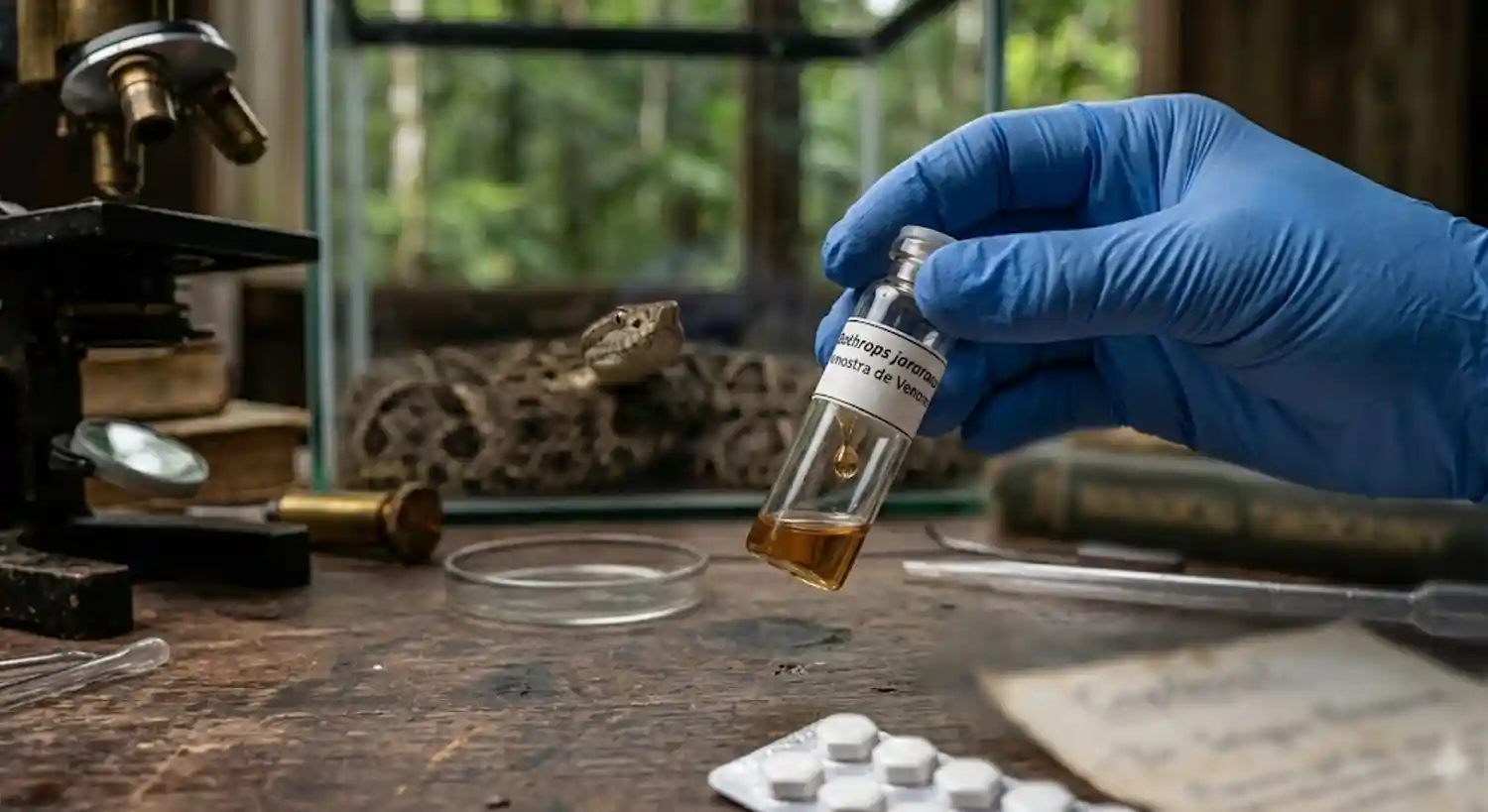
A single drop of the translucent fluid produced by the glands of Bothrops jararaca is enough to collapse a prey animal’s blood pressure within seconds. For centuries that capability was read as nothing but a threat. Pharmacology now recognises it as the starting point of one of the great advances in modern cardiovascular medicine: the first drug in history designed rationally from molecular knowledge of its biological target. What evolution perfected in order to immobilise small mammals ended up as a tablet that millions of people swallow every morning.
The jararaca, a pit viper, rules the shaded forest floor of Brazil, across the remnants of the Atlantic Forest and the transition zones reaching toward Amazonia. Its colouring merges with dry leaf litter and fallen branches, which makes it nearly invisible to anyone walking without care. For generations, an encounter with this reptile meant only fear for riverside communities, farmers and visitors from the city. That view began to shift when a group of researchers stopped treating the animal’s chemical arsenal as something to be fought at any cost and started treating it as a library of biological compounds waiting to be decoded.
A venom that targets the bloodstream
The composition of this snake’s toxic fluid is a showcase of evolutionary biology. Unlike strictly neurotoxic venoms, which shut down the nervous system, the jararaca’s chemical attack concentrates on the circulatory system and soft tissue. The toxin triggers an abrupt and severe drop in blood pressure, pushing the victim into circulatory shock and removing any chance of escape. For many decades medicine approached snakebite with a single objective: producing antivenom capable of saving lives in the emergency room. Nobody had stopped to ask which exact component caused that collapse, or whether the mechanism could be tamed and turned toward human health.
The peptide that rewrote cardiology
That question drove the Brazilian pharmacologist Sérgio Ferreira, whose pioneering work would go on to change global medicine. During the 1960s, working in the laboratories of the Ribeirão Preto Medical School, part of the University of São Paulo, Ferreira spent years isolating a specific peptide from jararaca venom. He named it Bradykinin Potentiating Factor, a molecule with one singular property: it prevented bradykinin from being broken down inside the body.
Bradykinin is a substance the human body produces naturally, and it widens blood vessels to ease the flow of blood. By chemically blocking its destruction, the factor Ferreira isolated forced arteries and capillaries to stay open and relaxed. There lay the explanation for the dramatic pressure crash seen in bite victims. And there lay the therapeutic opening as well: if that mechanism could be isolated and dosed in pill form, medicine would finally hold a precise tool against chronic arterial hypertension, a silent condition that at the time meant early death or severe complications for millions of patients with no real alternative. The concept was striking on its own terms, turning a wild animal’s mechanism of killing into an instrument of longevity.
From rainforest to global pharmacy
The leap from a Brazilian laboratory bench to pharmacy shelves worldwide required a long and demanding process of industrial chemical synthesis. Building on Ferreira’s biochemical findings, international research groups managed to design the first synthetic molecule faithfully based on the structure of the South American snake’s peptide. The result was captopril, formally approved in the United States in 1981 and regarded as ground zero for the drug class known as angiotensin converting enzyme inhibitors, the ACE inhibitors.
Its significance runs deeper than clinical effectiveness. Captopril entered history as the first pharmaceutical developed entirely through targeted design against a specific biological receptor, a method that is now routine across the industry. Until then, the available treatments for chronic cardiovascular disease carried harsh side effects and often failed to stabilise the most serious cases. Patients living with congestive heart failure and resistant hypertension suddenly gained quality of life and years they had not expected. Brazil supplied the biological inspiration and the initial scientific scaffolding for a revolution that helped drive cardiovascular mortality down across every continent.
The impact did not stop at blood pressure. Developing the molecule opened a far deeper understanding of how the kidneys and the heart actually work, and enzyme inhibition became standard protocol in cardiology guidelines everywhere. It is concrete proof that knowledge generated in tropical ecosystems carries incalculable value for global public health, and that funding basic biodiversity research is not an academic luxury.
A chemical library under threat
Against a backdrop of climate crisis and accelerating habitat loss, this story works as the most pragmatic argument available in favour of conservation. When an endemic species vanishes in Amazonia or in any other threatened biome, what disappears is not merely scenic beauty: a genetic library of therapeutic solutions burns before anyone has read its first page. Tens of thousands of bioactive compounds lie dormant in the barely explored venoms of spiders, scorpions, amphibians and other snakes that science has hardly touched.
Ethical bioprospecting, combined with genetic sequencing and artificial intelligence, promises a new era of discovery, provided the habitats of those animals are still standing. The quiet revolution set in motion by the jararaca is a reminder that the cure for complex disease may be crawling across the damp floor of a tropical forest. Protecting Brazilian biodiversity is not a poetic gesture: it is a survival calculation. Every preserved hectare holds pharmacological components that the medicine of the future has not yet learned to name.
Reporting: Anne Silva / Amazonia Mag. Source: Revista Amazônia, revistaamazonia.com.br

Editor, English Edition — Amazonia Mag
Anne Silva is the editor of Amazonia Mag, the English-language edition of Revista Amazônia. She curates, translates and adapts the outlet's science and environment coverage for an international audience, reporting on Amazon wildlife, flora, rivers, climate and research. Every story she edits is grounded in peer-reviewed studies, official data and on-the-ground reporting from the Revista Amazônia newsroom in Belém, Pará, Brazil. More by Anne Silva →