
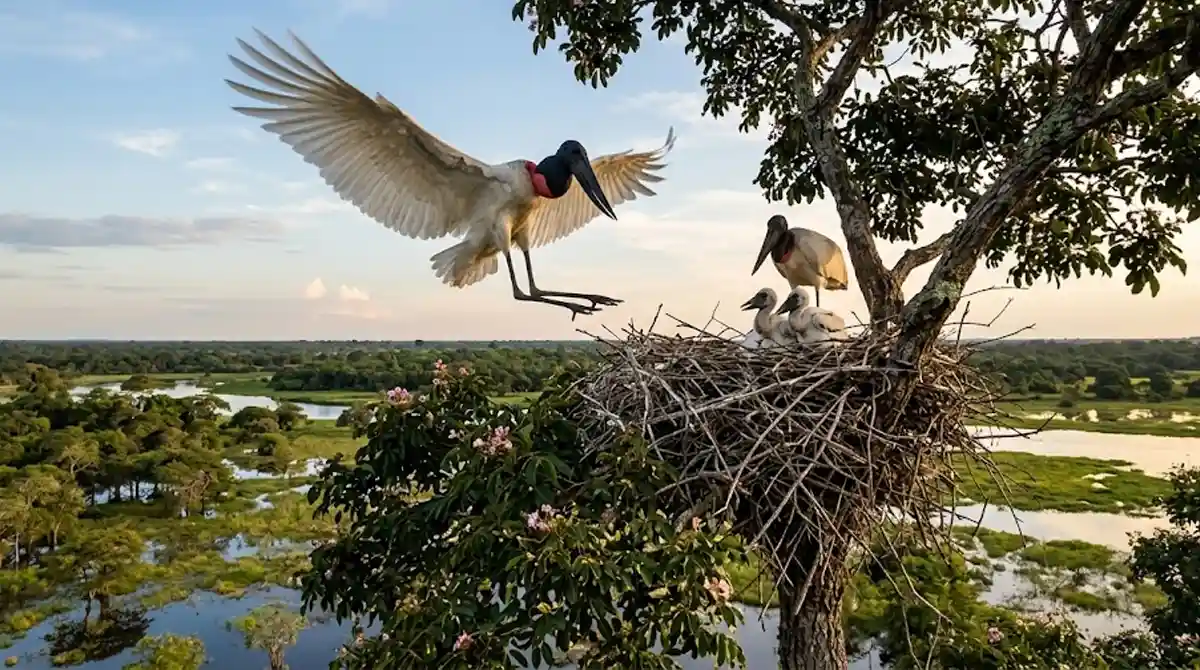
A wingspan of more than 2.5 metres and a nest sturdy enough to hold the weight of a grown adult: the jabiru stork, known in Brazil as the tuiuiú, needs no introduction on the flooded plains of the Pantanal. The giant bird is filling the sky again with a frequency specialists had not recorded for years. Researchers and birdwatchers have documented a significant rise in the population density of the species across parts of the Pantanal and in specific niches of the Cerrado, reversing the downward trend that defined the previous decade.
That finding carries far more weight than a striking photograph. The presence of active nests of Jabiru mycteria works as a first order biological indicator, because it shows that the health of the local aquatic ecosystem is going through a resilient process of restoration. Where the giant bird breeds again, the water, the fish and the tall vegetation are all doing their job. Where it vanishes, something usually broke earlier in the chain, and rarely in the air itself.
Water writes the calendar
The population growth is no accident. It is tied directly to the recovery of wetland areas after critical periods of drought and fire. When the plain floods again on schedule, the whole system reorganises itself: lagoons fill, riverside vegetation grows back, and the animals that depend on that pulse recover a predictable calendar for feeding and breeding. The jabiru is among the first to answer that signal, which is precisely why its return is read by biologists as a thermometer for the entire floodplain.
The species depends on tall trees, such as the piúva and the cambará, to build its nests. Those structures are not abandoned at the end of the season: they are reused and enlarged year after year, until they reach dimensions that impress anyone looking up from the ground. Losing a single mature tree can therefore mean losing decades of accumulated construction, which is why protecting large trees matters just as much as protecting the water regime that feeds the surrounding wetland.
The regional bird census indicates that breeding success in the colonies rose by around 15% over the past two years. For conservationists, the figure is both a relief and a confirmation. The jabiru functions as an umbrella species: protecting its nesting sites and feeding grounds indirectly secures the survival of dozens of other species that share the same habitat, from fish and amphibians to the smaller birds that occupy the lower layers of the same stands of forest.
Ranchers turned guardians
The recovery of Pantanal birdlife reflects joint effort between landowners, non governmental organisations and environmental agencies. Many Pantanal ranches have adopted the model of Private Natural Heritage Reserves, known in Brazil as RPPN, and in doing so formally protect the places where the jabiru builds and rebuilds its nests. It is a legal instrument that turns the rural producer into a direct guardian of the bird, without forcing anyone to abandon economic activity on the plain.
Food supply added a decisive push. The abundance of fish, molluscs and small amphibians during recent flood cycles gave jabiru pairs the energy they needed to raise chicks with a higher survival rate. This is the cycle of life asserting itself over the climate adversity of recent years, and the logic behind it is hard to argue with: a full wetland feeds whatever lives off it, and an empty one feeds nobody at all, no matter how well protected the nesting trees may be.
The threats that never went away
Optimism still demands constant vigilance from the authorities. Among the challenges pressing on the jabiru are deforestation in the headwaters of the rivers that feed the plain and contamination by pesticide residues carried downstream by the water flow. Neither problem can be solved inside the Pantanal itself, because both begin upriver, in territories where land use decisions are taken far away from the nesting colonies and rarely with those colonies in mind.
Maintaining ecological corridors between the Cerrado and the Pantanal is equally essential. The jabiru is a short distance migratory bird and moves between different feeding areas as water levels rise and fall. Without those connected refuges, the species faces the risk of population isolation once more, a scenario in which groups become confined to fragments and lose the capacity to bounce back from a new drought or another severe cycle of fires.
Satellites, springs and public policy
Conservation science has been using satellite monitoring technology to better understand the dispersal routes of these giants. By mapping where the birds feed during the dry season, specialists can aim public policies for spring and headwater protection with precision, instead of working from broad estimates. The return of these storks in robust numbers is proof that nature retains an extraordinary capacity for regeneration, provided the triggers of destruction are interrupted and natural pastures are managed sustainably.
A recovery that has to be repeated
Reversing a decade of decline is an achievement, but it is not a finish line. The same conditions that produced the rebound, wet years, standing tall trees, protected nesting sites and abundant prey, can be undone quickly by a single severe fire season or by a run of failed floods. Continuous monitoring is what allows managers to tell a real trend from a lucky cycle, and that is why the census work and the satellite tracking matter as much as the nests themselves.
A bird that pays its way
Watching a jabiru in full flight over the flooded plains is an experience that defines the identity of central Brazil. The bird is the living symbol of a biome that resists and renews itself, and protecting it is not only a question of biodiversity. It is also cultural and economic preservation: birdwatching tourism has become a sustainable source of income for local communities, one that values the living animal in its natural habitat above any other form of exploitation.
The future of the jabiru now depends on the collective ability to hold a balance between agricultural expansion and the integrity of hydrological cycles. As long as there are tall trees and clean water, the giant of the open wings will remain the sentinel of the region’s greatest ecological sanctuaries. The recovery of the species is a reminder that, with science and political will, it is still possible to rewrite the fate of the continent’s most emblematic wildlife.
Reporting: Anne Silva / Amazonia Mag. Source: Revista Amazônia (revistaamazonia.com.br).

Editor, English Edition — Amazonia Mag
Anne Silva is the editor of Amazonia Mag, the English-language edition of Revista Amazônia. She curates, translates and adapts the outlet's science and environment coverage for an international audience, reporting on Amazon wildlife, flora, rivers, climate and research. Every story she edits is grounded in peer-reviewed studies, official data and on-the-ground reporting from the Revista Amazônia newsroom in Belém, Pará, Brazil. More by Anne Silva →