
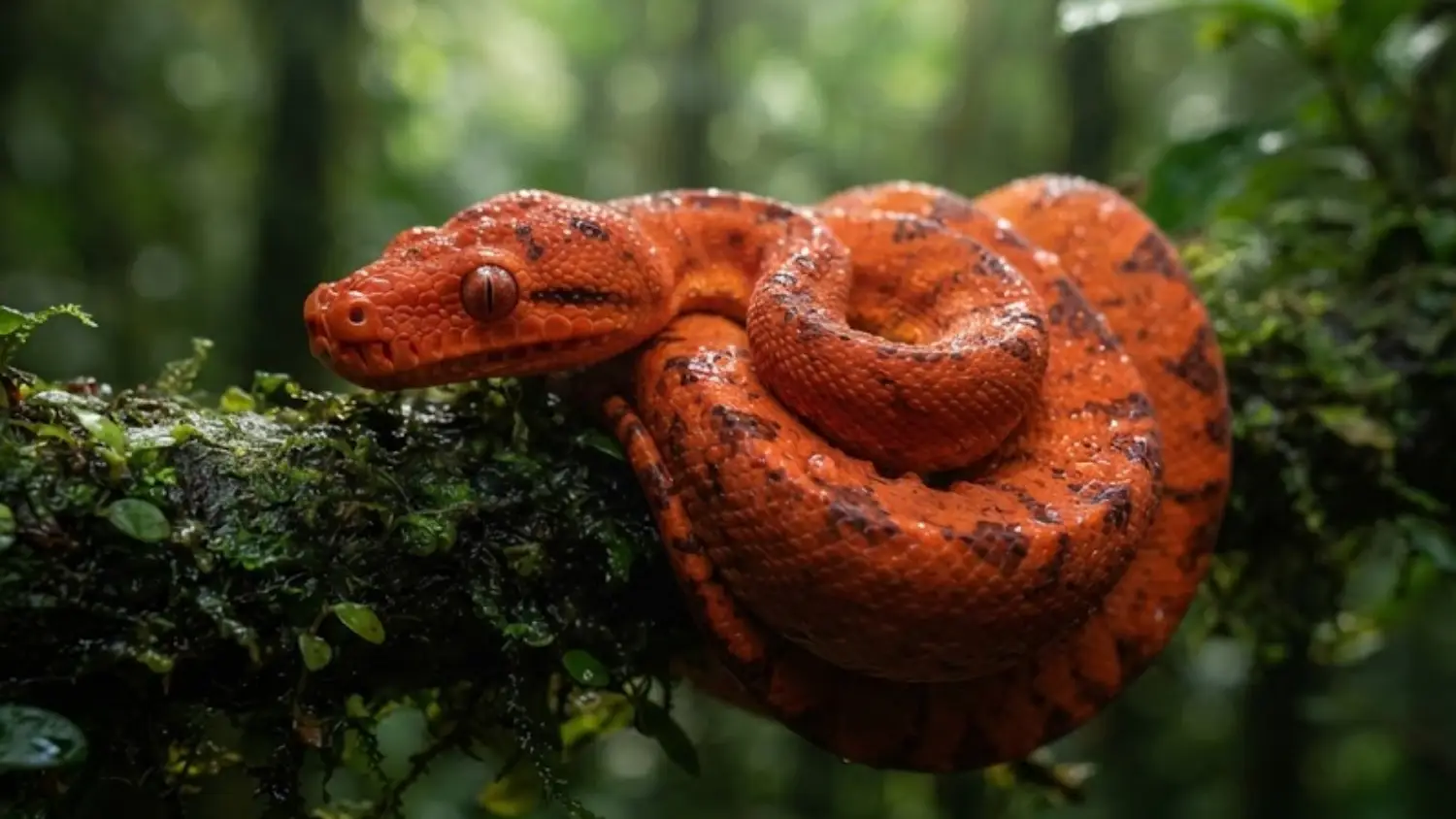
In the depths of the largest tropical forest on the planet, nature hides visual secrets that challenge the imagination and reveal genuinely ingenious survival strategies. One of the most fascinating phenomena in Amazonian herpetology involves the parrot snake, a tree-dwelling species with predominantly nocturnal habits whose body is specialized for life among the highest branches of the forest. What astonishes scientists and observers is not only its elegance as it moves through the foliage, but a radical shift in appearance: these animals change color completely over the course of their lives, in a process that refines their camouflage stage after stage.
When they hatch, the young of this species display an intense red or vivid orange coloration, a trait that contrasts sharply with the greenish, discreet appearance of the adults that fill the imagination of anyone exploring local biodiversity. This chromatic transition across the animal’s growth represents a sophisticated evolutionary mechanism designed to optimize concealment at each distinct phase of development. In other words, the snake does not keep a single disguise for its entire existence: it replaces that disguise as it changes habitat and grows in size.
Why the hatchlings are born red
The biology of this animal shows that the initial red or yellow coloration of the newborns plays a fundamental ecological role in the specific environments of low vegetation and shrubs, where the young spend their first months of life. At this early stage, the contrast with the green of the leaves may seem risky to the untrained eye, yet it works as a warning signal or as a form of mimicry linked to fallen fruits and flowers, making the young harder for visually guided predators to detect. Far from being a weakness, that glowing red is a defensive tool honed by natural selection.
As time passes and body size gradually increases, the snake changes its preferred habitat and climbs toward the higher canopy, where dense foliage demands a different camouflage strategy. It is at this point that the metabolism and the physiology of the skin come into play to promote the progressive replacement of the red pigments with scales of a brilliant emerald green. The animal then becomes perfectly blended among the treetops, where it begins to hunt its usual prey with extreme efficiency. The change of color therefore accompanies a change of life: from the undergrowth to the canopy, from red to green, from hiding among fruits to blending among leaves.
The science behind the shifting hues
The detailed study of color changes in arboreal snakes demonstrates the complexity of dermal tissues and the presence of specialized cells called chromatophores, which reflect light and control external pigmentation in a dynamic way. In the specific case of the parrot snake, this process, known scientifically as ontogenetic color change, does not happen overnight but instead accompanies each shedding of the skin throughout the first years of existence, until the animal reaches full sexual maturity. Every shed is one more step in that slow chromatic transition.
Researchers who monitor the fauna of the Amazon region point out that environmental and genetic factors work together to regulate the speed at which green replaces red, ensuring that the animal remains protected within its ecological niche at all times. This capacity shows how evolution has sculpted incredibly refined adaptive responses to guarantee the reproductive success and longevity of species that inhabit complex and highly competitive ecosystems, such as the canopy of the tropical forest.
The progressive adaptation of these snakes reflects the impressive biological plasticity that characterizes the fauna living in the most diverse tropical ecosystems on the globe. Every detail of the external and internal anatomy evolved over ages to secure the survival of these lineages in the face of intense and constant selective pressures. In an environment where a single moment of visibility can mean the difference between life and death, a body that continually retunes its own appearance is nothing less than a masterpiece of natural engineering, written over millions of years of trial and refinement.
A balance that depends on standing forest
Maintaining the ecological integrity of the forest corridors in the Amazon is an indispensable condition for the conservation of arboreal species that depend on specific microclimates and leafy trees to complete their complex life cycles. The destruction or fragmentation of native forest directly compromises the dynamics of snake populations and of their natural prey, generating imbalances that affect the entire food chain of the region. Through initiatives focused on the bioeconomy and on the sustainable management of green areas, it becomes possible to reconcile the economic development of local communities with the rigorous protection of endemic biodiversity.
Every creature that lives in the forest, from the smallest insects to the most specialized predators, acts as a pillar supporting the climatic and environmental stability of the planet, and demands from all of us a firm commitment to the conservation of natural resources. Observing the wonders of Amazonian wildlife invites us to rethink our place in the world and our shared responsibility in protecting the ecosystems that sustain life on Earth. When we understand that a biological detail such as the color transformation of a snake was shaped by millions of years of natural harmony, we realize that preserving the forest is not merely a question of environmental conservation, but an essential act of respect for the ancestral wisdom of nature itself.
Reporting: Anne Silva / Amazonia Mag. Source: revistaamazonia.com.br

Editor, English Edition — Amazonia Mag
Anne Silva is the editor of Amazonia Mag, the English-language edition of Revista Amazônia. She curates, translates and adapts the outlet's science and environment coverage for an international audience, reporting on Amazon wildlife, flora, rivers, climate and research. Every story she edits is grounded in peer-reviewed studies, official data and on-the-ground reporting from the Revista Amazônia newsroom in Belém, Pará, Brazil. More by Anne Silva →