
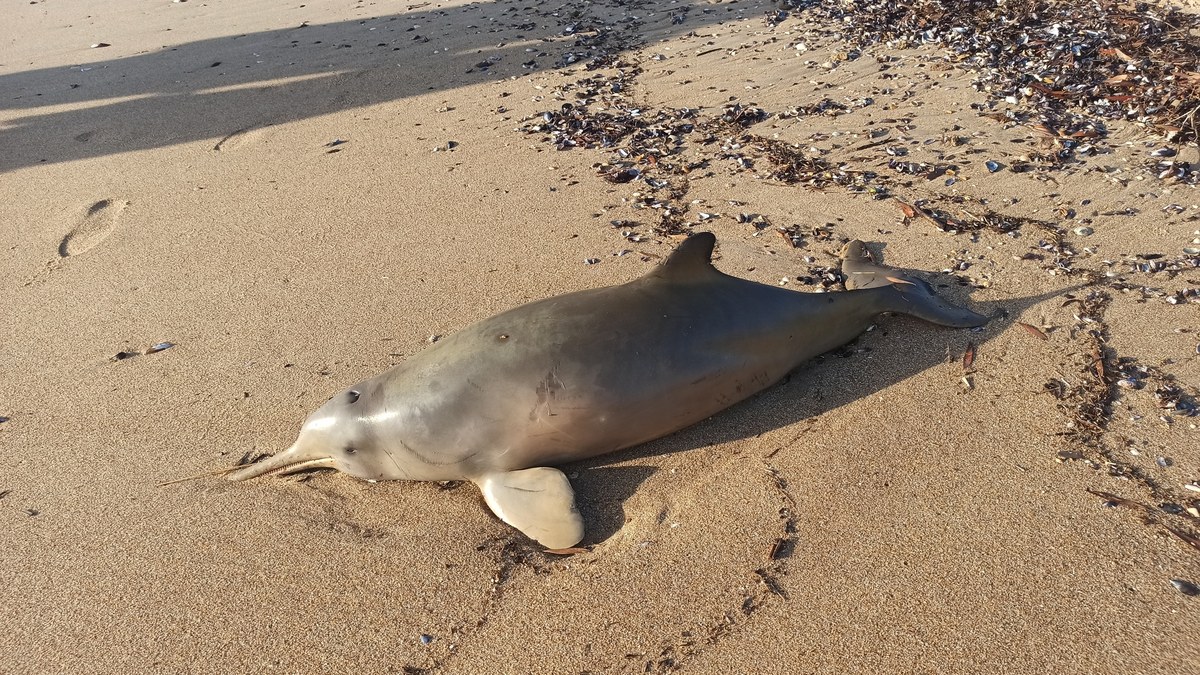
Two pups of the franciscana dolphin (Pontoporia blainvillei), known in Brazil as toninha and regarded as the most threatened dolphin in the South Atlantic, were taken in serious condition from the coast of Rio Grande do Sul to the rehabilitation center of the R3 Animal Association, in Florianópolis. The operation had an escort from the Environmental Military Police of Santa Catarina. Named Antônia and Dedé, the pups receive intensive care around the clock.
Saving a pup of this species is rare. In Santa Catarina, according to R3 Animal, the survival record for a pup in rehabilitation is 43 days.
Who Antônia and Dedé are
Antônia, the female, measures 29 inches (74 centimeters) and weighs about 11.5 pounds (5.2 kilograms). She was rescued on October 2, 2026, on the shore at Balneário Quintão, in Palmares do Sul (Rio Grande do Sul), with low blood sugar, low body temperature and the traits of a newborn. According to R3 Animal, she improved after the first treatment, but recent gastrointestinal changes still call for special care.
Dedé, the male, weighs about 12.1 pounds (5.5 kilograms) and is more active and more reactive to handling. Tests, however, showed clinical changes that need continuous monitoring.
Both had been under the care of the Center for Coastal, Limnological and Marine Studies of the Federal University of Rio Grande do Sul (Ceclimar/UFRGS), in Imbé (Rio Grande do Sul), as part of the Beach Monitoring Project of the Pelotas Basin. Both pups are young, light and facing health problems that will not be solved in a few days.
A trip planned to reduce stress
The transfer was done in stages. The pups traveled in mobile rescue units, with a strategic stop in Laguna (Santa Catarina), at the Zoology Laboratory of the Santa Catarina State University (Udesc). Breaking the trip into stages is part of the plan: the pups were not asked to cover the whole distance in a single leg. The route had an escort from the 3rd Company of the 1st Environmental Military Police Battalion of Santa Catarina, and the Federal Highway Police were notified in advance.
In Florianópolis, the pups stay in rehabilitation tanks at the R3 Animal facility in the Rio Vermelho State Park. The team gives medication, hydration and nutritional support, and monitors behavior, clinical signs and water quality on a continuous shift.
The reason for so much planning is the animal itself. Franciscana dolphins are fragile and very sensitive to stress, so every stop, every hour on the road and every change of environment has to be weighed against the benefit of reaching a center with the right equipment.
Why it is so hard to save a pup
Franciscana dolphins are delicate animals. A newborn pup depends completely on its mother in the wild. In the case of Valentino, a pup rescued in Florianópolis at the end of 2024, feeding was a milk-based formula made specifically for dolphins, given every 45 minutes, including through the night. He survived 43 days, the record for a pup of the species in rehabilitation in Santa Catarina, according to R3 Animal.
“It is a very fragile species and sensitive to stress. Because this is a newborn pup, the probability of surviving outside its environment is low,” Emanuel Ferreira, operations manager of the monitoring project at R3 Animal, explained at the time.
A schedule like that shows what intensive care means for a tiny dolphin. There is no day or night in it: the same feeding, the same observation and the same water control repeat around the clock, with a team willing to keep going through the hours when nothing seems to change.
The most threatened dolphin in the South Atlantic
The franciscana is a small dolphin with a long, thin beak. It lives only in coastal, shallow waters of Brazil, Uruguay and Argentina. It is discreet and rarely seen from the beach. The main threat is accidental capture in fishing nets, which places the species among the most threatened cetaceans in the region.
That combination explains why each stranded pup carries weight beyond its own fate. A species that lives so close to shore, and that depends so much on its mother in its first stage of life, has little room to lose animals.
Found a stranded dolphin? What to do, and common questions
If you find a stranded dolphin, follow these steps: do not try to put the animal back in the sea; keep people and pets away; protect the animal from the sun and avoid handling it unnecessarily; do not cover the blowhole on top of the head; and call the rescue teams in your region or the Environmental Military Police immediately.
What is the franciscana dolphin? A small coastal dolphin of Brazil, Uruguay and Argentina, regarded as the most threatened in the South Atlantic.
Where are the pups now? At the rehabilitation center of the R3 Animal Association, in the Rio Vermelho State Park, in Florianópolis.
Why not put a stranded dolphin back in the sea? Because the animal may be sick or injured and needs veterinary evaluation before any release.
What is the biggest threat to the franciscana? Accidental capture in fishing nets.
The team keeps assessing the condition of the two pups day by day. Recovery, if it comes, will be long.
Reporting: Revista Amazônia newsroom / Amazonia Mag

Editor · Amazonia Mag
Anne Silva is the editor of Amazonia Mag, the English-language edition of Revista Amazônia. She curates, translates and adapts the outlet's science and environment coverage for an international audience, reporting on Amazon wildlife, flora, rivers, climate and research. Every story she edits is grounded in peer-reviewed studies, official data and on-the-ground reporting from the Revista Amazônia newsroom in Belém, Pará, Brazil. More by Anne Silva →