
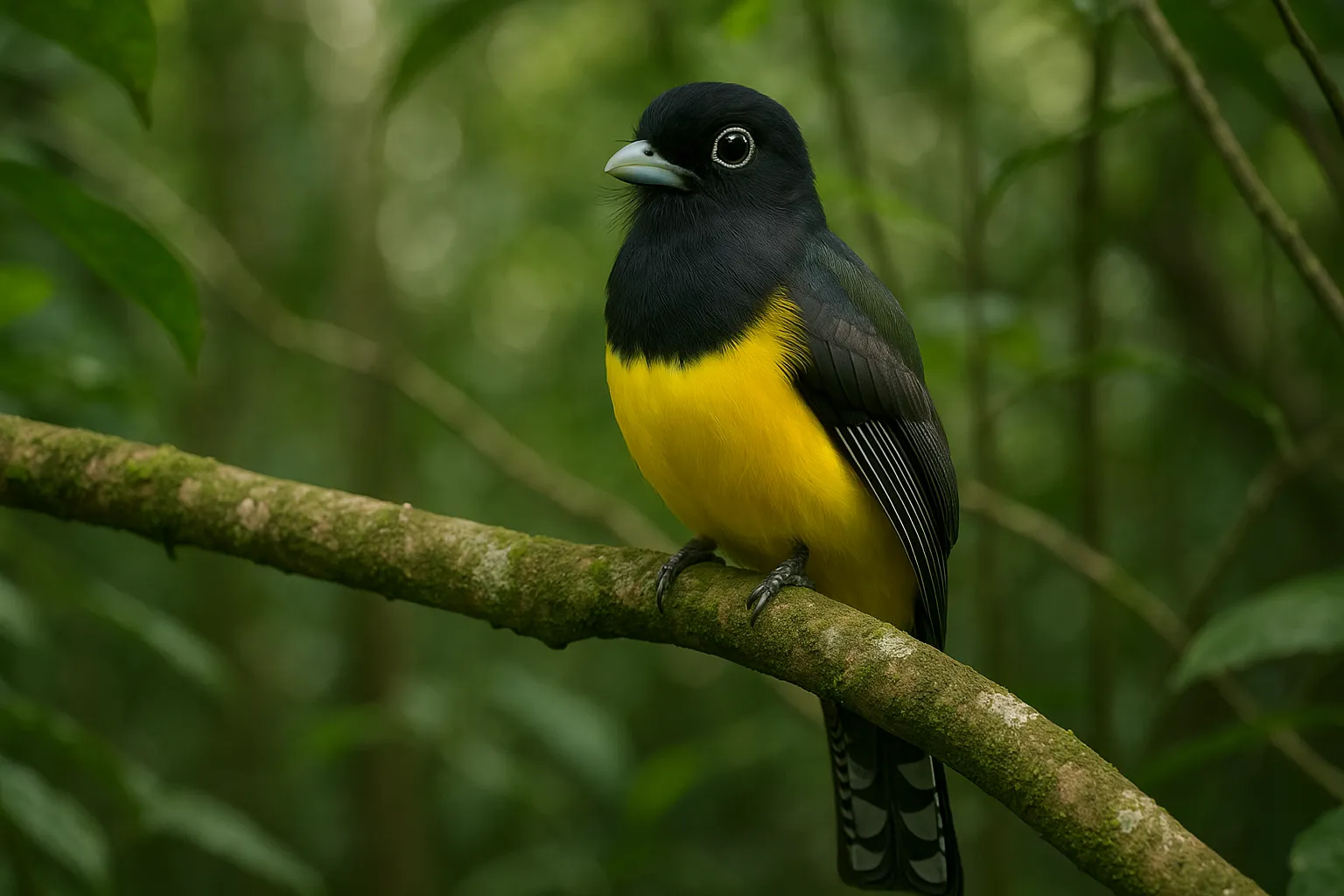
In the heart of Brazil’s densest forests, a bird of singular beauty lives among the high branches and silent shadows: the black-throated trogon, which Brazilians call surucuá-de-barriga-amarela. Its name may sound exotic, but its looks are even more striking, with a golden breast, a dark head and a barred tail. It seems like a living painting. Even so, anyone who has seen it in the wild knows it is a rare privilege. The difficulty of finding it is not only a challenge for birdwatchers: it reflects much deeper questions about the environment and the survival of species.
Beauty camouflaged in the foliage
The black-throated trogon (Trogon rufus) is a bird of the family Trogonidae, known for its vibrant plumage but also for its discretion. Unlike many colorful birds that show off on high perches or with flashy behavior, this trogon prefers to live in the shade. It inhabits closed forest, mostly in areas of dense cover where sunlight barely penetrates. That trait makes it practically invisible to a casual glance, despite its intense colors.
Its behavior is also extremely quiet. Its song, when it gives one, is low, monotonous and short, more like a call that blends into the ambient sounds of the forest. The result is that it can be very close, a few yards away, and still nobody sees it.
There is a physical reason for that paradox. Bright plumage works as a signal in full light, but inside a closed forest the light arrives filtered and broken up, and colors fade among patches of shadow. For a bird that also stays motionless, simply not moving is enough to vanish.
A species that depends on mature forest
Much of the difficulty in spotting the black-throated trogon comes from the destruction of its habitat. The species depends on mature, continuous forest to feed and breed. The Atlantic Forest, one of the regions where it lives, has lost more than 85% of its original vegetation to urban, agricultural and industrial expansion. The bird is not limited to that biome: its range covers several forest regions of tropical America, and the IUCN rates it Least Concern globally. But local forest loss remains a recognized threat.
With the forest fragmented, the trogon struggles to hold its territories. That shrinks populations and pushes the bird to withdraw even further. Species that are this selective about their surroundings are the first to feel the effects of degradation, which is why their presence, or absence, works as a thermometer of forest health.
The discreet way it feeds
Another reason it is so hard to observe lies in its feeding habits. It eats mainly insects and small fruits, which it usually catches in short, almost invisible flights. Unlike birds such as toucans, which move in groups and make noise while feeding, the trogon acts stealthily. It stays motionless for long periods before grabbing its prey and quickly returns to the same branch.
That ambush technique makes energetic sense: instead of spending effort chasing insects, the bird waits for one to come within reach. It is a quiet and economical method, but it leaves the bird with almost no visible movement. Its preference for the middle and upper canopy makes it harder still for anyone walking on the forest floor to see it.
Secretive breeding and well-placed nests
Besides being discreet when feeding, the trogon is reserved when it breeds. Trogons as a family nest in cavities: in tree hollows, in rotting trunks or in termite nests, sometimes many feet above the ground. These sites offer safety from predators, but they also keep the nests from being found easily.
During the breeding period, the pair becomes even more reclusive, calls less and stays in rarely visited areas. That behavior is a real challenge even for experienced researchers, who often manage to follow the species only through occasional records.
A central problem for this bird is the lack of information about it. Because it is so hard to find and study, large gaps remain in what is known about its behavior and population patterns. That makes it harder to design public policies aimed specifically at protecting it. In other words, the difficulty of finding the trogon also limits our ability to help it survive.
It is a familiar loop in conservation. What is not seen is studied little, and what is studied little receives few concrete measures. Breaking that loop takes patience, time in the field and the protection of the forests where these birds still hide.
How to help
Even if you have never seen a black-throated trogon in the wild, you can help conserve it in simple but effective ways. The first is to support tropical forest conservation projects, whether through organizations, donations or simply by sharing reliable information on the subject.
Another way is to avoid consuming or buying wild animals, directly or indirectly. That includes not visiting places that exploit birds without authorization or in irregular captive conditions.
Finally, cultivating curiosity and admiration for these species is a powerful step. The more people know the black-throated trogon exists and why preserving it matters, the better the chances that it will keep living in our forests for many generations.
The black-throated trogon teaches that not all beauty wants to be noticed. Sometimes it prefers silence, shade and the shelter of the forest. And that delicacy deserves to be protected with even more care.
Reporting: Revista Amazônia newsroom / Amazonia Mag

Editor · Amazonia Mag
Anne Silva is the editor of Amazonia Mag, the English-language edition of Revista Amazônia. She curates, translates and adapts the outlet's science and environment coverage for an international audience, reporting on Amazon wildlife, flora, rivers, climate and research. Every story she edits is grounded in peer-reviewed studies, official data and on-the-ground reporting from the Revista Amazônia newsroom in Belém, Pará, Brazil. More by Anne Silva →