
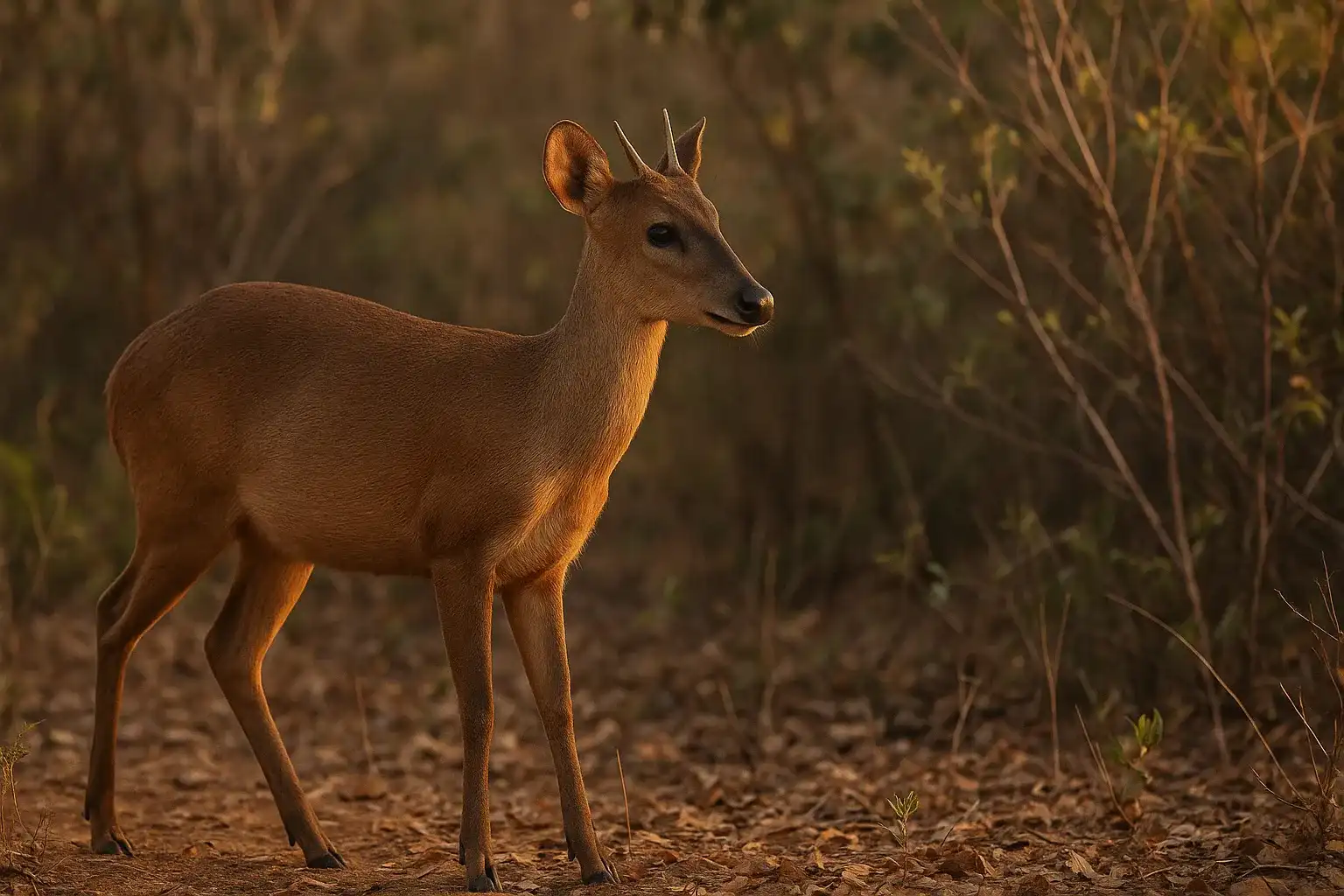
Among the dry leaves of the cerrado and the understory of little-explored forests walks one of Brazil’s most discreet animals: the gray brocket, known there as the veado-catingueiro. Although it often goes unnoticed by hurried eyes, this small deer plays a quiet but decisive role in the ecological balance of the ecosystems where it lives. Understanding its importance means looking more closely at the machinery that sustains the biodiversity of the country’s most threatened biomes.
The gray brocket and its role in the ecosystem
The gray brocket (Mazama gouazoubira) is a small species typical of open areas such as the cerrado, the caatinga and forest edges. It is solitary and tends to be most active around dawn, dusk and at night, so it is rarely seen, even in places where it is relatively common. Its discretion, however, does not reflect the scale of its ecological role.
This deer is a natural seed disperser. By eating a wide range of fruits, it helps plant species spread to different points of the territory. That action is fundamental to the natural regeneration of vegetation, especially in areas hit by fire or selective deforestation.
The mechanism is simple. A plant cannot move, but the animal that eats its fruit can: it carries the seeds along and drops them far from the parent plant, in places where they may sprout with less competition. Its diet also helps keep plant populations balanced, preventing some species from becoming dominant and smothering others.
A bridge between species
Another important role of the gray brocket is to serve as a link in the food chain. As prey for large native carnivores, among them the puma and the ocelot, it takes an active part in the predator-prey dynamic. That natural balance is essential for keeping both ends of the chain healthy: the predators and their prey alike.
A large cat needs medium-sized animals to feed on. If prey are missing, predators suffer, and when predators disappear, prey can multiply unchecked and put pressure on vegetation. A species like the brocket, sitting at the center of that web, supports the system from both sides.
By moving between open habitats and denser forest, the gray brocket also favors exchange between different ecosystems. As it travels it may carry seeds and other organisms from one side to the other, adding to the complexity and biological richness of the whole territory where it lives.
Adaptation and resilience
One of the gray brocket’s most notable traits is its ability to adapt. Even with growing habitat fragmentation and ever more intense human presence, it manages to survive in areas of secondary vegetation, gallery forests, pastures and even plantations. But that adaptability should not be mistaken for security.
Its presence in degraded areas can often be a warning sign: the original environment is in decline and the deer is hanging on as best it can. The species’ future depends directly on keeping connected native areas, with enough vegetation to provide food, shelter and escape routes.
Put differently, an animal still being there does not mean the place is healthy. A deer crossing a pasture or a crop field can be the last trace of a forest that no longer exists, and looking only at its presence without looking at the landscape around it leads to conclusions that are too optimistic.
Conservation challenges
Although it is not currently considered threatened with extinction, the gray brocket faces severe challenges. Hunting remains a reality, both for food and because of conflicts with farming activities. In addition, road deaths and the continuing loss of habitat directly affect its populations.
Its value as an environmental indicator, meanwhile, is little recognized. The presence or absence of the gray brocket can say a lot about the health of a biome. When it disappears from a region, it is a sign that something is deeply out of balance there.
Environmental education and valuing wildlife
Promoting environmental education and valuing the gray brocket as a symbol species of the balance between cerrado and forest is a strategy that can bring practical benefits to conservation. By placing its image in campaigns, school materials and community actions, it is possible to build an emotional bond between people and the animal, something essential for changing attitudes toward nature.
It is also vital to invest in ecological corridors that let the species move safely between patches of vegetation. Such measures support genetic variability and the resilience of local populations, and they also help preserve other species that share the same habitat.
The gray brocket may look small and discreet, but its importance is huge. It acts as the gardener of the cerrado, a link in the food chain and a messenger between forests and open fields. In times of climate crisis and accelerated loss of biodiversity, understanding and protecting animals like it is more than necessary: it is urgent.
Preserving the gray brocket is, in truth, caring for a whole system that depends on its presence to keep working. It is the sign that life still beats where vegetation holds on, where forests try to regenerate and where the cerrado still breathes.
Reporting: Revista Amazônia newsroom / Amazonia Mag

Editor · Amazonia Mag
Anne Silva is the editor of Amazonia Mag, the English-language edition of Revista Amazônia. She curates, translates and adapts the outlet's science and environment coverage for an international audience, reporting on Amazon wildlife, flora, rivers, climate and research. Every story she edits is grounded in peer-reviewed studies, official data and on-the-ground reporting from the Revista Amazônia newsroom in Belém, Pará, Brazil. More by Anne Silva →