
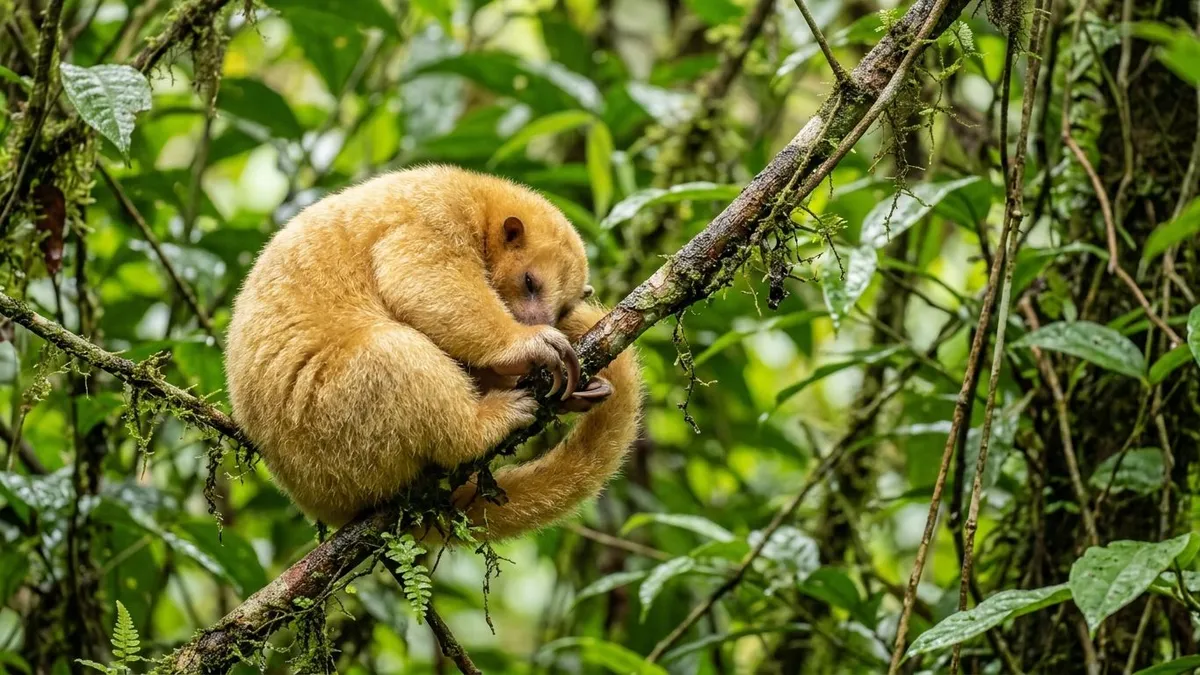
The silky anteater (Cyclopes didactylus), known in Brazil as tamanduaí, tamanduá-i, tamanduá-seda or tamanduá-cigarra, is the smallest of the anteaters. According to the species account in the ICMBio’s Biodiversity Extinction Risk Assessment System (SALVE), published in 2024 by Flávia Miranda and colleagues, the adult is rarely heavier than 14 ounces (400 grams).
The same account describes it as a little-studied species because of its cryptic, nocturnal and tree-dwelling habits: it lives in the trees and rarely comes down to the ground.
A loner that rests curled up among lianas
Silky anteaters are solitary, except for the pair formed by a female and her young and for couples that stay together for short periods in the breeding season. During the day, the animal rests in the canopy and, according to the ICMBio account, which cites Nowak (1999), it does not spend more than two days in the same resting tree. The IUCN Anteater, Sloth and Armadillo Specialist Group records that it rests curled up in the shade of lianas or of the canopy.
That combination of night activity, tiny size and hidden resting helps explain why it is so hard to see, even in places where the species exists.
Silky fur, claws and tail for a life spent hanging on
The ICMBio account describes the fur of Cyclopes didactylus as very dense and short, yellowish brown, with gray feet and tail and well-marked black dorsal and ventral stripes. It is this fur that gives the species its common name, silky anteater. According to the Animal Diversity Web of the University of Michigan, the silky fur resembles the fibers of the fruits of trees of the genus Ceiba, the kapok trees. That resemblance is pointed to as camouflage against sharp-eyed predators such as the harpy eagle.
The Animal Diversity Web also describes how the animal defends itself when threatened: it rises on its hind legs, anchors itself to the branch with its feet and tail, holds its forelimbs close to its face and strikes quickly with its large claws.
The silky anteater’s forelimb has two long claws, on the second and third digits, and the hind limb has four long claws, according to the ICMBio account, which cites Emmons and Feer (1990). The tail is long, prehensile and hairless on its underside. The same account, relying on Dickman (1984), reports that a joint in the sole of the foot allows the claws to fold back, which, together with the tail, helps the animal cling to branches.
Ants that live in lianas and branches
The preferred food is ants that live in liana stems and branches, according to ICMBio, which cites Best and Harada (1985), Montgomery (1985) and Miranda and colleagues (2009). Beetles appear in smaller proportions in the diet. Analyzing the stomach contents of two individuals captured on São Luís Island in Maranhão, Miranda and colleagues found fragments of four ant genera: Camponotus, Dolichoderus, Pseudomyrmex and Solenopsis.
The Animal Diversity Web describes the animal as opportunistic: it searches for food in the canopy and raids ant nests with its long, sticky tongue. The source estimates an average consumption of 100 to 8,000 ants a day, a wide range.
Low metabolism, a small range and a single young
The silky anteater’s low metabolic rate translates into a body temperature of about 91 degrees Fahrenheit (33 degrees Celsius) and a reduced ability to regulate heat, according to McNab (1985), cited by ICMBio. That limit restricts the species to forests below 4,900 feet (1,500 meters) in elevation.
In a study on Barro Colorado Island in Panama, Montgomery (1985) estimated the home range of an adult male at 27 acres (11 hectares), against an average of 6.9 acres (2.8 hectares) for females. The male he followed overlapped his territory with that of two females, but not with that of other males.
Gestation lasts 120 to 150 days and results in a single young. According to the ICMBio account, which cites Eisenberg and Redford (1999), parental care is intense. According to the Animal Diversity Web, the female leaves the young in a nest of dry leaves inside a hollow in a trunk, both parents feed it with semidigested insects they regurgitate, and the male sometimes carries the young on his back.
Seven species and a threatened population in the Northeast
For a long time, the genus was treated as a single species. In a taxonomic revision published in 2018 in the Zoological Journal of the Linnean Society, Flávia Miranda and colleagues analyzed mitochondrial and nuclear DNA, skulls and fur patterns of more than 280 museum specimens and concluded that the genus Cyclopes includes at least seven species. The name Cyclopes didactylus was left restricted to part of the range.
In Brazil, according to ICMBio, Cyclopes didactylus occurs on the right bank of the Amazon River, in Pará, and in the states of Maranhão and Piauí. There is also an isolated population in the Atlantic Forest of the Northeast, separated from the Amazonian one by about 620 miles (1,000 kilometers). The species is classified as Least Concern (LC) because the Amazonian subpopulation, which makes up most of the total, does not face major threats. The Northeastern one, with a very restricted and fragmented distribution, could be classed as Vulnerable, according to the account.
The main threats pointed out by ICMBio are agriculture, deforestation, habitat disconnection and capture for the illegal trade. In the Amazonian portion, habitat loss within the area of occurrence was estimated at 4.1% over the last 20 years, according to an ICMBio calculation based on MapBiomas data. In the Atlantic Forest of the Northeast, according to ICMBio, the species does not survive when the original forest is converted into sugarcane fields and other crops.
Reporting: Natália Santos / Amazonia Mag

Editor · Amazonia Mag
Anne Silva is the editor of Amazonia Mag, the English-language edition of Revista Amazônia. She curates, translates and adapts the outlet's science and environment coverage for an international audience, reporting on Amazon wildlife, flora, rivers, climate and research. Every story she edits is grounded in peer-reviewed studies, official data and on-the-ground reporting from the Revista Amazônia newsroom in Belém, Pará, Brazil. More by Anne Silva →