
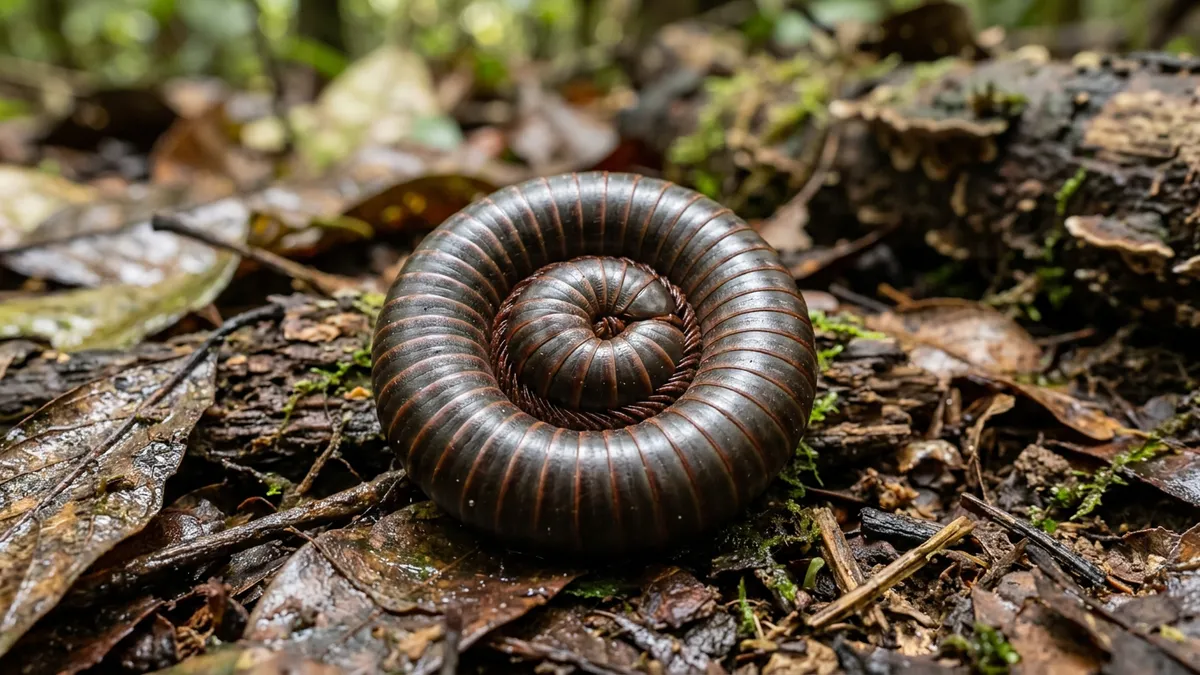
When a millipede feels threatened, it curls its segmented body into a tight spiral. The move shrinks the exposed surface, keeps the soft underside tucked inward and turns the harder outer parts of the body toward whatever is trying to attack. The posture works as a physical barrier before any contact even happens.
The defense can be backed up by glands that release an irritating substance. The compound does not rely on a bite or a stinger: it comes out through structures along the sides of the body and can drive off an animal that tries to handle the millipede. The same creature that reacts to danger this way spends much of its time chewing dead leaves, an activity that breaks organic matter into pieces and contributes to soil formation in the forest.
The spiral closes off the most vulnerable surface
A millipede’s body is made of many jointed segments, which lets it bend progressively. As it begins to curl, it reduces the gaps through which it could be reached and brings the two ends of the body closer together. The ventral side, which lacks the rigid protection of the outer surface, ends up facing the inside of the spiral.
This movement is not an attack. It is a form of withdrawal that makes it harder for a predator to bite or pierce the animal. The posture also limits access to the legs and other moving parts. The millipede can stay motionless while it gauges whether the threat is still nearby, saving energy and avoiding movements that might draw even more attention.
An irritant without a bite or a stinger sends the predator a signal
Millipedes have defensive glands linked to openings along the sides of the body. When the animal is pressed, touched or threatened, these structures can release a secretion with an irritating effect. The composition varies among the different groups of millipedes, but the general purpose is the same: to make contact unpleasant for whoever is trying to catch one.
The substance does not work like an injected venom. The millipede does not need to pierce a predator’s skin to defend itself, because the secretion acts on the surface it touches and can cause irritation. The combination of a body coiled shut and a chemical compound creates two difficulties at once, one mechanical and one sensory.
On finding a coiled millipede, a predator may try to sniff it, bite it or lift it off the ground. Contact with the irritating secretion changes the outcome of that attempt. Instead of an easy prey item, the predator meets a protected surface and a chemical stimulus that can cause discomfort, which may lead it to drop the animal and give up.
The response requires no chase and no prolonged confrontation. The millipede stays compact during the moment of greatest risk and can wait until the predator moves away. This strategy is especially useful for a slow-moving animal that cannot rely on speed to escape every threat it meets in the layer of leaves covering the forest floor.
A slow decomposer inside a chain of relationships
The millipede takes part in decomposition by cutting and grinding dead leaves with its mouthparts. It does not turn an entire leaf into soil on its own, but it reduces the size of the material and changes its structure. After this fragmentation, microorganisms and other decomposers can work on the plant remains more easily.
That activity is what makes the chemical defense relevant to how a forest functions. By surviving long enough to keep feeding, the millipede maintains its contribution to nutrient cycling. The protection does not serve only to preserve one individual: it helps keep running a discreet stage in the processing of the organic matter that piles up on the ground.
In the leaf litter, the millipede finds shelter, moisture and food. Fallen leaves form a layer with different stages of decay, and the animal takes part in transforming that material by scraping and fragmenting it. What remains after it has fed stays available to fungi, bacteria and other organisms living in the soil.
At the same time, the millipede is part of the diet of animals that hunt small invertebrates in the forest. Its defense does not make it untouchable, but it raises the cost of catching it. Predators may learn to avoid millipedes or pick individuals that are less well protected, while the species remains connected to the flows of energy that run through the leaf litter.
How a small defense fits into the life of the forest floor
The behavior takes place mainly in the microenvironment where the millipede lives and feeds, among leaves, decaying twigs and soil particles. The moisture of the leaf litter favors the activity of many decomposers and also provides cover for an animal that needs to conserve water and avoid direct exposure.
As long as the layer of dead material stays on the ground, the millipede has the conditions to carry out its ecological role. Its presence links individual defense to the dynamics of the environment: the same body that closes up to escape a predator also returns to the leaf litter to fragment leaves. On the forest floor, protection and decomposition are part of the same cycle.
The millipede shows that an efficient defense does not have to turn an animal into a hunter or a fighter. Curling up, shielding the underside and releasing an irritating substance is enough to create a pause in front of a predator. That pause preserves a small, slow organism that is tied to the ground, where dead leaves stop being mere remains and enter the forest cycle again.
Watching this mechanism is a way of seeing that life in the soil depends on little-noticed actions, repeated between one threat and the next. A spiral on the leaf litter may look like nothing more than a stopped animal. In fact it is a defense in progress, and it is also a step in the slow work that returns nutrients to the forest.
Reporting: Natália Santos / Amazonia Mag

Editor · Amazonia Mag
Anne Silva is the editor of Amazonia Mag, the English-language edition of Revista Amazônia. She curates, translates and adapts the outlet's science and environment coverage for an international audience, reporting on Amazon wildlife, flora, rivers, climate and research. Every story she edits is grounded in peer-reviewed studies, official data and on-the-ground reporting from the Revista Amazônia newsroom in Belém, Pará, Brazil. More by Anne Silva →