
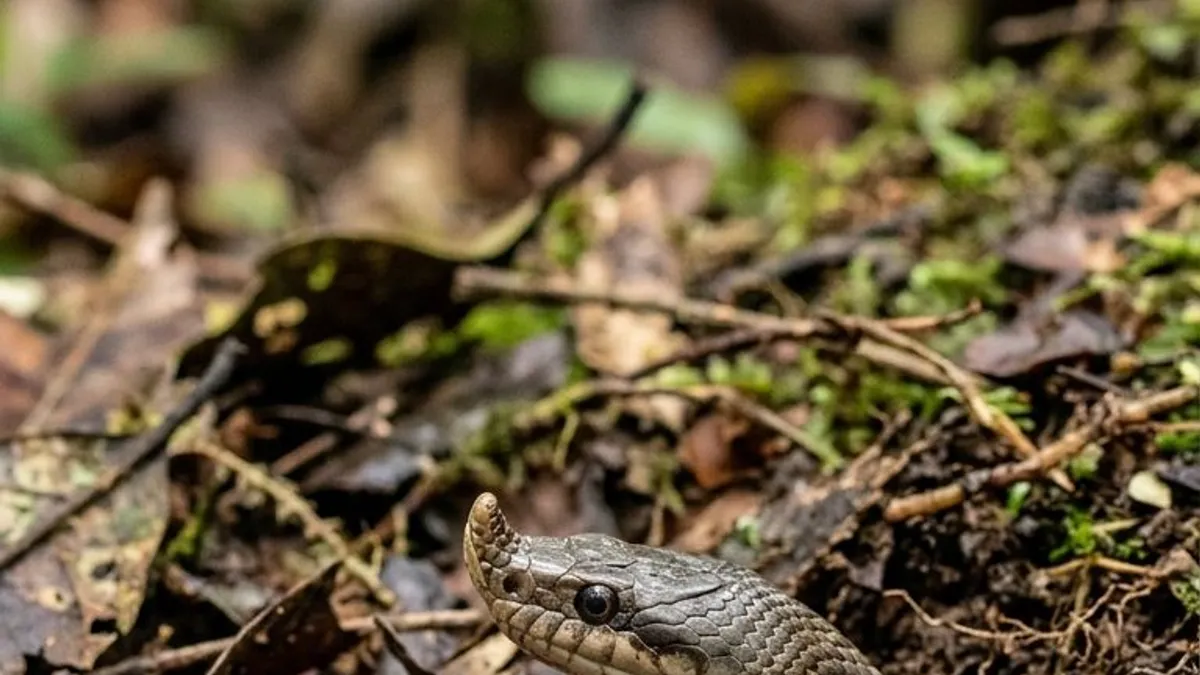
The snout rises at the tip of the head and turns the cobra-nariguda, a hognose snake, into a specialized digger. On finding a toad hidden in the ground, it uses this modified part of the face to clear away the material covering the prey and reach an animal that is not exposed at the surface. The same snake can also eat toxic toads, a food source that demands physiological resistance to the substances the prey produces.
The behavior brings together three traits that usually appear separately in other predators. The modified snout works in the search, physiological tolerance allows the snake to cope with the toad’s toxins, and the defensive response changes the outline of the body when there is a threat. The snake also has the Duvernoy’s gland, a structure associated with the production of oral secretions, and flattens its neck to look wider in front of a possible attacker.
The snout works as a digging tool
In the cobra-nariguda, the snout does not serve only to lead the head as the snake moves. Its raised tip favors contact with the ground and lets the snake push, clear or shift the cover that hides a toad. The movement concentrates the action in the front part of the body, while the rest of the snake stays braced and ready to advance. This combination gives it access to prey that is buried or partly covered.
The modified snout also helps explain why the species does not rely only on finding toads walking in open areas. Toads can stay under leaves, loose soil or other material close to the ground. By working those spots, the snake uses the anatomy of its head as a search tool. What matters is not just the shape of the nose, but the relationship between that shape, the digging behavior and a diet based on animals that may stay out of sight.
Resistance lets it catch prey that makes toxins
Toxic toads are not easy prey. Many toad species release substances through the skin, especially when squeezed or bitten. For a predator with no tolerance to these compounds, an attempt at capture can end in irritation, physiological disturbance or abandoning the food. The cobra-nariguda, however, shows physiological resistance to the toxins of its own prey. This trait opens a food source that other animals may avoid.
Resistance does not mean the toad is harmless or that its toxins disappear. It means the snake’s body can withstand the effects that would make the prey dangerous to other predators. Capture still requires direct contact with the toad’s skin and its secretions. That is why the behavior combines internal tolerance and predatory adaptation. The snake not only locates the toad but also manages to complete the sequence of capture and swallowing.
The Duvernoy’s gland takes part in the capture system
The cobra-nariguda has the Duvernoy’s gland, a structure found in several snakes and linked to the production of oral secretions. It should not automatically be treated as equivalent to the injection apparatus of a viper. The gland is part of the set of resources used during feeding, but its presence alone does not allow us to say that the snake injects venom in the same way as a rattlesnake or a lancehead.
This distinction matters because the snake’s prey produces toxins of its own, while the snake has secretions associated with the process of capture and digestion. They are different systems, with different origins and functions. The physiological resistance described for the cobra-nariguda is tied to its ability to cope with the substances of the toad, not to a supposed general immunity to any venom. Its oral anatomy should be seen in that context, without turning the species into a typical venomous snake.
The flattened neck changes its look under threat
When it feels threatened, the cobra-nariguda flattens its neck. The movement visually enlarges that region and changes the profile of the head, making the animal look wider than it does when relaxed. This is a defensive response based on posture, not a permanent change in anatomy. By changing the outline of its body, the snake signals that it has been detected and tries to discourage anyone from coming closer.
The flattening also shows that the digging snout is not the only visible adaptation of the species. The head takes part both in the search for food and in defensive signaling. At one moment, the snout is aimed at the ground to uncover a toad; at another, the neck spreads sideways in the face of a threat. The sequence reveals a snake that combines form and behavior for different tasks, without relying only on speed or strength to survive.
A strategy tied to environment and diet
By pulling toads out of their hiding places, the cobra-nariguda links the surface of the soil to the food chain. The predator exploits a resource that stays available even when the toad is not moving in the open. Its tolerance of toxins widens this opportunity, while the raised snout lowers the difficulty of reaching the prey. The result is a feeding strategy based on locating, digging up and eating animals protected by skin secretions.
This relationship also helps show why a snake’s anatomy cannot be read in isolation. A different snout makes sense when it is used for digging; physiological resistance makes sense when it allows a toxic toad to be eaten; and a flattened neck makes sense when it appears as a defensive response.
Taken together, the cobra-nariguda has a snout modified for digging, feeds on toxic toads, resists the toxins of its prey, has a Duvernoy’s gland and flattens its neck when threatened. A small lift at the tip of the snout can open the soil, physiology can neutralize a feeding risk, and a change in the neck can transform a silhouette. In nature, survival often depends on this precise combination of structure, habit and the limits of one’s own body.
Reporting: Natália Santos / Amazonia Mag

Editor · Amazonia Mag
Anne Silva is the editor of Amazonia Mag, the English-language edition of Revista Amazônia. She curates, translates and adapts the outlet's science and environment coverage for an international audience, reporting on Amazon wildlife, flora, rivers, climate and research. Every story she edits is grounded in peer-reviewed studies, official data and on-the-ground reporting from the Revista Amazônia newsroom in Belém, Pará, Brazil. More by Anne Silva →