
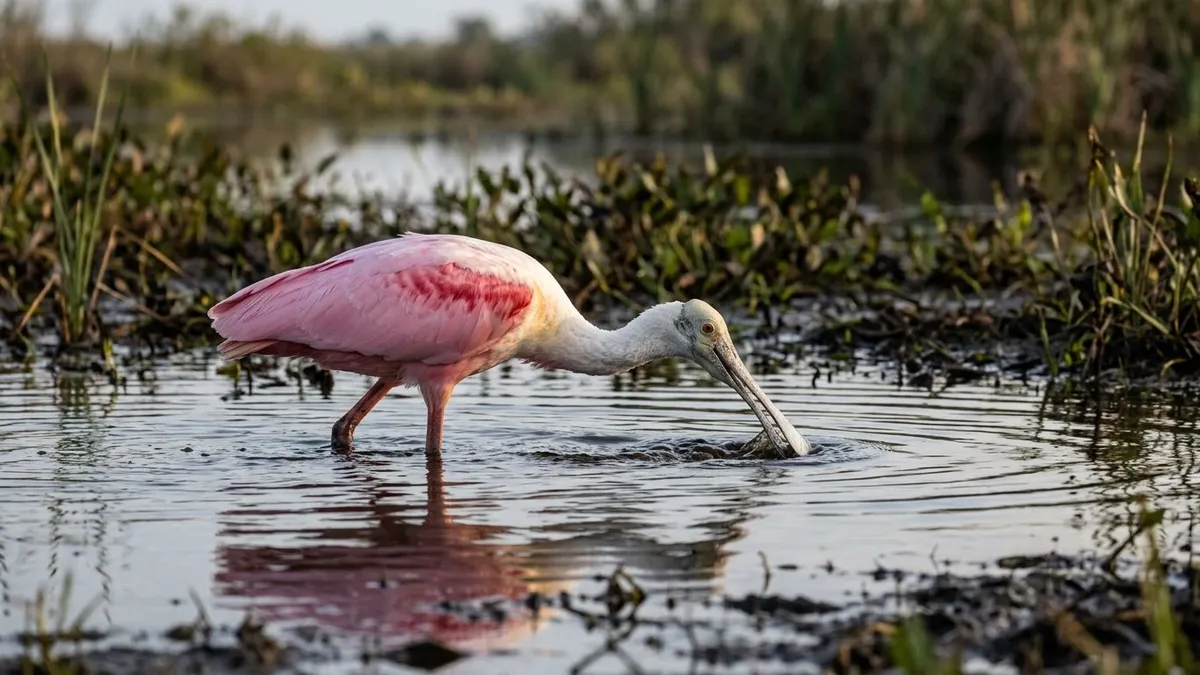
The roseate spoonbill (Platalea ajaja), known in Brazil as colhereiro, catches small aquatic animals without relying on sight alone. It dips its spoon-shaped bill into the water, sweeps it from side to side and snaps the two halves shut when an organism is felt by touch. The movement turns the tip of the bill into a sensory area that keeps working even when the water is murky.
This mechanism combines sweeping, tactile perception and a reflex closing. The strategy lets the bird explore shallow environments where visibility is limited by sediment, organic matter or the bird’s own movement. The pink color of the spoonbill is also tied to its way of life, since it comes from a diet rich in crustaceans and other foods that supply pigments to the plumage.
How the bill turns water into a search area
The spoonbill’s bill is long, flat and widened at the end, like a spoon. While foraging, the bird keeps the tip partly submerged and moves it sideways. This motion increases the area examined at each pass and makes the water circulate around the sensory surfaces of the bill.
Tactile receptors in the structure detect contact with a possible prey item. The response does not require the spoonbill to see the animal clearly. When it feels the touch, the bill closes by reflex, trapping the organism between its two parts. The behavior is different from a visual, targeted capture, because the bird does not need to aim precisely at each prey item before closing its bill.
The mechanism depends on coordination between the sweeping movement and the muscular response of the bill. While the bird moves its head, the two halves stay open or partly apart. When contact occurs, the tactile information triggers the closing, which shortens the interval in which the prey could escape.
This is useful because water distorts vision and makes it hard to identify small animals. The bird does not have to stop its search to inspect every point of the environment. It keeps up a continuous motion, receives signals through the tip of its bill and reacts when it meets something that fits as food. Afterward, it lifts its head and swallows what it has caught, separating the search stage from the swallowing stage.
The spoonbill explores murky waters where vision loses efficiency
Shallow, murky waters can hold suspended particles, leaves, twigs and other materials that reduce transparency. In such places, a bird that depended on spotting each prey item visually would have more trouble keeping up an efficient capture. The spoonbill gets around part of this problem by using its bill as an instrument of contact.
The strategy works in flooded areas, margins and other shallow aquatic environments, as long as there is room for the bird to move its head sideways. The bill does not serve only to pick up food at the surface. It also lets the bird probe the water while it walks or stays in a thin layer of water. In this way, turbidity stops being just a barrier and becomes a condition in which the sense of touch gains importance.
The spoon shape widens the sweep
The wide end of the bill creates a larger area of contact with the water than a narrow structure would. With each sideways movement, the spoonbill covers a relatively broad strip and raises its chances of finding small crustaceans, fish and other aquatic organisms. The shape also favors closing over the prey when contact happens.
The bill, however, does not work alone. The neck moves the head over and over, the legs carry the bird through shallow water and the muscles that close the bill respond to the tactile signal. The efficiency arises from the combination of anatomy and behavior. Instead of chasing each prey item individually, the spoonbill walks over an area and takes advantage of the encounters produced by its own sweeping.
Diet helps explain the pink plumage
The pink color of the spoonbill is linked to eating foods rich in carotenoids, pigments found in crustaceans and in other parts of the diet. These compounds are obtained through feeding and contribute to the color of the feathers. The shade of the bird is therefore not a detail separate from its foraging behavior, but also reveals a relationship between what it catches and the look of its body.
The intensity of the color can vary with diet, age and individual condition. This does not mean that every prey item produces the same effect, or that the bird chooses food by its color. The central point is that the environment offers resources that take part both in survival and in the formation of the plumage. By searching for crustaceans in the water, the spoonbill finds food and takes in pigments that become part of its body.
The behavior connects the spoonbill to the balance of flooded areas
By catching crustaceans and other small aquatic animals, the spoonbill takes part in the feeding relationships of flooded areas. Its activity also shows how different species use different parts of the same environment. While some birds depend on sight to find prey at the surface, the spoonbill explores the water with sideways movements and tactile perception.
This division of strategies reduces the complete overlap between animals that share a marsh, a margin or a shallow lagoon. The spoonbill turns a feature of the environment, low-visibility water, into a feeding opportunity. Watching the bird work with its bill shows that ecological efficiency does not depend on a single sense. It can come from a specialized structure, a fast reflex and a behavior adjusted to the conditions of the place.
The spoonbill is a reminder that water does not have to be transparent to support a precise search. At the tip of the bill, touch replaces part of what the eyes cannot resolve, while the sideways movement keeps the search going. The pink plumage adds another layer to the story, because it records on the body the presence of the crustaceans that feed the bird. In flooded environments, surviving can mean exploring discreet signals, reacting at the right instant and using the shape of one’s own body to find food where other senses fail.
Reporting: Natália Santos / Amazonia Mag

Editor · Amazonia Mag
Anne Silva is the editor of Amazonia Mag, the English-language edition of Revista Amazônia. She curates, translates and adapts the outlet's science and environment coverage for an international audience, reporting on Amazon wildlife, flora, rivers, climate and research. Every story she edits is grounded in peer-reviewed studies, official data and on-the-ground reporting from the Revista Amazônia newsroom in Belém, Pará, Brazil. More by Anne Silva →