
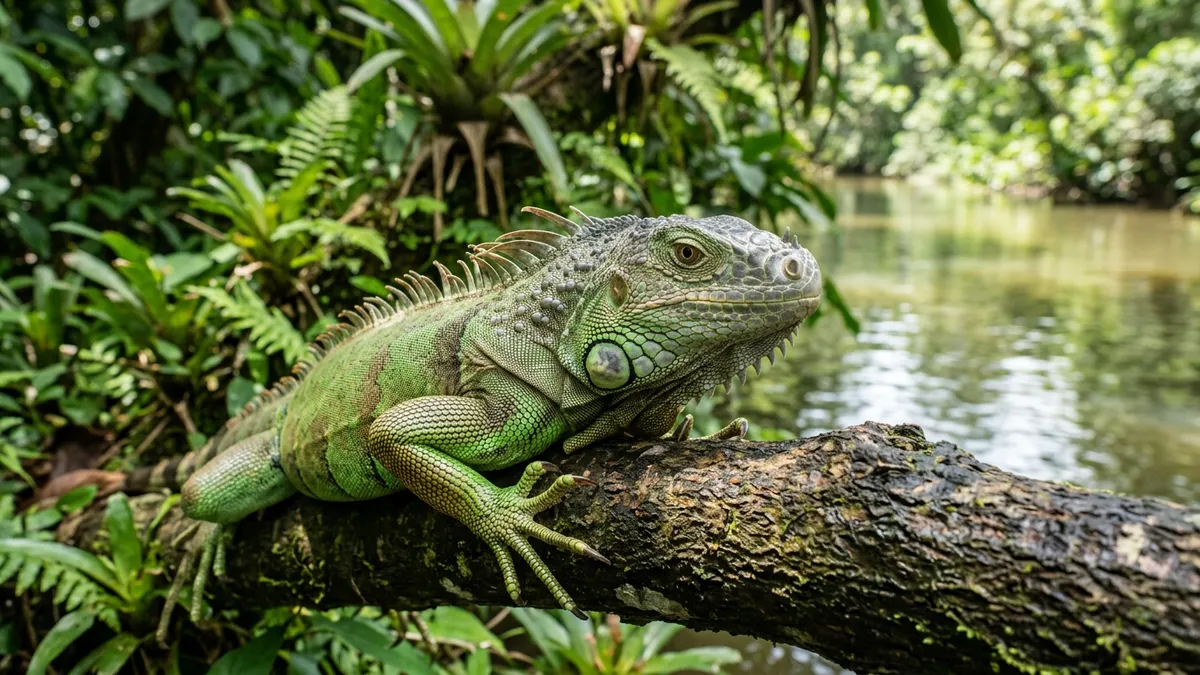
A structure on top of the head senses changes in light and helps the reptile react to threats from the sky.
On top of its head, the green iguana has a parietal eye able to perceive changes in brightness, including the shadow that crosses the field of light when a predator approaches from above. The structure does not form images the way the side eyes do. It works as a sensor associated with the pineal complex, helping the reptile notice a sudden change in its surroundings.
That perception is part of a set of responses that includes fleeing to the water, diving and swimming. Meanwhile, since it feeds mainly on leaves, the iguana keeps a community of microorganisms in its gut that ferments plant fiber. The same animal that detects a shadow overhead depends, therefore, on sensory, behavioral and digestive mechanisms to live among trees, riverbanks and tropical waterways.
How the parietal eye perceives a shadow
The parietal eye sits on the upper part of the head, under a small area of scales and skin, and is related to the pineal complex of reptiles. It contains light-sensitive cells able to register variations in light intensity. When a shadow quickly covers the area around the iguana, the contrast between the earlier brightness and the brief drop in light produces a sensory signal.
That signal is not equivalent to detailed vision of prey or predator, because the parietal eye does not have the same function as the side eyes, which are responsible for forming images. In practice, the mechanism works as an alert to a change in the environment above the body. A bird of prey or another aerial predator can cast a shadow over the iguana before the animal is reached.
The perception does not necessarily identify which species caused the shadow, but it can contribute to a quick response. On noticing the change, the iguana can stop what it is doing, look for cover, run to the water’s edge or abandon an exposed branch. The value of this sensor lies in early warning, not in visual precision.
The anatomy that links light, behavior and biological rhythm
The parietal eye is part of a sensory system connected to pineal structures, which take part in the perception of light and in organizing rhythms of the body. In reptiles, ambient light influences processes related to the daily cycle, to activity and to physiological regulation.
The position of the organ is consistent with its function: at the top of the head, it receives changes in lighting from the sky with less interference from the ground, low vegetation or the animal’s own body.
The side eyes remain essential for seeing branches, leaves, water, food and obstacles. The parietal eye adds another kind of information, based on variation in light. This division of labor helps explain why calling the structure a third eye is useful as a comparison, but does not mean that the iguana has a third camera able to produce a full image. The organ is a detector of light and shadow integrated into the nervous system, while detailed vision depends on the conventional eyes.
When the iguana escapes to the water
The iguana usually occupies trees, riverbanks and the edges of lakes or flooded areas. When it feels threatened, it can run toward the water and use swimming as an escape route. Diving also lets it disappear temporarily from the surface, reducing the chance of being reached by a predator that would attack on land or from the air.
The response does not depend only on the parietal eye, since other senses, the vision of the side eyes and the perception of movement also take part in assessing the risk.
In the water, the body and tail contribute to propulsion, while the legs help with steering. The iguana can stay submerged for some time and reappear at another point, especially where it finds a bank, root or vegetation that offers shelter. This behavior turns the landscape into part of the defense. A river is not only a source of water: it can work as an escape corridor. Banks connected to trees and hiding places widen the reptile’s options when a threat comes from above or from the ground.
Why leaves require fermentation in the gut
The iguana’s diet is predominantly herbivorous and includes leaves, shoots, flowers and other plant material, depending on what the environment offers. Leaves contain cellulose and other fibers that vertebrates cannot easily break down using only their own digestive enzymes. To make use of part of that energy, the iguana depends on microorganisms that live in the digestive tract and ferment the plant material.
During this process, bacteria and other microorganisms associated with the gut turn components of the fiber into substances that the host can use. Digesting leaves is slower and requires the animal to manage its activity, its feeding and its energy expenditure. The system lets it exploit an abundant resource, even if the immediate return is low, and reduces its dependence on animal prey.
Herbivory also influences the circulation of nutrients, because the iguana consumes vegetation and returns organic matter to the environment through its waste.
Combining several alerts, and the place the iguana lives
An aerial predator can approach at speed and limit the reaction time of an animal exposed on a branch. In that scenario, sensing an abrupt change of light can offer an advantage even before the threat clearly enters the field of view of the side eyes. The most efficient response, however, is not produced by a single organ. The light alert has to be integrated with muscles, balance and the other senses to result in escape.
The combination of shadow detection, running, climbing, diving and swimming creates alternatives depending on where the iguana is. If it is in a tree over the water, a fall or a leap can lead directly to an escape route. If it is on the ground, dense vegetation or the bank may offer protection. The behavior does not make the animal invulnerable, but it raises the likelihood of interrupting an attack.
In Brazil, the iguana occurs in tropical environments where it finds vegetation to eat and structures near the water for shelter and escape. The association with rivers, lakes and bank areas does not mean that every individual depends on exactly the same setting, but it highlights the importance of landscapes that keep trees, shrubs, banks and stretches of water connected. Losing one of these elements could reduce the options for feeding or escape that are available to the reptile.
The third eye of the iguana does not replace vision and does not announce exactly which predator is coming. It records a simple change, the passage from light to shadow, and turns it into time to react. Fermentation lets the animal extract energy from leaves, and the water offers a physical way out. Instead of a single extraordinary resource, the iguana brings together small solutions adjusted to the place where it lives.
Reporting: Natália Santos / Amazonia Mag

Editor · Amazonia Mag
Anne Silva is the editor of Amazonia Mag, the English-language edition of Revista Amazônia. She curates, translates and adapts the outlet's science and environment coverage for an international audience, reporting on Amazon wildlife, flora, rivers, climate and research. Every story she edits is grounded in peer-reviewed studies, official data and on-the-ground reporting from the Revista Amazônia newsroom in Belém, Pará, Brazil. More by Anne Silva →