
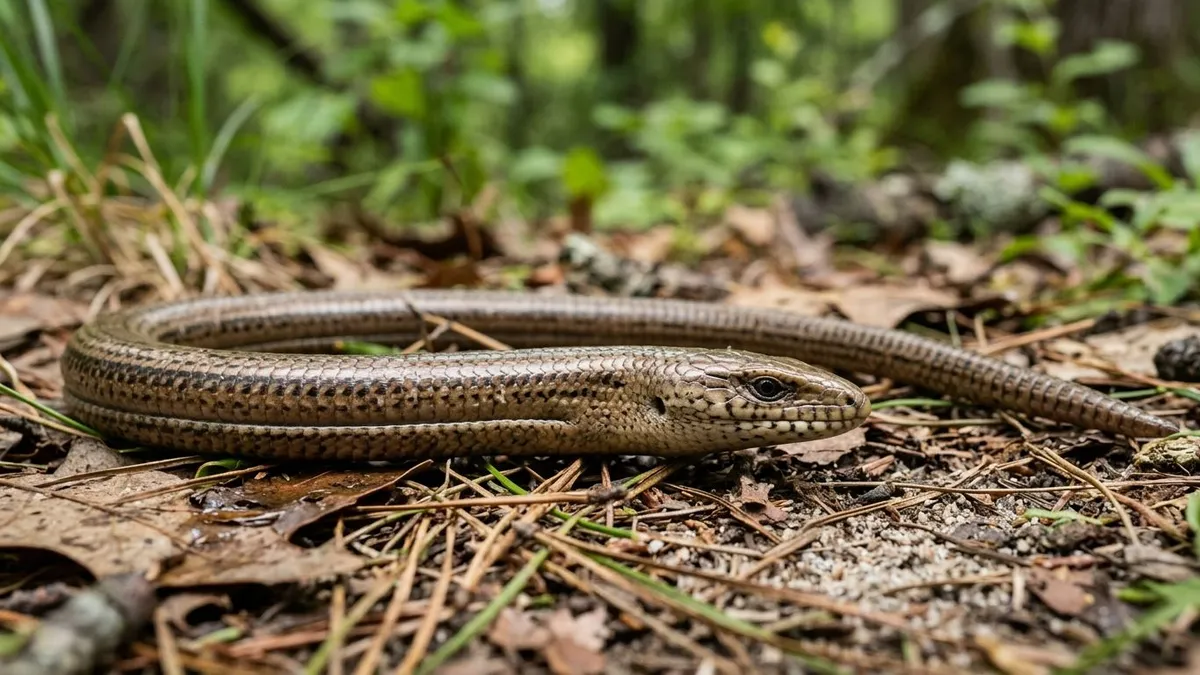
The reptile looks like a snake at first sight, but its movable eyelids and the regeneration of its tail show that it is a lizard.
A legless lizard that can still blink
Lying on the ground, the glass lizard can be mistaken for a snake because its body shows no visible limbs. The resemblance ends when the animal moves its eyelids. That detail, easy to miss for someone looking quickly, marks an important difference between the two groups: lizards have movable eyelids, while snakes do not have this movable structure over the eyes.
The absence of legs, then, does not turn the reptile into a snake. It only changes the shape the animal uses to move and hide in its environment. The long body draws the attention of whoever finds it, but a look at the eyes offers a safer clue. The popular name describes the limbless appearance, not a family relationship with snakes. Correct identification depends on a combination of traits, and not only on the long shape of the body.
The glass lizard is recognized by three elements that work together. The first is the absence of limbs, which causes the initial confusion. The second is the presence of movable eyelids, which separates it from snakes at a glance. The third lies in the tail, which can detach by caudal autotomy when the animal needs to escape a threat.
The tail breaks in several places and leaves the predator without a target
Caudal autotomy is a defensive response based on separating part of the body. In the glass lizard, the break can happen at multiple points along the tail, so that it splits into several pieces. That feature helps explain why the scene does not look like the loss of a single end.
While the tail breaks apart and keeps drawing attention, the legless animal can use the opportunity to flee. The principle is simple, but the result depends on a precise bodily sequence: the threat triggers a response, the tail separates, and the lizard leaves behind a moving distraction. For an observer, the movement of the fragments can make the scene even harder to interpret. The mechanism has a clear function: to cut off contact with the possible attacker.
The fact that the tail can split into many pieces, instead of dropping off as a single part, shapes how the defense works. One piece would leave the attacker a single thing to follow. Several moving pieces turn the tail into a distraction with more than one point of attention, while the lizard, with its long, limbless body, slips away. The cost is real, since the animal gives up part of its body, and that is why the replacement matters.
There is no need to attribute human intention to the phenomenon. It is a biological response that reduces immediate contact with danger. Afterward, the body starts forming a new tail, which does not reproduce the original structure exactly.
A new tail, shorter and made of cartilage
The original tail does not grow back as it was. The regeneration produces a shorter version, and the most important difference appears in the tissue formed during the process. The new tail contains cartilage, not bone.
That substitution shows that regenerating a structure does not mean rebuilding it with all the same components as the lost part. The animal remakes a tail that is functionally different, with less length and a composition that does not match that of the original tail. The new tail is a shorter reconstruction, not a full copy.
Nor should every loss be expected to produce exactly the same result. The solid facts are narrower and more useful: the tail breaks at several points, the new one is shorter, and its internal support is cartilage. A reader who sees a glass lizard with a short, differently textured tail is therefore looking at an animal that has probably escaped from a threat before, and not at a different kind of lizard.
The specific, well-established point is this: autotomy occurs through breaks at multiple points, and the later regeneration forms cartilage instead of bone. The visual consequence is double. The animal loses its original tail in several segments and, later on, carries a regenerated structure made of cartilage.
Why the eyelids tell the story
The story starts with a reptile that has no legs and is often confused with a snake, and it ends with a regenerated tail that is shorter. Between those two points sits the mechanism that organizes the whole account.
It is worth noticing how little it takes to tell the animals apart. A snake and a glass lizard can share a long, limbless outline, yet a blink gives the lizard away. The same lizard that blinks can also drop its tail in pieces, and each of those features points to the same conclusion: this is a lizard that happens to lack legs.
In the end, the distinction has value for anyone who comes across an elongated animal in the wild: looking at the eyelids and understanding the tail can prevent a hasty identification. In biodiversity, recognizing a small difference often changes the whole reading of an animal. The lizard does not need legs to make it clear that it is not a snake.
Reporting: Natália Santos / Amazonia Mag

Editor · Amazonia Mag
Anne Silva is the editor of Amazonia Mag, the English-language edition of Revista Amazônia. She curates, translates and adapts the outlet's science and environment coverage for an international audience, reporting on Amazon wildlife, flora, rivers, climate and research. Every story she edits is grounded in peer-reviewed studies, official data and on-the-ground reporting from the Revista Amazônia newsroom in Belém, Pará, Brazil. More by Anne Silva →