
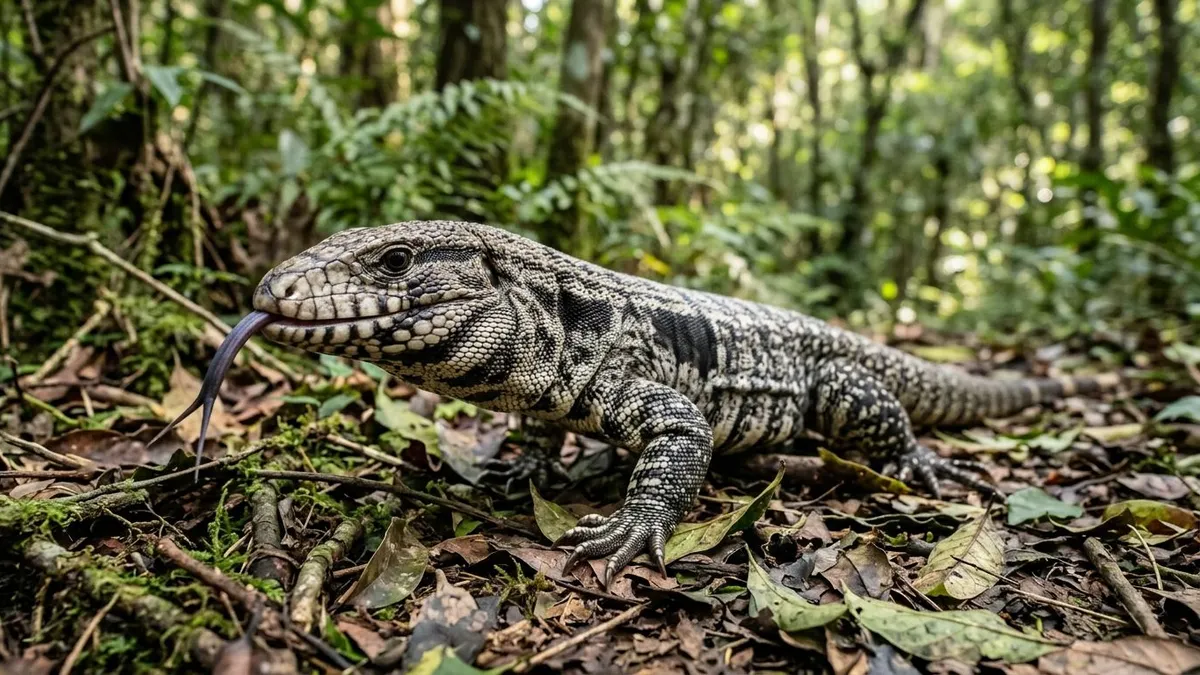
The Brazilian lizard combines constant tongue flicking with analysis in the palate to map its surroundings, locate prey and detect predators.
The tegu extends its forked tongue in a constant movement to collect volatile molecules suspended in the air and deposited on the surface of vegetation and soil. This repetitive behavior works as a continuous chemical sweep of the surrounding microenvironment, letting the reptile pick up the presence of potential prey, mates and threats without needing direct visual contact.
When the tongue is drawn back into the mouth, its two forked tips bring the collected particles to two small openings in the roof of the mouth. These openings lead the samples to the vomeronasal organ, a specialized sensory center that processes chemical signals and turns molecular stimuli into a spatial picture that helps the animal find its way.
Collecting chemical particles with the tongue
The constant flicking of the tegu’s tongue is a quick muscular action that exposes the moist surface of the tongue to air currents in the environment. As the tongue moves out and in, microscopic odor particles stick to its lining. The fork at the tip increases the contact area and allows chemical samples to be collected from two slightly different points at the same time.
That physical separation between the tips creates a subtle difference in the concentration of molecules picked up on the left and on the right. Based on this asymmetry, the lizard’s central nervous system can work out the direction from which an odor comes, a mechanism that guides the animal’s movement across the terrain.
Because the tongue keeps moving, the sampling never really stops. Each flick is a fresh reading of the air and of the ground, and the repetition is what turns a series of small samples into a picture of the surroundings.
The anatomy behind the vomeronasal organ
The vomeronasal organ, also known as Jacobson’s organ, sits just above the palate of the tegu and has no direct connection to the external nostrils. It is made up of two chambers lined with a highly specialized sensory tissue, full of nerve endings connected directly to the accessory olfactory bulb in the reptile’s brain.
When the tongue returns to the mouth, its tips touch the entrances to the two vomeronasal chambers or transfer the mucous fluid carrying the collected particles. The receptor cells analyze the chemical composition of the deposited material in a fraction of a second, which lets the animal tell apart specific substances given off by mammals, birds, fruit or other reptiles.
In plain terms, the animal tastes the air with its palate rather than smelling it with its nose. The tongue is the delivery system, and the vomeronasal organ is the analyzer.
Tracking prey and feeding habits
As an opportunistic omnivore with a very varied diet, the tegu relies on the vomeronasal sense to find food hidden under the ground, leaf litter or tree bark. The animal can follow scent trails left by small rodents, bird eggs, invertebrates and fallen fruit, tracing the chemical gradient left on the vegetation.
Beyond locating food sources that are motionless or buried, the sensory system guides the lizard’s stealthy approach before an attack. A tracker that does not depend on seeing its target has an obvious advantage when the food is hidden in soil or under debris, where sight alone would not reveal it.
Sensing threats and signals from other animals
Chemical processing in the vomeronasal organ plays a crucial role in protection against predators in the ecosystem. By picking up molecules from larger carnivores in the air, the tegu can identify danger at a distance and head for shelter in dense vegetation or deep burrows, reducing the chances of being caught by surprise.
The same chemical channel is also used during the breeding season to locate partners. In areas where animals are few and far between, following scent signals is one way for individuals to find each other.
Cold months, wide range and a role in the ecosystem
During the colder months of the year, when prey becomes scarce and low temperatures slow the metabolism of reptiles, the tegu changes its behavior sharply. The animal buries itself in deep underground burrows or uses holes dug by other animals to enter a long period of dormancy. During this stretch of several months, body functions slow down and the use of the forked tongue is suspended. The energy built up in the warm seasons through efficient foraging carries the reptile through underground until rising temperatures signal the time to return to the surface and switch its sensory systems back on.
Widely distributed across Brazilian biomes such as the Cerrado, the Caatinga and the Atlantic Forest, the tegu acts as a key element in local ecological balance. Its constant search for food makes it a seed disperser when it eats native fruit, and it also helps control populations of invertebrates and small vertebrates in its habitat.
The efficiency of its chemical sweep allows the tegu to explore varied niches and occupy open or transitional areas. Its presence contributes to nutrient cycling and to the dynamics of food webs, as both a generalist predator and as prey for birds of prey and large mammals.
The sensory refinement of the tegu shows how evolution shaped closely integrated anatomical structures to ensure survival in one of the largest lizards of the South American continent. The constant interplay between the forked tongue and the vomeronasal organ is a complex way of perceiving the world, in which the ground is read not only through sight but through a map of odors and chemical signals.
Reporting: Natália Santos / Amazonia Mag

Editor · Amazonia Mag
Anne Silva is the editor of Amazonia Mag, the English-language edition of Revista Amazônia. She curates, translates and adapts the outlet's science and environment coverage for an international audience, reporting on Amazon wildlife, flora, rivers, climate and research. Every story she edits is grounded in peer-reviewed studies, official data and on-the-ground reporting from the Revista Amazônia newsroom in Belém, Pará, Brazil. More by Anne Silva →