
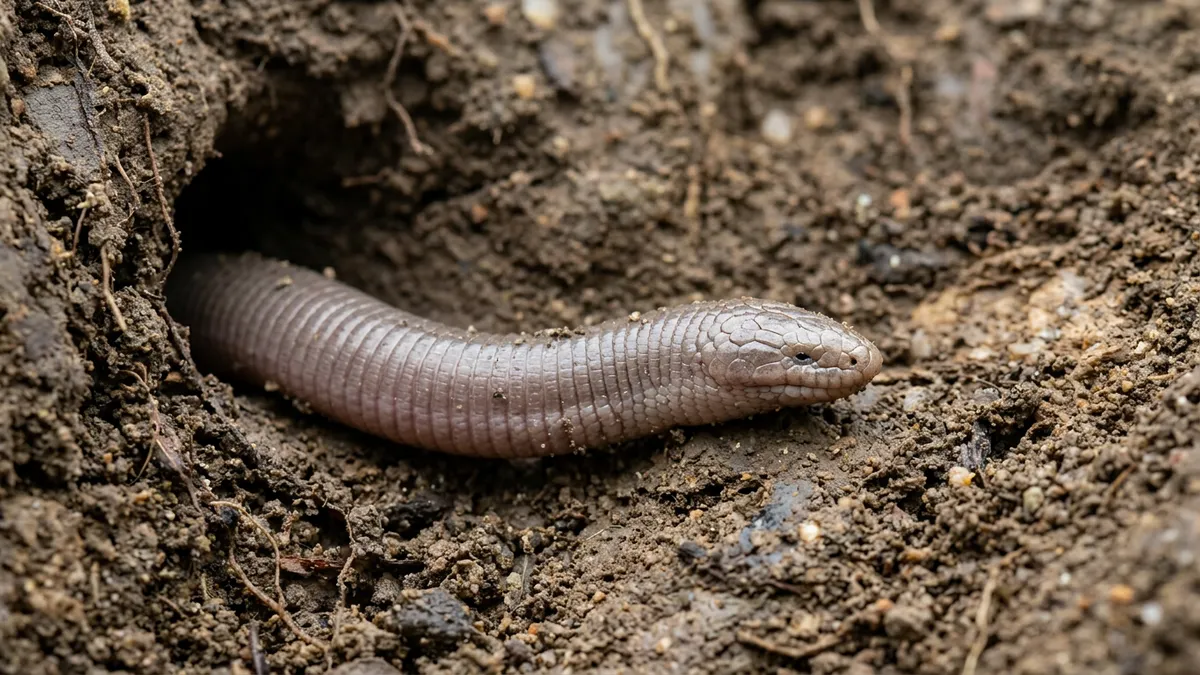
Known as the two-headed snake, the worm lizard belongs to a group separate from snakes and lizards and lives adapted to the underground.
The animal that seems to have two heads
Beneath the ground, where a long body must push through narrow passages, the worm lizard uses its own head as a tool. The animal popularly called the two-headed snake (cobra-de-duas-cabeças in Brazil) is not a snake, and it is not an ordinary lizard either. It belongs to the amphisbaenians, a group that stands apart from both.
Its ringed body creates a particular visual impression: the two ends look alike enough that, in a dark tunnel, it can be hard to tell at once which end is in front. The popular name was born from that appearance and also from an unusual ability to move. When it needs to change direction inside a gallery, the amphisbaenian can walk backward as easily as it moves forward. It is not an animal with two heads, but a body adapted to a space in which turning around can be difficult or impossible.
The most important scene for understanding the amphisbaenian does not take place on the surface. It happens inside the tunnel, when the animal pushes against the soil with the front of its body, opens a way through and then backs out without needing to make a full turn.
The ringed skin follows this underground shape and reinforces the segmented look of the body. That shifts attention away from the easy comparison with a two-headed snake and toward the real mechanism: the amphisbaenian is a specialized digger, with a compact skull, a ringed body and reversible locomotion. Each feature makes sense in combination, within a way of life tied to narrow galleries and little light.
A group apart from snakes and lizards
Correct identification starts with classification. The amphisbaenian forms a group of its own, distinct from snakes and lizards, even though its elongated appearance can prompt an immediate association with them. The separation does not rest only on the popular name or on the absence of visible legs.
Instead of treating the animal as an unusual snake, it is more accurate to see it as an underground vertebrate with its own solutions for digging and getting around in tight passages. The shape of its body is not only for moving over the ground. It is linked to constant contact with the soil and to the need to spread force against the resistance of the tunnel.
Appearance can mislead for another reason. Sight plays little role in the life of the amphisbaenian, and the ringed skin gives the body a texture different from the popular image of a smooth snake. The compact head should not be read as a deformity or as the presence of a second head. It works as a digging structure. The result is an animal whose anatomy looks strange when seen outside the environment it is adapted to, but becomes coherent once it is analyzed inside the tunnel.
The key factual correction is simple: two-headed snake is a popular name, while amphisbaenian is the name of the group to which this animal belongs.
The skull turns the head into a tool
The digging mechanism is concentrated in the front part of the body. The compact skull withstands contact with the soil and allows the head to be used to open or widen the tunnel. That function changes how the animal’s shape should be read. In a snake, the head is usually associated above all with catching food, sensing the surroundings and leading the body. In the amphisbaenian described here, the head also acts as a tool that physically confronts the earth.
Compaction of the skull matters because the animal has to apply force in a confined space, without relying on sight to choose its path. Digging therefore depends on the combination of skull structure, ringed body and the ability to progress underground.
The ringed skin completes this set of adaptations. Rather than showing a visually uniform surface, the body is divided by rings that follow its elongated shape. That organization is associated with life in tunnels and helps explain why the animal can look alike at each end. The amphisbaenian does not need a clear visual orientation to move on. It digs with a reinforced head and keeps a way of moving that allows it to withdraw along the same path.
Why walking backward matters
In an underground environment, going forward is not the only task. The animal also has to return, escape an obstacle or leave a passage without being able to turn its body around. This is where the reversible locomotion of the amphisbaenian becomes important. It can walk backward in the tunnel as easily as it moves forward, a trait that lies behind the popular name two-headed snake.
The visual similarity between the ends can strengthen the impression that either side is the head, but the central biological fact is movement in both directions. The adaptation spares the animal from needing a wider area to make a turn. In terms of behavior, it allows the underground space to be used as a passage for going and coming, rather than a corridor that can be traveled in only one direction.
The movement is an efficient mechanical solution, but it is not proof that the animal has two heads or two control centers. The head opens the passage, the body fits into the corridor, and the same structure can drive movement in the opposite direction.
What defines the amphisbaenian
The group brings together well-established biological traits: a classification separate from snakes and lizards, a compact skull for digging, ringed skin, little use of sight and reversible movement in tunnels. Taken one by one, each trait can seem odd. Taken together, they describe a coherent animal.
The most useful fact stays concrete: the amphisbaenian uses its head to dig and can retreat along its own tunnel without losing mobility. For a reader who meets the name two-headed snake, that is the detail worth keeping. The animal has one head, a compact skull built for pushing through soil and a body that moves in either direction.
Reporting: Natália Santos / Amazonia Mag

Editor · Amazonia Mag
Anne Silva is the editor of Amazonia Mag, the English-language edition of Revista Amazônia. She curates, translates and adapts the outlet's science and environment coverage for an international audience, reporting on Amazon wildlife, flora, rivers, climate and research. Every story she edits is grounded in peer-reviewed studies, official data and on-the-ground reporting from the Revista Amazônia newsroom in Belém, Pará, Brazil. More by Anne Silva →