
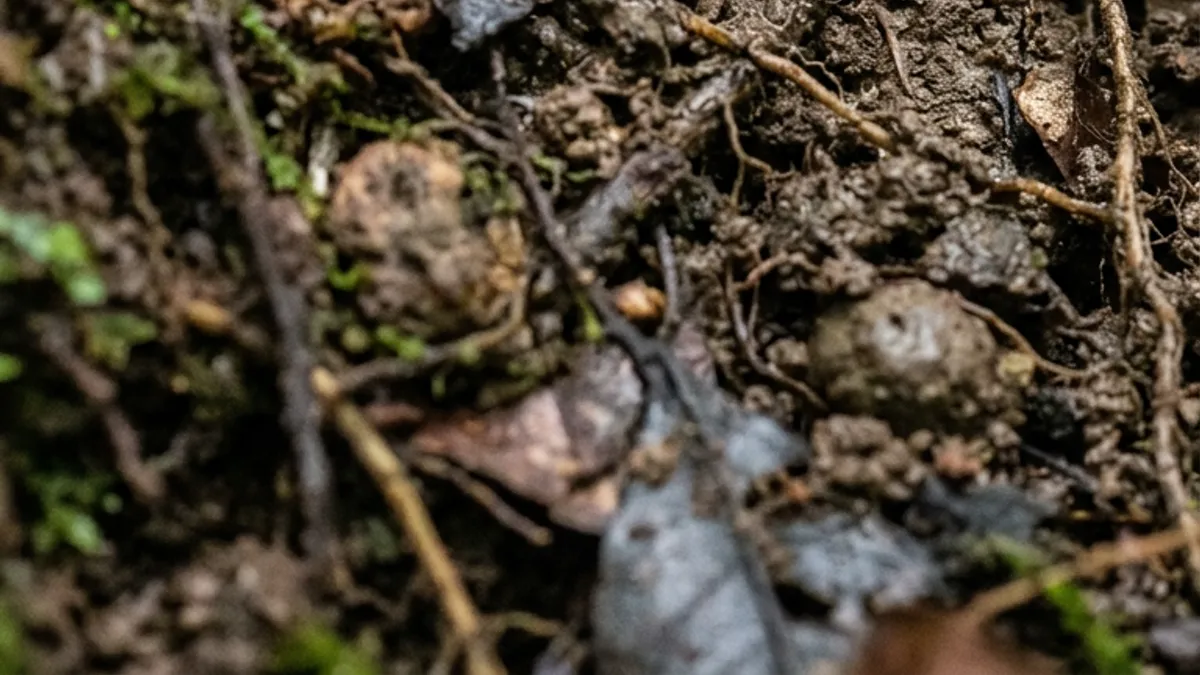
In some caecilians, the female turns her own skin into food for her young while she stays hidden in the underground environment.
Hidden in the soil, the caecilian moves without legs and keeps a body adapted to a world of little light. In some species of this group of amphibians, the female also does something that looks unusual at first glance: she produces a layer of nutrient-rich skin so that her offspring can feed directly from her body.
The behavior is called maternal dermatophagy. The young scrape off and swallow the nutritious skin that the female produces, a resource tied to the early stage of development. The same anatomy that helps the animal live beneath the ground includes a sensory tentacle between the eye and the nostril, a structure that widens its perception of the underground environment. In Brazil the animal is known as cobra-cega, literally blind snake, although it is not a snake at all.
A legless amphibian that lives far from the surface
Despite its popular name and its long body, the caecilian is not a snake. It belongs to the caecilians, amphibians that lost their legs over the course of evolution and developed a body shape suited to digging, squeezing through cracks and advancing through moist soil. Living underground reduces exposure to light and makes the senses used by surface animals less important.
A cylindrical body and the absence of limbs do not mean the animal has no sensory structures. The caecilian has reduced eyes, often of little use, and it has a tentacle between the eye and the nostril. That position is one of the marks of the group. The organ works as a perception structure close to the ground, helping the amphibian pick up chemical and tactile information while it moves through a narrow environment.
For a reader used to thinking of amphibians as frogs and salamanders near ponds, the caecilian is a reminder of how varied the group is. Here is an amphibian with no legs, almost no use for its eyes and a daily life spent entirely in the soil, where almost everything happens out of sight.
The female grows a layer of skin meant for feeding
The reproductive behavior described for some caecilians involves a temporary change in the female’s skin. Instead of simply replacing the outer covering, her body produces a layer with a higher concentration of nutrients. The young approach the mother’s body and remove this tissue with their mouths, swallowing skin that was formed precisely to serve this purpose.
The process is called maternal dermatophagy, an expression that means feeding on the mother’s skin. The word does not describe aggression between unrelated animals. It describes a form of parental care recorded in caecilian amphibians. The female remains a direct source of food during this period, and the young use their own feeding behavior to obtain the resources they need to grow before they depend entirely on the outside environment.
It helps to picture the scene in concrete terms. The skin is not a leftover that the young happen to find. It is a tissue with extra nutrients, produced by the mother and removed by the offspring with their mouths. Care and feeding are the same act, and they take place in the same spot.
Life underground organizes the whole sequence of care
The sequence begins with the female and her young staying together in a protected space in the soil. In that setting, the mother produces the nutritious layer and the young eat it directly. The behavior combines shelter and feeding in one place, and it does not require the young to move away to look for small invertebrates or other food.
This strategy makes sense within the biology of an underground animal. Little light makes it hard to locate food and reduces the usefulness of vision, while the humidity of the soil favors close body contact. The female offers a resource that is available right in the shelter. The young, for their part, use their mouths to remove the tissue and repeat the process during the stage when they need to grow.
Seen this way, the behavior is less strange than it first appears. An animal that lives in permanent shelter, with little light and no easy way to forage on the surface, relies on what the shelter itself can offer. The mother’s body becomes part of that shelter.
The tentacle between the eye and the nostril
The sensory tentacle is one of the details that separates the caecilian from a snake and helps explain its adaptation to the soil. It appears at the front of the head, between the eye and the nostril, and works as a specialized structure for collecting information close to the body. In a narrow tunnel, that position lets the animal explore the way ahead without depending on sight alone.
Underground life also favors a set of physical traits: the elongated body, the absence of legs and the ability to advance through confined spaces. These traits did not appear because of maternal dermatophagy. They belong to the way of life of the caecilians as a group, while feeding on the mother’s skin is a reproductive strategy observed in some forms within it. Keeping the two apart avoids a common mix-up, in which a body shape is explained by a behavior that came from a different part of the animal’s biology.
Food on the mother’s own body, but not a rule for every amphibian
The scene can lead to a wrong generalization. Not all amphibians feed their young this way, and maternal dermatophagy should not be attributed indiscriminately to every caecilian. The phenomenon depends on the species and on the reproductive stage. Nor does it mean that the female continually loses her ordinary skin, or that the young feed on it for their entire lives.
Another distinction matters: the nutritious skin is one thing, and later feeding is another. As the young grow, they depend more and more on the resources available in the environment, according to their stage of development and their species.
The sequence describes a mechanism of parental care, not a change caused by disease, injury or lack of food. In certain caecilians, the mother’s own skin becomes a resource for the growth of the young. Underground, where nearly everything happens beyond the reach of the eyes, care can take the form of a layer that slowly disappears, eaten by the next generation.
Reporting: Natália Santos / Amazonia Mag

Editor · Amazonia Mag
Anne Silva is the editor of Amazonia Mag, the English-language edition of Revista Amazônia. She curates, translates and adapts the outlet's science and environment coverage for an international audience, reporting on Amazon wildlife, flora, rivers, climate and research. Every story she edits is grounded in peer-reviewed studies, official data and on-the-ground reporting from the Revista Amazônia newsroom in Belém, Pará, Brazil. More by Anne Silva →