
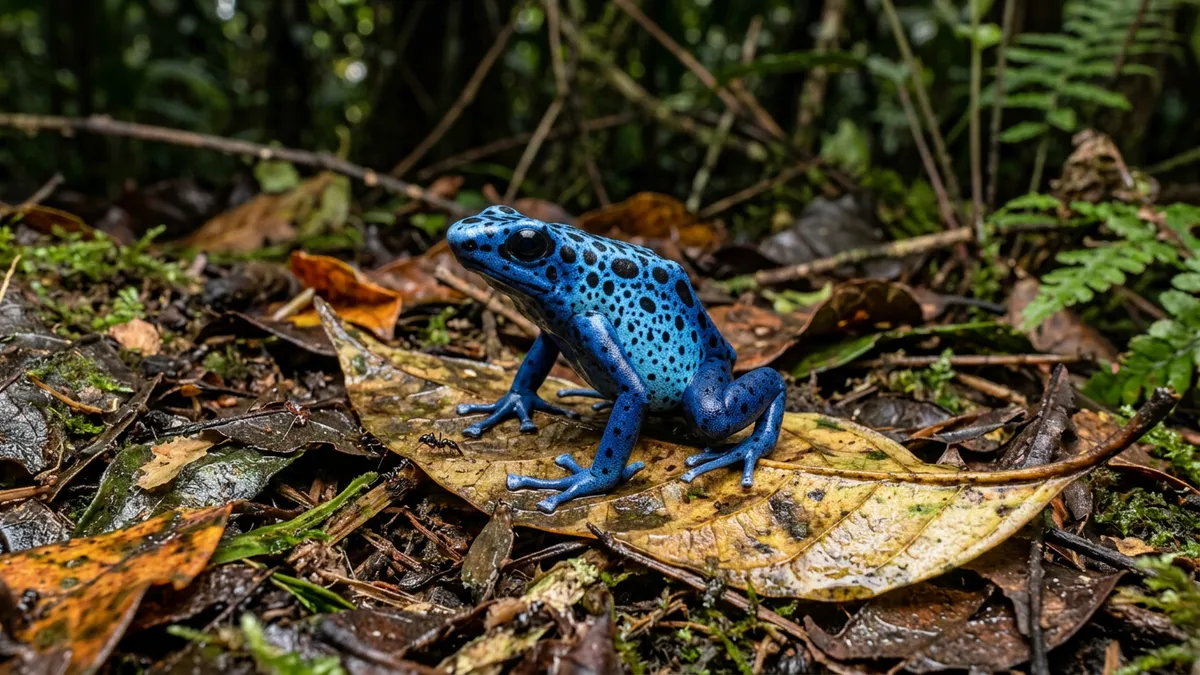
A poison dart frog does not manufacture the alkaloids that make its skin toxic. It gets them from its food, mainly small ants and mites, absorbs part of those molecules and sends them to its skin glands. The result is a chemical defense that depends on the diet available in the forest.
Kept in captivity on food that does not contain those arthropods, the frog can lose much of the toxicity it had stored. Its intense colors work, in this context, as aposematism, a visual signal telling predators that touching or swallowing the animal may have consequences. Appearance, in other words, is tied to a feeding and physiological mechanism.
The poison begins with the frog’s diet
Poison dart frogs belong to a group of small amphibians whose skin defense relies on alkaloids found in the food chain. Ants and mites living in leaf litter, damp soil and decaying leaves can carry these substances in their own bodies. When the frog catches and digests these arthropods, it receives molecules it does not have to build from scratch. Diet is the front door of the whole defensive system.
The term sequestration describes exactly this ability: pulling compounds out of food, moving them through the body and storing them in defensive tissue. It does not mean the frog simply keeps the prey’s contents in its stomach. The alkaloids go through digestion and absorption, reach the bloodstream and end up concentrated in the skin.
The makeup of the toxin can vary with the species, the age of the frog, the place where it lives and the arthropods it eats. That is why not every dart frog carries exactly the same set of molecules or the same level of toxicity.
Skin glands hold the defensive compounds
An amphibian’s skin is a working organ, not just an outer covering. It takes part in breathing, helps control the passage of water and contains glands that release secretions. In dart frogs, skin glands can store alkaloids obtained from food and release them when the animal is pressed, bitten or handled by a predator. The secretion reaches the surface and turns physical contact into a chemical barrier.
These molecules interfere with the working of nerve and muscle cells in different animals, although the effect depends on the alkaloid, the amount and the species exposed. The frog does not need to inject anything the way a venomous snake does. The defense sits in the skin and can be absorbed through the mouth or sensitive tissues of whoever tries to eat the frog.
The difference between poison and venom helps explain the mechanism. The frog is considered poisonous because the substance acts when it is touched or swallowed, without any specialized structure to deliver it.
Captivity changes the chemistry that protects the frog
In captivity, feeding usually relies on small insects that are bred or supplied regularly, such as flies and other farmed items. That diet may not reproduce the variety of ants and mites that supplies alkaloids in the wild. Without a steady intake of those molecules, the frog stops replenishing part of the compounds that would be stored in its skin. Toxicity does not vanish because of a change in behavior but because the food source has been cut off.
This shows that bright color alone does not reveal how much toxin an animal carries. A frog raised without the right arthropods can keep its yellow, orange, blue or red pattern and still have a weaker chemical defense. How long the compounds are retained varies with the substance and the species, so the loss should not be treated as instant or universal.
The link between diet and toxicity also explains why results seen in animals kept under human care should not be carried over directly to wild populations.
Colors that work as a warning
Aposematism is a strategy in which a visible trait signals a defense that may be chemical, mechanical or behavioral. In dart frogs, strong coloring can lower the chance that a predator starts an attack, because individuals that have had a bad experience tend to link that pattern with risk. The warning does not need to be understood as a conscious message. It works through learning, selection and pattern recognition.
The signal is only useful when a real defense stands behind it. In the forest, a predator that catches a toxic frog may feel unpleasant effects and avoid other frogs that look similar. Over generations, frogs whose color makes the risk easier to recognize may have a better chance of escaping.
The tie between alkaloids and coloring therefore joins two different processes. Diet supplies the raw material of the defense, while the visual pattern reduces the need to use it in every predation attempt.
A direct link to the small animals of the leaf litter
The mechanism creates a direct ecological relationship between the dart frog and the tiny arthropods of the forest floor. The frog depends on the availability of these prey to keep its stock of alkaloids, and the arthropods depend on an environment with enough moisture, organic matter and shelter. Fallen leaves, rotting logs and spaces shielded from the sun support a community of invertebrates that takes part in the amphibian’s diet.
The frog does not pick a ready-made formula. What is available in its food influences which alkaloids can be taken in and in what quantity. Changes in the soil, in humidity and in the leaf layer alter the supply of prey, so protecting the frog means protecting the network of small organisms behind its body chemistry.
By eating ants, mites and other small invertebrates, the dart frog also takes part in controlling the populations that live on the ground. As prey, it shapes the behavior of animals that forage among leaves and low branches. Its chemical defense changes the odds of being captured, but it does not make the frog immune to predation.
The dependence on diet shows that conserving this amphibian cannot stop at protecting the visible animal. Keeping the forest also means keeping the humidity, the leaf litter and the diversity of arthropods that allow the frog to acquire its alkaloids. When this circuit works, feeding, physiology, behavior and natural selection reinforce one another.
The dart frog turns its own meals into a barrier against predators. The warning color only makes full sense when seen together with the diet, the skin glands and the reaction of predators. That connection changes the question of what it means to protect a species: it is not enough to save the animal, because its defense is built from the conditions that let it feed.
Reporting: Natália Santos / Amazonia Mag

Editor · Amazonia Mag
Anne Silva is the editor of Amazonia Mag, the English-language edition of Revista Amazônia. She curates, translates and adapts the outlet's science and environment coverage for an international audience, reporting on Amazon wildlife, flora, rivers, climate and research. Every story she edits is grounded in peer-reviewed studies, official data and on-the-ground reporting from the Revista Amazônia newsroom in Belém, Pará, Brazil. More by Anne Silva →