
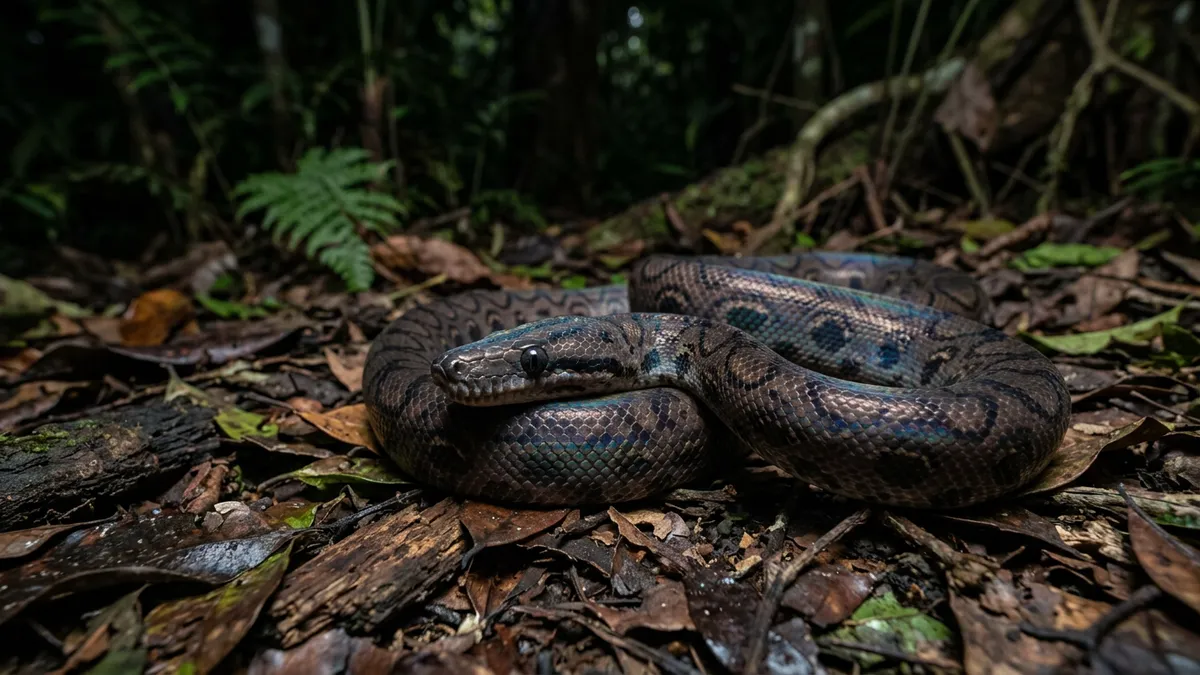
At first glance, the rainbow boa seems to carry its colors inside its body. Yet when light reaches its scales, the colorful effect does not depend on a pigment producing red, green, blue or any other shade. The shimmer comes from the way the surface of the scale is organized at a microscopic scale. The structure works as an arrangement of layers that can change the path of light and separate its visible components.
That phenomenon is called structural iridescence. The color you see can shift with the lighting and the angle of observation, because the reflection depends on how light meets the layers of the scale. The sheen, then, is not a natural paint laid down in the tissue. What the eye registers as a rainbow is an optical response of the body surface, produced by the microscopic architecture of the scales.
Microscopic structure stands in for colored pigment
In many animals, visible colors are tied to pigments, molecules that absorb part of the light and send the rest back to the eye. In the case of the rainbow boa, the iridescence occurs without a pigment doing that work. The layers in the scale diffract light, which means they reorganize how it travels and make different wavelengths stand out for anyone looking at the snake.
The difference matters because it separates two ways of making color. A pigment acts by selective absorption, while the structure of the scale makes the sheen through a physical interaction with light. The multicolored look therefore does not mean the boa has a collection of colored pigments under its skin. It reveals a surface organized in dimensions too small to see with the naked eye, yet able to alter the reflection.
You can picture the effect with everyday examples such as the colors on a soap bubble or on a thin film of oil. Neither holds a rainbow of dyes. In both, the colors come from how light behaves at a layered surface, and they move as the viewer moves.
Because the effect depends on light and viewing angle, the same snake can look different from one moment to the next. Under a bright beam it may flash blue or green, while in dim light it may look much plainer. That variability is itself a clue that the colors are produced by structure and not by dye.
The sheen belongs to a ground-dwelling, nocturnal snake
Iridescence does not change the rainbow boa’s basic way of life. The species is nocturnal and terrestrial, a combination that puts the snake into action mainly at night and close to the ground. The shimmer can be seen when there is enough light, but its origin stays tied to the scale, not to a change in behavior or to light produced by the animal on purpose.
During the day, the snake can stay outside its period of greatest activity, while the night marks the moment linked to its routine. What is clear is the link between the species and the ground, along with its night-time activity. Colorful appearance and ground-dwelling behavior are different traits, even though they belong to the same animal.
Hunting by constriction, not by venom
The rainbow boa is also known for using constriction. This mechanism relies on the snake’s muscular body and lets it restrain prey through pressure, rather than depending on injecting venom.
The distinction helps avoid a common association between snakes and venom. The sheen of the scales has no stated role in subduing prey, scaring off predators or lighting the way. It is an optical effect produced by the microscopic layers of the body surface. Constriction, on the other hand, is the mechanism tied to capture.
In practice, the two traits belong to different parts of the animal’s story. One is about how the snake looks to anyone who sees it in the light. The other is about how it feeds.
Live young that repeat the same architecture
Another reproductive detail sets the rainbow boa’s story apart from generic descriptions of snakes. Its young are born alive, rather than depending on eggs that hatch outside the mother’s body.
Newborns also carry the scale structure responsible for the iridescence, since the mechanism is tied to the organization of the body surface. The structural trait belongs to the scales of the rainbow boa, while live birth describes its mode of reproduction.
What the animal’s appearance tells us
The central scene is simple and precise: light reaches the scale, interacts with its microscopic layers, is diffracted and arrives at the eye as a multicolored sheen.
The picture adds up to three concrete mechanisms. The scale diffracts light without colored pigments, the snake lives on the ground and at night, and capture happens by constriction. The young are born alive.
Seen this way, the rainbow boa also offers a simple lesson in reading appearances. A color on an animal can come from a chemical trait or from a physical one, and telling them apart changes what the color can be said to mean.
When the color seems to come from inside the animal, the explanation is on the surface. It is a reminder that in nature, a look can be created less by what exists as paint and more by how matter has been arranged.
Reporting: Natália Santos / Amazonia Mag

Editor · Amazonia Mag
Anne Silva is the editor of Amazonia Mag, the English-language edition of Revista Amazônia. She curates, translates and adapts the outlet's science and environment coverage for an international audience, reporting on Amazon wildlife, flora, rivers, climate and research. Every story she edits is grounded in peer-reviewed studies, official data and on-the-ground reporting from the Revista Amazônia newsroom in Belém, Pará, Brazil. More by Anne Silva →