
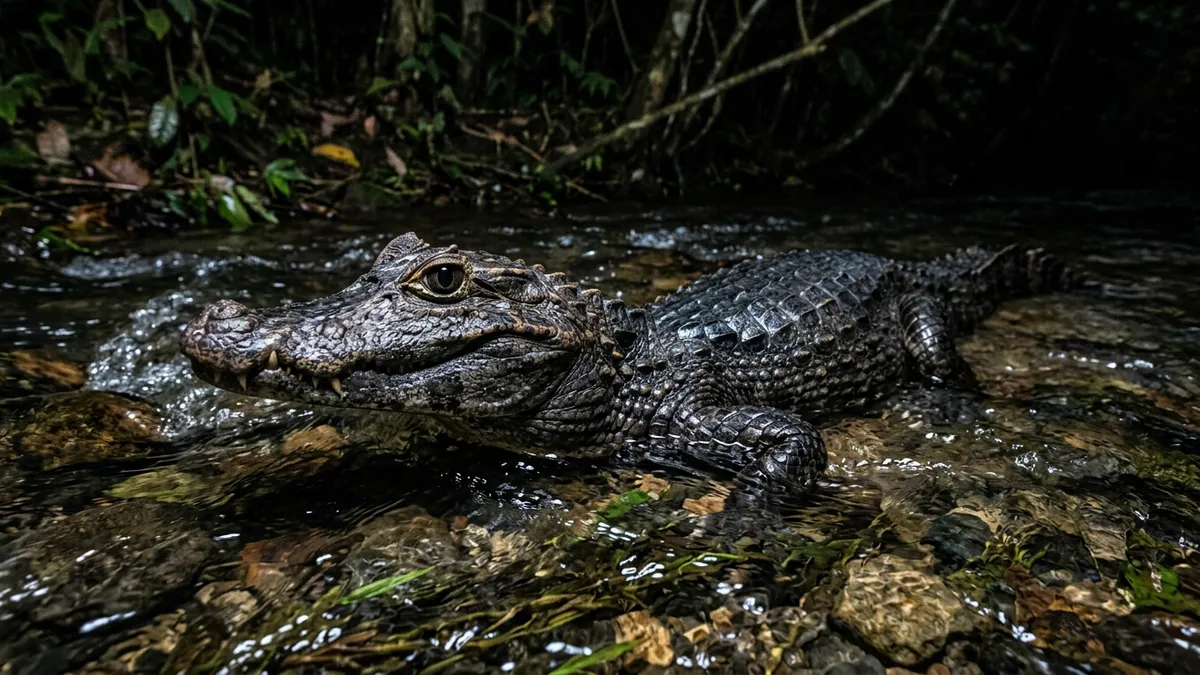
Most people picture a caiman in still, murky water. The dwarf caiman, Paleosuchus palpebrosus, breaks that picture. It is the smallest crocodilian in the Americas, and it is associated with a setting unusual among caimans and alligators: shallow, fast-moving streams. It lives alone, it is active at night, and the bony armor in its skin reaches all the way to its eyelids.
These traits are best read as a set, not as four separate curiosities. Small size, a solitary life, nocturnal activity and the use of fast streams all describe the same animal, and together they explain why this species deserves attention in its own right.
A small caiman in water that does not stand still
Instead of occupying only still water or slow stretches, the dwarf caiman is associated with shallow, fast streams. In the Amazon and other parts of South America these narrow watercourses are known as igarapés, one of the most recognizable forms of small streams in the region. The current is one of the defining features of the habitat this crocodilian uses, because it creates a scene quite different from the one usually imagined when people think of caimans.
In a narrow stream the bottom, the depth and the speed of the water can change within a few yards. The animal stays tied to these small watercourses, and that choice of habitat is unusual among caimans. It is one of the reasons the species’ behavior is worth studying separately from that of its larger relatives.
Smaller does not mean simpler
Being the smallest crocodilian in the Americas is a comparison of scale between species. It is not a sign that the dwarf caiman is an unfinished version of the others. Its reduced size comes with a protected head, well-developed bony plates and the ability to occupy shallow, fast streams. The relationship between size and protection is one of the most important points about the species.
The comparison also has to avoid another common mistake: smaller does not mean less specialized. The species combines an outer armor that reaches the eyelids with a use of habitat considered unusual among caimans. Body size is only one part of the description. The animal makes the most sense when anatomy and environment are read together. Shallow, fast streams impose conditions of their own, while a nocturnal, solitary lifestyle defines a discreet way of being present. The safest way to put it is that these traits appear together in the known profile of the dwarf caiman.
A face protected by bony plates
Osteoderms are bony plates embedded in the skin, and they are found in several crocodilians. In the dwarf caiman the protection is notable because it also develops in the eyelid. The structure should not be confused with ordinary scales, or with an outer layer that can be removed. It is a rigid formation built into the body covering, and it reaches a delicate area of the face.
The eyelids take part in protecting the eyes, and the presence of osteoderms there adds a bony component to the armor of the head. The result is an anatomy that combines a working opening for sight with a hardened surface around the eyes.
It helps to be precise about what this means. The animal does not have its eyes completely sealed by plates, and the eyelids do not stop moving. The correct statement is that osteoderms develop even in this region. The armor reaches the eyelids, reinforces the anatomical singularity of the species and offers a clue about how much body protection has mattered in its evolutionary history.
A solitary routine after dark
The dwarf caiman is solitary and nocturnal. That means its routine is concentrated in the hours of low light, and that it does not form stable groups while it goes about its activities. The combination shapes how it uses the stream. At night, the shallow, fast watercourse becomes the space where a predator that does not depend on social life moves and stays.
Night activity is not the same as total invisibility. The dwarf caiman remains subject to the physical conditions of the stream: the level of the water, the presence of shelter and the speed of the flow. The current can limit how long the animal stays in certain spots and favor others, especially where there are shallow areas and stretches less exposed to the push of the water. The central information is behavioral and environmental: it lives alone, is active mainly at night and uses a kind of watercourse that is unusual among caimans.
Its place in the stream
As a crocodilian, the dwarf caiman is part of the community of vertebrates in the watercourse and takes part in the ecological relationships of the stream. What a freshwater predator contributes has to be described with caution. The animal holds a place in the ecological network, but the details of that place call for studies and observations of their own.
The connection to Brazil is direct, because igarapés are among the most recognizable small watercourses of the Amazon. Getting to know this caiman is a way of noticing that the size of an animal does not determine how complex its relationship with its surroundings is. A small body, an armored face, a solitary night shift and a home in fast water make up a profile that sets the dwarf caiman apart from the image most people carry of the caiman.
Reporting: Natália Santos / Amazonia Mag

Editor · Amazonia Mag
Anne Silva is the editor of Amazonia Mag, the English-language edition of Revista Amazônia. She curates, translates and adapts the outlet's science and environment coverage for an international audience, reporting on Amazon wildlife, flora, rivers, climate and research. Every story she edits is grounded in peer-reviewed studies, official data and on-the-ground reporting from the Revista Amazônia newsroom in Belém, Pará, Brazil. More by Anne Silva →