
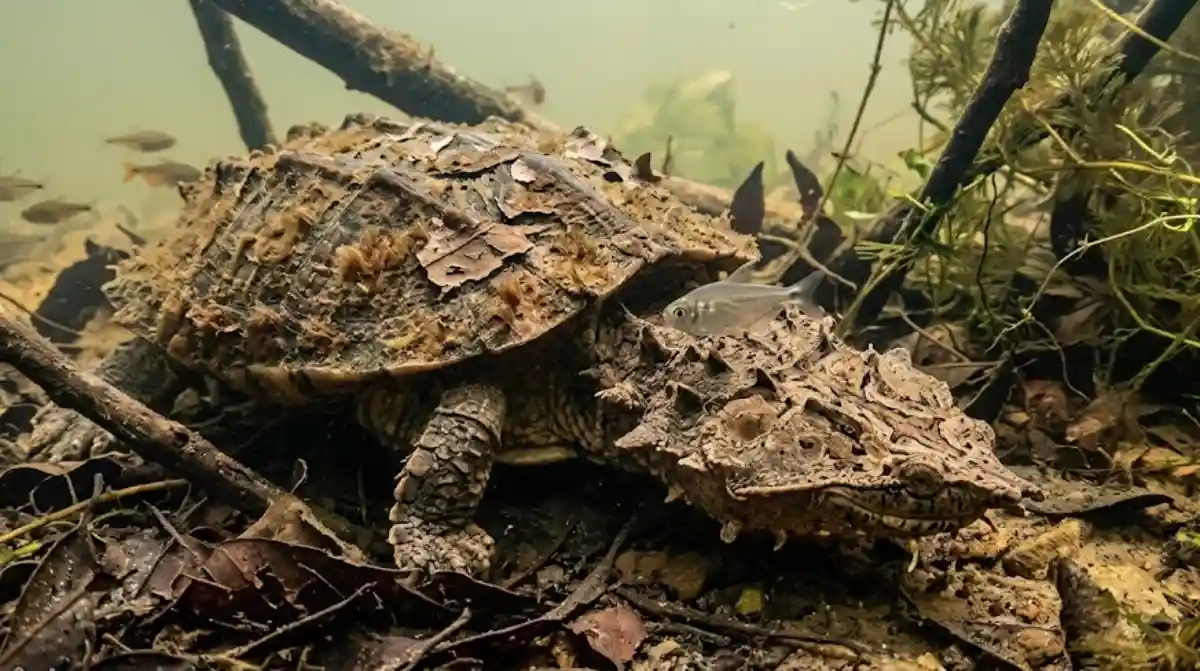
The matamata turtle, scientifically known as Chelus fimbriata, has such an unusual appearance that it can easily be mistaken for a pile of decomposing leaves on the muddy bottom of an Amazonian river. Its body seems to belong to the submerged landscape, where vegetation, mud and cloudy water blend together.
Its rough, irregular shell is covered with projections, while folds and fringes of skin imitate the texture of submerged vegetation. A broad head, an elongated neck and a body covered with skin appendages complete an appearance that is anything but accidental. Each detail helps the animal become almost invisible on the river bottom.
Unlike relatives that chase prey, the matamata waits. Small fish and crustaceans may come close because the turtle remains concealed by its plantlike disguise. Once a prey animal moves within reach, the turtle begins a precise and extremely fast feeding sequence, one very different from an active pursuit.
A disguise built from shell and skin
The matamata is an ambush predator in the fullest sense. Its extreme appearance reflects an evolutionary history shaped over millennia, with body form closely connected to the need to remain hidden and capture food in a complex aquatic environment.
The shell’s projections and the folds of skin break up the animal’s outline. Instead of presenting a clear silhouette, they create the impression of an irregular mass of leaves and plant debris. The broad head and skin appendages strengthen that effect, allowing the turtle to resemble another feature of the river bottom.
This camouflage does more than conceal the matamata. It is also central to the way the turtle feeds. The animal does not need to move rapidly after every fish. Its strategy is to wait patiently, remain hidden and respond at the instant when prey approaches.
In this way, the matamata turns its own body into a hunting tool. The shell, skin, neck and mouth work together. The appearance of a decomposing leaf is not an isolated trait, but an adaptation linked to the turtle’s behavior and survival.
The suction strike that captures whole prey
When an unsuspecting fish swims near its head, the matamata thrusts its long, flexible neck forward. At the same time, it quickly opens its funnel-shaped mouth. That movement creates a powerful suction current.
The prey is drawn in whole along with a large amount of water and enters the turtle’s throat. The action is rapid, an essential feature for catching agile organisms in turbid water. The attack depends not on a long chase, but on surprise and precise movement.
Suction feeding is unusual among reptiles and more common among fish. For that reason, the matamata’s strategy offers a fascinating example of evolutionary convergence. Organisms from different groups can develop similar mechanisms when they face comparable demands in their environments.
Studies published by researchers at the Museu Paraense Emílio Goeldi describe how the bony and muscular structure of the matamata’s neck enables this “rapid suction” mechanism. That anatomical combination helps explain how the turtle can catch agile prey even when visibility in the water is limited.
The matamata has no teeth for chewing. Its mouth is designed to capture and swallow rather than grind food. After drawing in its prey, the turtle expels excess water through the sides of its mouth while retaining the food it has just captured.
This feeding behavior is so efficient that the matamata can consume large quantities of small fish in a short time. The energy is converted into slow but steady growth. Its specialized diet also makes the turtle an important regulator of small-organism populations in the aquatic ecosystems where it lives.
A signal of river health
The matamata’s ecological importance extends beyond its role as a predator. Its presence in an aquatic environment can indicate a balanced ecosystem. Because it is a long-lived species with a low reproductive rate, it is sensitive to habitat degradation and pollution.
Monitoring matamata populations can therefore provide valuable information about the overall health of Amazonian rivers and lakes. A decline in these animals may reflect changes in the conditions they need, even though their extreme camouflage can make them difficult to observe directly.
The traditional knowledge of river communities is crucial to conservation efforts. These communities often live alongside aquatic wildlife and can help identify important matamata habitat, as well as the threats affecting those areas.
Bringing local knowledge together with science makes it possible to understand the species more fully. The goal is not only to study its anatomy or feeding behavior, but also to understand the places where it lives and the changes affecting those environments.
Threats and paths toward conservation
Despite its extraordinary camouflage, the matamata faces significant challenges. The alteration of aquatic habitats, mining and the illegal wildlife trade are ongoing threats to this Amazonian turtle.
Changes in the environments where it finds shelter and food can affect a species that depends on particular conditions and reproduces slowly. Pollution is also a concern, especially because the turtle’s presence is connected to the broader condition of the rivers and lakes where it lives.
Projects and initiatives focused on its protection are under way. These efforts combine scientific research with local knowledge and promote sustainable management and environmental education. Both approaches offer promising ways to help the species continue to thrive in the Amazon.
Valuing biodiversity means paying attention not only to the most visible animals. Species that are masters of disguise, such as the matamata, also perform essential functions in healthy ecosystems. Its discreet appearance does not make it less important. Instead, it reveals the complexity of the adaptations that support life in Amazonian rivers.
The matamata invites us to look beyond the obvious. Every leaf resting on the river bottom, every projection on its shell and every skin appendage recalls a long evolutionary history. Its body shows how form and function are closely connected, allowing the turtle to survive and feed efficiently in a complex habitat.
Preserving the Amazon also means preserving these secrets and the discreet forms of life that belong to the planet’s vast, interconnected biodiversity puzzle. Protecting the matamata means recognizing the value of a species that can almost vanish from sight while playing a meaningful role in the health of aquatic environments.
Reporting: Anne Silva / Amazonia Mag

Editor, English Edition — Amazonia Mag
Anne Silva is the editor of Amazonia Mag, the English-language edition of Revista Amazônia. She curates, translates and adapts the outlet's science and environment coverage for an international audience, reporting on Amazon wildlife, flora, rivers, climate and research. Every story she edits is grounded in peer-reviewed studies, official data and on-the-ground reporting from the Revista Amazônia newsroom in Belém, Pará, Brazil. More by Anne Silva →