
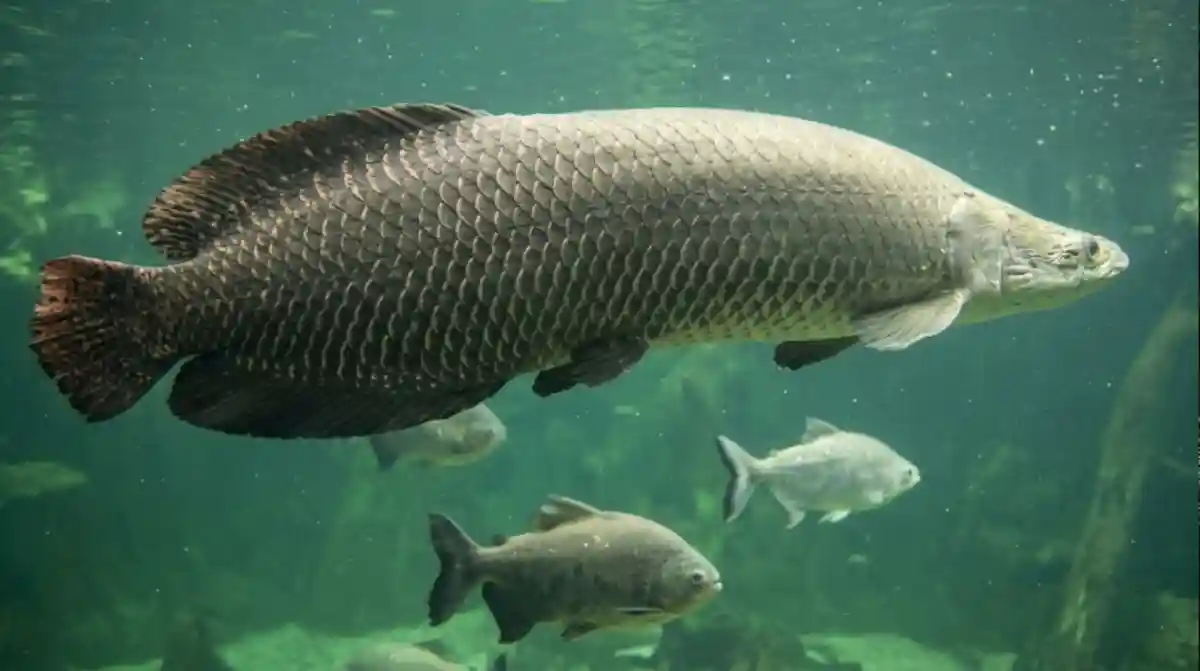
The pirarucu can accomplish something extraordinary: it survives in waters where most other fish would suffocate and die from a lack of dissolved oxygen. This river giant, scientifically known as Arapaima gigas, developed a remarkable evolutionary adaptation over millions of years, becoming a fish that must breathe air.
Unlike the vast majority of aquatic species, which rely entirely on gills, the pirarucu must rise to the surface every 10 to 20 minutes to take in atmospheric air. It uses a modified swim bladder as a highly efficient lung, allowing it to remain active even when the water becomes nearly unlivable for other fish.
How a swim bladder became a lung
In many fish, the swim bladder is used mainly to control buoyancy. In the pirarucu, however, that organ became a complex gas-exchange system. Its inner wall is richly supplied with blood vessels and has a texture reminiscent of human lung tissue, enabling oxygen to move directly into the bloodstream.
This feature is more than a biological curiosity. It is an essential survival strategy during the Amazon’s dry periods, when river levels fall and the decomposition of organic matter consumes oxygen in the water. Under those conditions, the pirarucu can stay active and healthy while its competitors become weakened by hypoxia.
The species’ dependence on atmospheric air also shaped its behavior. Every trip to the surface is an unavoidable pause for breathing, and the fish must coordinate its life underwater with this regular ritual of renewal.
When the fish raises its head above the water and produces a characteristic sucking sound, it creates one of the most emblematic scenes in the wildlife of floodplain lakes. For people familiar with these environments, the sound announces an animal that visibly links the aquatic world with the world above the surface.
The adaptation that makes it visible
The same adaptation that allows the pirarucu to survive oxygen-poor water can also make it vulnerable to fishing. Because the fish must surface regularly, its appearances can be watched by fishers and by those involved in population monitoring.
Studies carried out by the Mamirauá Institute show that this need to emerge allows researchers and local communities to conduct visual counts of individual fish. The technique has become a fundamental tool for tracking populations and evaluating sustainable-management projects that now serve as a model around the world.
Visual counting takes advantage of behavior imposed by the fish’s own biology. Each breath creates an opportunity to record individuals, estimate their presence in lakes and support community decisions about fishing. An apparent weakness thus becomes a conservation tool as well.
Guardian of Amazonian lakes
The pirarucu’s importance reaches far beyond its respiratory physiology. As a top predator, it feeds on a wide variety of smaller fish and crustaceans. By controlling those populations, it helps keep species diversity stable in the river basins where it lives.
The presence of large individuals in a lake is a direct indicator of ecosystem health. It suggests that the food web is complete and functioning properly. Protecting the pirarucu therefore also means preserving the ecological relationships that support life in these flood-prone environments.
Its reproductive cycle adds another dimension to the story. The water giant builds nests on sandy or muddy bottoms during the flood season, and the male takes responsibility for protecting the young for several months.
During that period, the fry swim around their father’s head. The male releases chemical substances that help keep the school together and protect it from predators. This complex social behavior shows that the Amazon holds life forms with highly sophisticated survival strategies, closely connected to the region’s water cycle.
Community management brings populations back
There was a time when uncontrolled fishing pressure placed the pirarucu at severe risk in several regions. The situation changed through a combination of traditional knowledge and science, especially through sustainable-management systems implemented in extractive reserves.
By setting annual fishing quotas and protecting breeding lakes, communities increased pirarucu populations by more than 400% in some monitored areas over the past two decades. The result demonstrates that valuing biodiversity can go hand in hand with economic development while keeping the forest standing.
The model also transformed the socioeconomic reality of riverine and Indigenous communities. The pirarucu became more than a fishing resource. It became a symbol of active conservation, in which protecting the animal is connected to creating dignified income for forest peoples.
Full use of the animal strengthens that approach. Its highly nutritious meat is used as food, its scales are turned into crafts and bio-jewelry, and its skin is used by the sustainable fashion industry. Together, these practices exemplify the idea of a circular bioeconomy and show how biodiversity can create value when its natural rhythms and limits are respected.
An adaptation for a changing climate
In the face of global climate change, the pirarucu’s ability to breathe atmospheric air may become an even more important competitive advantage. As extreme drought events and warmer waters become more common, dissolved oxygen concentrations tend to decline in many aquatic habitats.
While other species struggle to adapt to these new conditions, the pirarucu already possesses the biological tool needed to thrive in warmer, less oxygenated water. That advantage depends on preserving its physical habitat and the surrounding forests, which are part of the conditions that sustain its populations.
Protecting this fish means preserving an evolutionary legacy that reaches back to the age of the dinosaurs. By safeguarding ecological corridors and the floodplain areas where it lives, people can help ensure the continuity of one of the oldest and most impressive lineages in Brazilian wildlife.
At about 3 meters long and weighing up to 200 kilograms, or about 9.8 feet and 441 pounds, the pirarucu is one of the largest freshwater fish on the planet. Its scales are so resistant that they serve as natural armor against attacks by piranhas.
In Brazil, its conservation is an international example of how community involvement can save species from extinction while generating dignified income for forest peoples. Watching this giant surface to breathe means witnessing a ritual of persistence that has taken place for thousands of years.
The pirarucu’s story shows that survival does not depend only on brute strength. It also depends on the ability to change in response to environmental limits. The fish is a link between water and air, a reminder of life’s resilience and of the extraordinary solutions nature has developed to overcome the harshest conditions of the tropical environment.
If the habitat that sustains its life cycle is protected, the pirarucu will remain much more than a giant of the rivers. It will continue to represent an alliance among traditional knowledge, science, conservation and an economy based on keeping the forest standing.
Reporting: Anne Silva / Amazonia Mag

Editor, English Edition — Amazonia Mag
Anne Silva is the editor of Amazonia Mag, the English-language edition of Revista Amazônia. She curates, translates and adapts the outlet's science and environment coverage for an international audience, reporting on Amazon wildlife, flora, rivers, climate and research. Every story she edits is grounded in peer-reviewed studies, official data and on-the-ground reporting from the Revista Amazônia newsroom in Belém, Pará, Brazil. More by Anne Silva →