
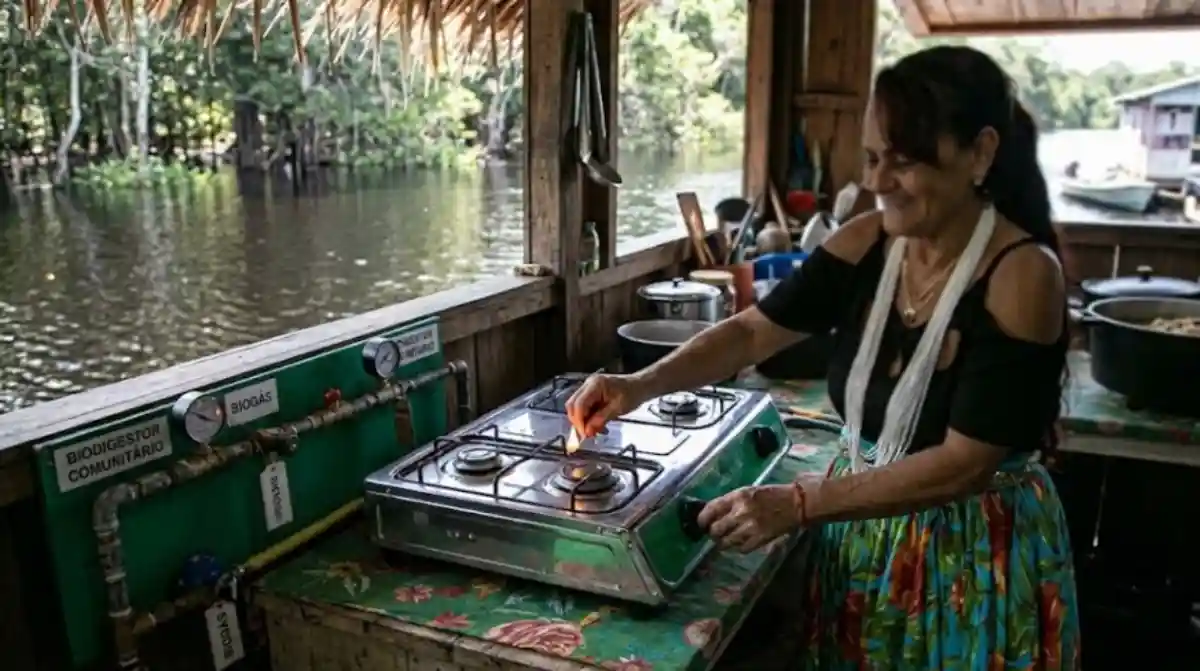
In isolated Amazon communities, cooking often depends on an expensive and unreliable supply chain. Families may rely on the costly transport of liquefied petroleum gas, or LPG, cylinders. When that fuel is unavailable, they may turn to firewood, a practice that affects respiratory health and local forest cover.
Community biodigesters offer a different path. The social technology transforms organic waste produced within the community into cooking gas and biofertilizer. In riverside and Indigenous locations, it combines energy production with waste management, creating more autonomy for residents while supporting sustainable development in the world’s largest tropical rainforest.
The biology behind the system
A biodigester works through a natural biological process called anaerobic digestion. The process depends on methanogenic bacteria, microorganisms that thrive in environments without oxygen. They break down complex organic matter and produce a mixture of gases, with methane, CH4, as the main component. That gas is known as biogas.
Community biodigesters installed in the Amazon are generally continuous-flow or batch systems. They are designed to be easy for residents to operate and maintain. The units receive organic material generated in the community, including food scraps, fruit peels and animal manure when it is available.
By accepting these materials, the biodigester creates a closed cycle for waste management. The approach is robust and adapted to local conditions. Organizations such as the Mamirauá Institute for Sustainable Development, IDSM, and the Saúde e Alegria project have implemented community biodigesters in the Amazon, demonstrating their feasibility and positive impact.
The system’s simplicity allows communities to take ownership of the technology. Residents can feed the biodigester each day and monitor biogas production. The resulting cooking gas can be piped directly to household stoves, creating a steady supply and sharply reducing dependence on energy brought in from outside.
Energy independence for riverside families
The price of an LPG cylinder can be prohibitive in isolated areas. Difficult river transport and high logistical costs mean that the price is often twice what is charged in urban areas. For families with limited resources, that difference can determine whether money is available for other basic needs.
When riverside families produce their own biogas, scarce financial resources can be redirected to health and education. This energy independence is also an important step toward community empowerment and poverty reduction in the region. With less dependence on purchased fuel, residents can invest in local development projects and improve their quality of life.
The benefits extend beyond household budgets. Burning firewood in rudimentary stoves, a common practice in many Amazon kitchens, releases smoke and particles that can cause chronic respiratory diseases, particularly among women and children.
Biogas burns cleanly, removing that smoke-related risk and creating a healthier household environment. Community biodigesters also reduce the need to gather firewood, a task that requires time and physical effort and is frequently carried out by women.
The time saved can be used for income-generating activities or education. In this way, the technology can strengthen the social structure of a community as well as provide a source of cooking energy.
Turning waste into fertilizer
Improper disposal of organic waste can contaminate soil and waterways in isolated communities. That contamination affects public health and aquatic ecosystems. By converting waste into biogas and biofertilizer, biodigesters close the nutrient cycle and reduce the environmental impact of disposal.
The biogas replaces fossil fuels and firewood, reducing greenhouse gas emissions and pressure on forests. The technology also prevents organic waste from being discarded improperly, supporting a cleaner and healthier community.
Biogas is not the only useful output. The digestate is the nutrient-rich liquid residue left after anaerobic digestion. It is a high-quality organic fertilizer that communities can use in shared gardens and subsistence crops.
Using digestate can increase productivity and strengthen food security. The biofertilizer also replaces synthetic chemical fertilizers, which are expensive and can harm the environment. This form of community-based organic agriculture strengthens local resilience and promotes long-term sustainability in the Amazon region.
A local tool with global relevance
Community biodigesters illustrate how social technology can respond to local challenges while supporting environmental protection. The same system addresses energy access, waste management, agricultural production and household health.
Methane produced by community biodigesters is a greenhouse gas 28 times more potent than carbon dioxide. By capturing it and burning it for cooking, the technology not only produces clean energy, but also prevents the methane from being released directly into the atmosphere.
That approach shows how small local solutions can have a significant global effect on climate change mitigation. Protecting the Amazon and the communities that live there requires creativity, traditional knowledge and support for initiatives that generate autonomy and well-being.
A community biodigester is therefore more than a device that produces gas. It is a tool for collective organization and territorial care, transforming a daily challenge, organic waste and difficult fuel access, into an opportunity to reinforce community life and protect the forest.
Reporting: Anne Silva / Amazonia Mag

Editor, English Edition — Amazonia Mag
Anne Silva is the editor of Amazonia Mag, the English-language edition of Revista Amazônia. She curates, translates and adapts the outlet's science and environment coverage for an international audience, reporting on Amazon wildlife, flora, rivers, climate and research. Every story she edits is grounded in peer-reviewed studies, official data and on-the-ground reporting from the Revista Amazônia newsroom in Belém, Pará, Brazil. More by Anne Silva →