
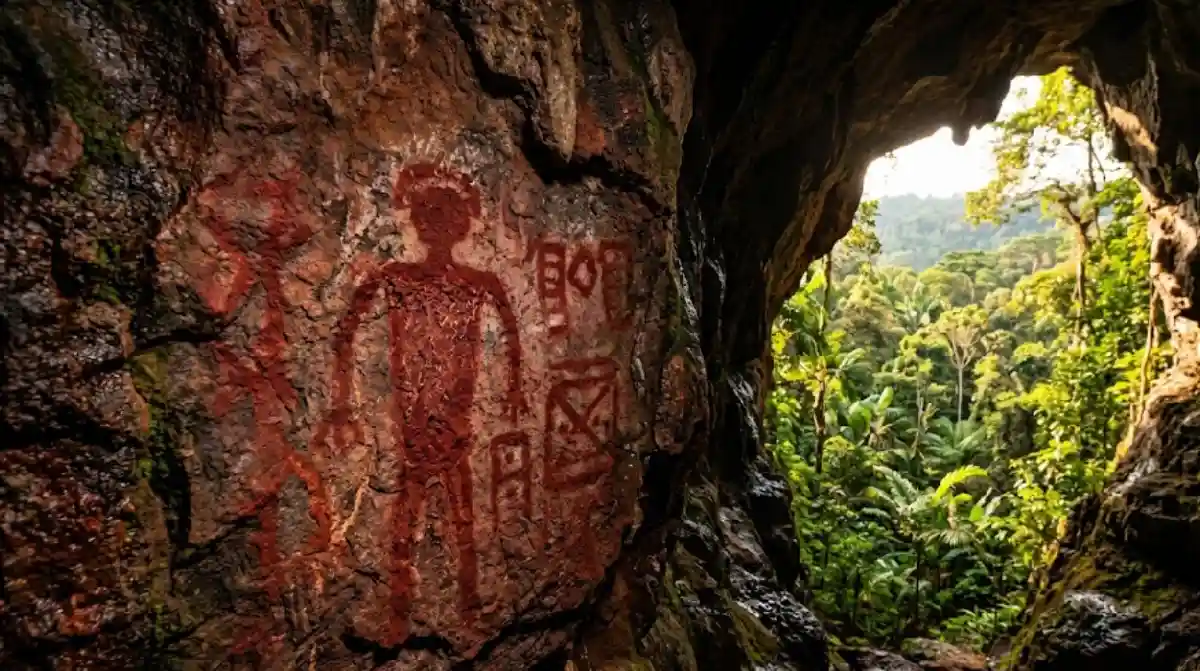
An archive of human presence in ironstone
In southeastern Pará, the Serra dos Carajás contains Brazil’s largest concentration of caves formed in ironstone, known locally as canga. More than 1,500 cavities have been cataloged in the Carajás National Forest alone. That number gives the region global geological importance, but the true distinctiveness of Carajás lies in what the caves preserve.
Inside these cavities is a continuous record of human occupation in the Amazon dating back more than 11,000 years. Rock paintings and archaeological artifacts survived in a landscape of extraordinary scenic beauty, where iron ore forms natural shelters and the surrounding forest meets rocky fields shaped by unusual geology.
Walking through a Carajás cave is like turning the pages of a natural and human history book written in iron ore. Unlike limestone caves, which are common in other parts of Brazil, caves in canga are drier and have a distinctive chemistry. Those conditions favored the preservation of organic materials and mineral pigments.
Archaeological research led by institutions such as the Museu Paraense Emílio Goeldi found that the caves served as shelters, ritual places and workshops for making tools. They were used first by hunter-gatherer groups and later by ceramic-producing populations. Together, these layers reveal changing ways of living in the Amazon.
The rock paintings were made mainly with iron oxide and manganese pigments. They depict zoomorphic figures, or animals, anthropomorphic figures, or humans, and geometric patterns. The images are more than art in a narrow sense. They are social codes created by populations that lived in close harmony with the forest long before Europeans arrived.
Studying the paintings and engravings allows scientists to reconstruct the region’s paleoecology. The evidence helps show which animals were common and how the Amazonian climate changed over time. Carajás is therefore an open-air laboratory for understanding human resilience and adaptation in the world’s largest tropical rainforest.
A forest growing above mineral wealth
Carajás is as remarkable for its biodiversity as it is for its archaeology. The region contains one of the world’s largest continuous tropical forests growing directly over enormous iron ore deposits. This specialized ecosystem is known as canga, or rocky fields over canga.
High metal concentrations and the ferriferous soil’s low water retention create difficult conditions for plants. The species that grow there have developed unusual adaptations, and many are endemic, meaning they exist only in that place. Shrubs, cacti and orchids form a vibrant mosaic of life that is both resistant and highly specialized.
During the rainy season, the canga becomes a colorful garden. Its vegetation contrasts sharply with the dark green of the surrounding upland forest. The seasonal display shows that iron-rich ground is not a lifeless surface. It is an ecosystem with its own plants, survival strategies and ecological relationships.
Protecting this biodiversity is a challenge that brings biologists and environmental managers together. Canga remains a frontier for botanical and ecological knowledge in the Amazon, because every plant adapted to its ferriferous substrate adds to the understanding of how life responds to difficult geological conditions.
Serra dos Carajás shows that mineral wealth and biological wealth can occupy the same landscape. Life finds ways to thrive in soil with high metal concentrations and limited water retention, while nearby caves preserve evidence of human presence over thousands of years.
The challenge of sustainable coexistence
Carajás is also known worldwide for hosting the planet’s largest open-pit iron ore mine, operated by Vale. The Carajás National Forest is a Sustainable Use Conservation Unit created specifically to mediate the relationship between mineral extraction and environmental protection.
This management model seeks to ensure that economic development does not compromise the region’s natural or archaeological heritage. Mining in Carajás operates under environmental control and impact-mitigation protocols focused on caves and biodiversity. The approach requires detailed mine planning and constant monitoring.
Brazilian law establishes clear guidelines for cave protection and classifies caves by relevance: maximum, high, medium and low. In Carajás, caves of maximum relevance are protected by law and cannot be affected by mining. Many contain unique archaeological or speleological heritage, making careful assessment essential before any intervention.
The coexistence of world-class mining and a historical archive more than 11,000 years old presents a demanding management challenge. It also offers an example of how the Amazon can be a testing ground for sustainable solutions that bring technology and conservation together.
Iron helps explain Carajás’s economic importance, but it does not define the full value of the region. Carajás ore can reach 67% purity, making it some of the best in the world. The canga’s true treasure, however, is its ability to support specialized life and preserve human history.
Knowledge tourism and the future of research
Carajás has immense potential for ecotourism and scientific tourism, although that potential remains little explored. Controlled visits to selected archaeological caves, combined with observation of the canga’s unique plants, could generate income for local communities and strengthen environmental education.
Routes could introduce visitors to Amazonian geology, the history of human occupation and the survival strategies of plants growing above iron ore. In this way, the Carajás National Forest could become a center for interpreting the Amazon, with history and nature as its main assets.
Infrastructure investments and training for local guides are essential for that possibility to become reality. Knowledge tourism is a sustainable alternative because it values heritage without destroying it. Public-use initiatives in the National Forest, supported by ICMBio, already demonstrate that a conservation economy can be developed in the region.
Carajás could serve as a model for how mining can help catalyze other sustainable economies around an extraction area. The goal is not to replace heritage with economic activity, but to recognize that archaeology, biodiversity, geology and culture can all contribute to the value of a landscape.
The future of Serra dos Carajás depends on continued investment in archaeological and biological research. Every newly discovered cave and every DNA study of canga plants opens another window into the Amazon and its long history of adaptation.
Partnerships among mining companies, universities, research centers and local communities are fundamental to ensuring that Carajás remains a legacy for future generations of Brazilians. Protecting the range means protecting both a record of human history and a biodiversity that still holds many unanswered questions.
Carajás teaches that the Amazon is not a uniform forest. It is a mosaic of environments and histories, and its underground spaces should be viewed not only as sources of ore but also as archives of our own species.
By balancing the need for resources with the imperative of conservation, Serra dos Carajás becomes a symbol of hope for Amazonian development that respects the past while building the future. The beauty of its rock paintings and the strength of vegetation growing on canga are reminders that life and culture are the forest’s greatest treasures.
Reporting: Anne Silva / Amazonia Mag

Editor, English Edition — Amazonia Mag
Anne Silva is the editor of Amazonia Mag, the English-language edition of Revista Amazônia. She curates, translates and adapts the outlet's science and environment coverage for an international audience, reporting on Amazon wildlife, flora, rivers, climate and research. Every story she edits is grounded in peer-reviewed studies, official data and on-the-ground reporting from the Revista Amazônia newsroom in Belém, Pará, Brazil. More by Anne Silva →