
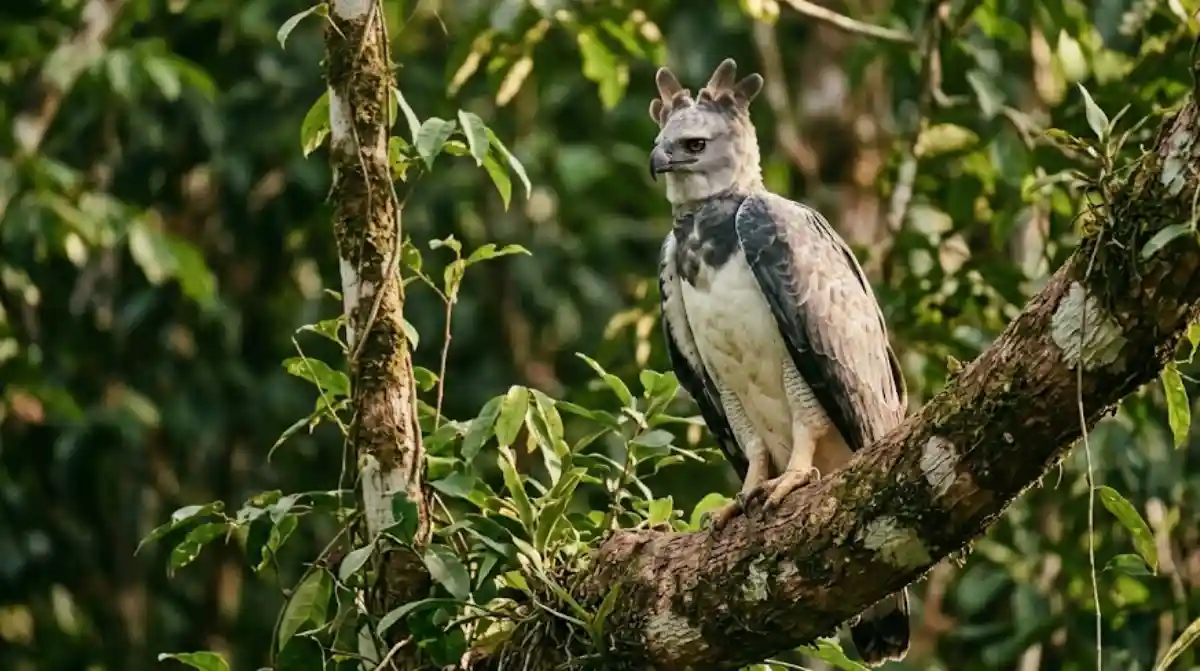
The Harpy eagle, scientifically known as Harpia harpyja, rules one of the most complex environments on Earth: the upper canopy of the Amazon rainforest. Its talons can exert more than 400 kilograms of pressure, or more than 882 pounds, exceeding the bite force of many large canids. This is not simply an anatomical curiosity. It is part of a biological design shaped for survival high above the forest floor.
As the largest aerial predator in the Americas, the bird plays an essential role in the health of the ecosystem. By controlling populations of tree-dwelling mammals, it helps the forest regenerate in a balanced and vigorous way. Its presence links physical strength, patience and precision to the wider functioning of the rainforest.
A nearly invisible hunter in the canopy
Despite its enormous proportions and a wingspan that can exceed two meters, or about 6.6 feet, the Harpy eagle is a master of invisibility. Unlike large eagles of open country that may soar for hours, it evolved to work inside extremely dense vegetation. In that setting, remaining still can be more effective than covering long distances in flight.
Its hunting strategy is based on sitting and waiting. The bird remains motionless on high branches for long periods, watching the forest and using its sharp hearing to locate animals that have not noticed it. A facial disk made of feathers directs sound toward the ears, helping the eagle detect movement in the tangled environment.
The wait ends in a short, explosive attack. Once a target is identified, the Harpy eagle displays an agility that seems to challenge its size. Its short, broad wings, combined with a long tail that works like a rudder, allow quick turns among branches, vines and other obstacles in the canopy.
Scientists observe that the bird can reach impressive speeds over short distances. It dives into the canopy to capture animals with surgical precision, reducing energy use and increasing its chances of success. The strategy depends less on a long chase than on surprise, timing and complete control of movement.
Talons, vision and a predator’s anatomy
To understand why the Harpy eagle impresses the scientific community, it is necessary to examine its natural tools. The rear talons can measure up to 13 centimeters, or about 5.1 inches, roughly the same size as the claws of a grizzly bear. They are not used only to hold prey. They also help ensure immediate neutralization.
When the eagle captures animals such as three-toed sloths or capuchin monkeys, the pressure exerted by its feet is enough to pierce bones. This prevents the prey from responding effectively and causing injuries during the struggle. The strength of the feet works together with the speed of the attack and the ability to choose the exact moment to strike.
The Harpy eagle’s visual acuity is another remarkable feature. It can detect a small animal hundreds of meters away, or hundreds of yards away, even under the diffuse light of the Amazon understory. Its binocular vision provides the depth perception needed to calculate a flight path between physical obstacles.
The combination of telescopic vision, directional hearing and physical strength places the Harpy eagle at a level of efficiency few animals on the planet can match. Its wings, tail and talons are not isolated features. Together, they form an integrated system for hunting in a space where every branch can alter the direction of flight.
Its plumage also contributes to its adaptation. The back is dark gray, while the underside is white. This pattern helps camouflage the bird against a bright sky when seen from below and against dark ground when seen from above. The crest feathers rise when the bird is alert, serving as a visual signal of its emotional state and attention to the surrounding environment.
A sign of a healthy rainforest
The presence of a Harpy eagle in a forested area is one of the main indications that the ecosystem is in excellent conservation condition. As an apex predator, it needs vast territories of primary forest to find enough food for itself and its young. A fragmented forest can directly affect that supply.
By preying on animals that consume seeds and new shoots, including monkeys and large rodents, the eagle indirectly protects plant life. Without this control, some herbivore species could increase excessively and harm the region’s plant diversity. The effect of predation therefore extends far beyond the instant when a capture takes place.
The species’ reproduction also reveals the complexity of Amazonian life. Its reproductive cycle is slow, with a pair generally raising only one chick every two or three years. This intensive parental investment gives the young bird time to learn the complex survival techniques it will need later.
The nest is built at the top of the tallest trees in the forest, including Brazil nut trees and kapok trees. It functions as a fortress where the next generation of predators develops under close adult supervision. This is an impressive example of biological dedication, but it requires time, territory and a reliable supply of food.
Adaptation in a changing biome
The Harpy eagle’s adaptability has been a subject of fascination, especially because of its varied diet. Although it prefers tree-dwelling mammals, the bird is opportunistic and may also eat reptiles such as iguanas and other large birds, including macaws and guans.
This flexibility is crucial in an environment where food availability can fluctuate with the seasons and with the fruiting of trees. The ability to move between different hunting niches demonstrates an instinctive intelligence that allows the species to persist in several layers of the forest.
Satellite monitoring studies have revealed that these birds have a remarkable spatial memory. They can return to specific hunting and nesting locations after traveling long distances. This knowledge of the territory is passed between generations and reinforces the importance of maintaining ecological corridors that allow gene flow among different populations.
Protecting the Harpy eagle therefore means more than protecting one species. It means safeguarding the entire system of interdependencies that keeps the Amazon alive and functional. Corridors, nesting trees and primary forest areas all belong to the same ecological network on which this powerful predator depends.
Protecting the silent guardian of the canopy
Conservation initiatives across Brazil have focused on protecting nesting trees and raising awareness among local communities. In many places, the bird is seen as a symbol of pride and protection for the forest. That relationship can strengthen the care of a natural heritage that requires large spaces and continuous forest cover.
Technology has also expanded interest in the species. High-resolution cameras installed at nests allow people around the world to follow the daily routine of these birds. This monitoring creates unprecedented engagement with environmental protection and with the value of Brazil’s natural heritage.
Seeing a Harpy eagle cut across the green sky captures the grandeur of Amazonian biodiversity. By protecting its habitat, people help ensure that the natural mechanisms of control and balance continue to operate fully. The Harpy eagle is not only a formidable hunter. It is also the silent guardian of a treasure shared by all.
The bird’s existence invites reflection on both the strength and fragility of life. In a world that often values only what is immediate, the Harpy eagle teaches patience, precision and the importance of occupying one’s place in nature with purpose and respect for the balance that sustains everyone.
Reporting: Anne Silva / Amazonia Mag

Editor, English Edition — Amazonia Mag
Anne Silva is the editor of Amazonia Mag, the English-language edition of Revista Amazônia. She curates, translates and adapts the outlet's science and environment coverage for an international audience, reporting on Amazon wildlife, flora, rivers, climate and research. Every story she edits is grounded in peer-reviewed studies, official data and on-the-ground reporting from the Revista Amazônia newsroom in Belém, Pará, Brazil. More by Anne Silva →