
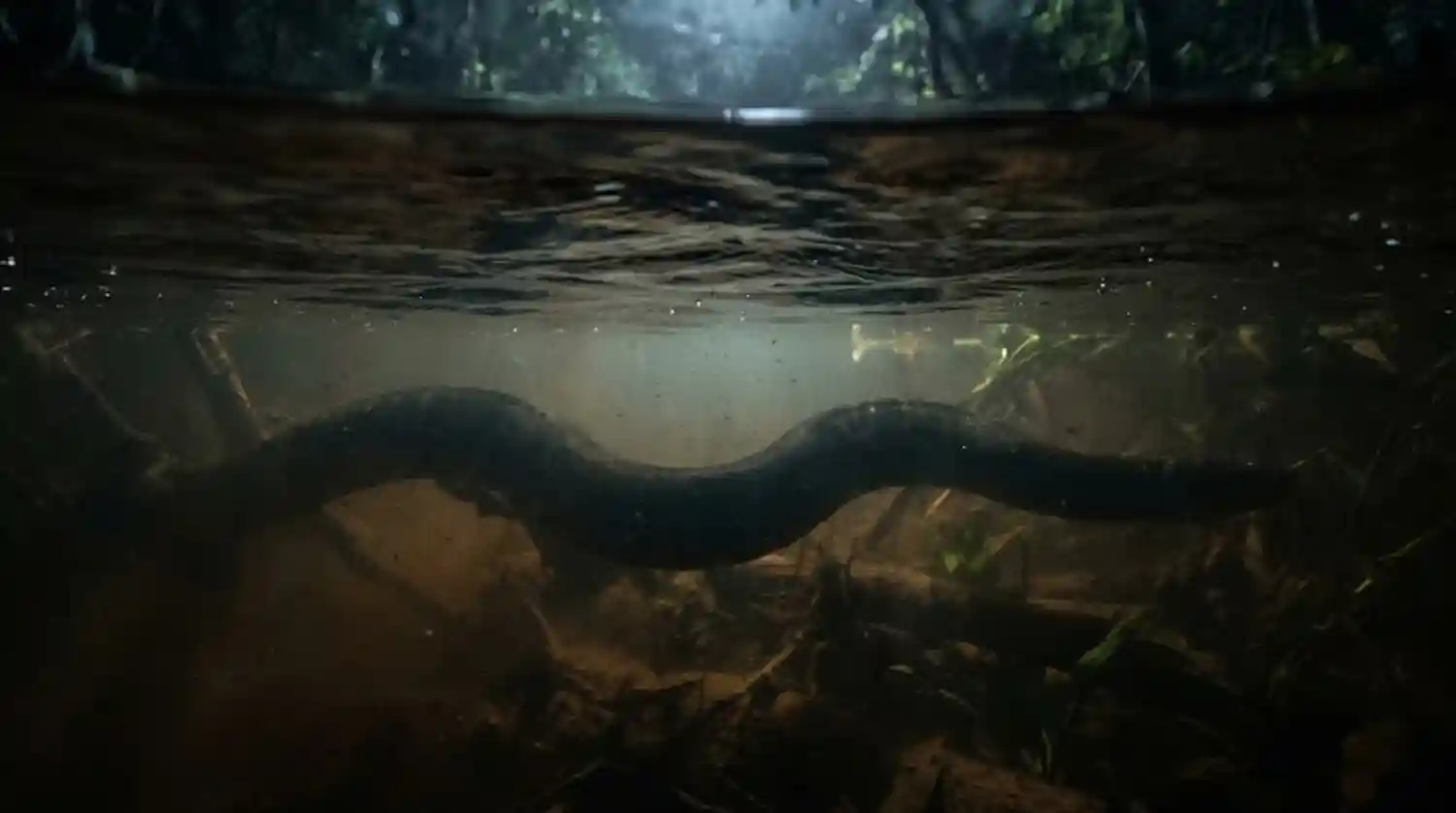
On the dark, humid nights of the Amazon, the sound of rivers blends with the calls of the forest and with stories passed from one generation to the next. Among these stories is the Great Serpent, also known as Boiúna, a colossal snake whose presence crosses ethnic borders and appears in the oral traditions of dozens of Indigenous peoples.
The myth describes a being capable of changing the landscape, influencing the fate of rivers and expressing forces that go far beyond fear. Its origins probably lie in close observation of real anacondas, especially Eunectes murinus, whose aquatic habits and remarkable size provided a biological foundation for imagining a powerful mythological entity.
The Great Serpent is therefore more than a fantastic creature. It is a cultural expression that connects the ecological reality of the forest with the worldview of peoples who have lived there for thousands of years.
A force that creates rivers and landscapes
For many Indigenous peoples of the Amazon, the Great Serpent is not a monster without complexity. It is associated with creation, transformation and the balance of nature. According to Tupinambá oral tradition, the colossal snake known as Boiúna was an aquatic deity that ruled over rivers and lakes.
In that tradition, its movements could create new waterways and alter riverbanks. The snake was not simply a threat, but a natural force capable of shaping the environment and creating the rivers that sustain life in the forest.
This interpretation reflects the vital importance of water in the Amazon. Rivers determine geography, support biodiversity and organize cultural practices, travel and ways of life. Where water defines the land, a creature associated with the depths can also symbolize the power of the region itself.
The Great Serpent also plays roles of transformation and initiation in different Amazonian mythologies. Among the Desana, for example, the mythological snake is associated with the origin of humanity and the transmission of sacred knowledge.
According to that oral tradition, the snake is not merely a physical animal of extraordinary proportions. It is a spiritual being that represents wisdom and a connection with the invisible world. Nature and the supernatural are thus deeply intertwined, and even the most feared beings can carry a profound spiritual meaning.
From a real anaconda to a mythological being
The biological foundation of the legend lies in observations of real anacondas, nonvenomous snakes that live in Amazonian rivers and wetlands. Eunectes murinus, the green anaconda, is also known as the anaconda or sucurí, and is the world’s largest snake by volume and weight.
Reliable records include individuals more than eight meters long, or more than 26 feet. The snake’s ability to swim and dive with ease, combined with its extraordinary strength and varied diet, helps explain how a real animal could become the basis for a colossal mythological figure.
According to the description preserved in the story, anacondas eat caimans, tapirs and even smaller anacondas. The sight of an enormous snake hidden beneath floating vegetation or in the murky depths of a river could feed the imagination, turning a real predator into an entity capable of changing the course of waterways.
The anaconda’s dark coloration and yellowish eyes also contributed to its association with mystery and the supernatural. Its ability to blend into the aquatic environment, becoming almost invisible until the moment of attack, reinforces a perception of unpredictability and danger.
Yet an anaconda, although it is a formidable predator, is not a constant threat to people. Attacks are extremely rare. The legend does not necessarily describe the animal’s actual behavior. Instead, it expresses a cultural perception of the strength, danger and mystery concentrated in Amazonian rivers.
Maitá and the Munduruku relationship with rivers
Among the Munduruku, the Great Serpent is known as Maitá. According to oral tradition, it lives in the depths of rivers and is associated with whirlpools, floods and accidents on the water.
Maitá is not a purely evil entity. It is a force of nature that must be respected and feared. This worldview reflects the Munduruku relationship with rivers, which are at once sources of food and transportation, and places of danger, mystery and knowledge.
In this perspective, the Great Serpent also serves as a guardian of rivers. It may punish those who break the rules of the forest or enter unknown territories. The story expresses, symbolically, the idea that the environment is not an empty space available for any kind of use.
Many oral narratives emphasize the need to make offerings or follow specific rituals to calm Maitá and ensure safety during river journeys. Communication and respect toward the forces of nature are part of that relationship.
For the Munduruku, nature is not merely a resource to be exploited. It is a living, conscious being that deserves respect and reverence. From this perspective, protecting the forest and rivers is not only an ecological necessity. It is also a spiritual duty that maintains balance between the human and supernatural worlds.
An environmental and cultural indicator
The presence of the Great Serpent in Amazonian mythology is not simply a piece of folklore. It also reveals the depth of the relationship between Indigenous peoples and their environment. Protecting the forest and rivers is essential to maintaining the conditions that allowed people to observe giant anacondas and develop a rich, complex oral tradition.
In this sense, the Great Serpent acts as a bioindicator of environmental and cultural quality. It symbolizes the health of Amazonian ecosystems and the resilience of Indigenous cultures. The survival of the mythological figure is connected to the continuity of the landscapes and communities that give it meaning.
Deforestation, river pollution and the construction of hydroelectric dams destroy anaconda habitats and the habitats of species that depend on them. At the same time, these changes threaten the oral traditions that celebrate the Great Serpent as a vital force of nature.
Preserving the Amazon therefore also means protecting cultural heritage and stories passed between generations. The Great Serpent is an intangible heritage of humanity, a unique cultural expression that connects the region with its millennia-old history and with Indigenous knowledge.
Valuing this mythology does not mean treating it as an exotic curiosity. It means recognizing that it can contribute to a new environmental ethic based on respect for biodiversity and cultural diversity. Protecting the forest is an ecological necessity and a moral duty that extends to every form of life, including those that inhabit the human imagination.
Biodiversity, territory and memory
The future of the Great Serpent, both in ecological reality and in mythological imagination, depends on the ability to protect the Amazon and value Indigenous cultures. Conserving the forest and rivers is essential to ensuring the survival of anacondas and the species that depend on them, allowing millennia-old evolutionary processes to continue.
It is also essential to support Indigenous peoples in their efforts to demarcate their lands, manage resources sustainably and value their languages and oral traditions. Amazonian sustainability requires an integrated approach that brings together biodiversity conservation, social justice and cultural diversity.
The story of the Great Serpent teaches us about the power of imagination and the need to respect the forces of nature. In the vast Amazon, every river, tree and animal may carry a story and a deep meaning.
The forest thus appears as a living, conscious being that must be treated with respect and reverence. Protecting the Amazon means preserving biodiversity, ecosystem services, cultural heritage and oral traditions that connect societies with the millennia-old history of their own existence.
The real anaconda, Eunectes murinus, also known as the green anaconda or sucurí, lives in the basins of the Amazon and Orinoco rivers. Its volume, weight, strength and ability to swim and dive helped provide the biological foundation for the legend.
The Great Serpent is not only a legend. It is the voice of the forest itself and a symbol of Amazonian resilience. Its millennia-old presence reminds us that the region’s future depends on the ability to live in harmony with it.
Reporting: Anne Silva / Amazonia Mag

Editor, English Edition — Amazonia Mag
Anne Silva is the editor of Amazonia Mag, the English-language edition of Revista Amazônia. She curates, translates and adapts the outlet's science and environment coverage for an international audience, reporting on Amazon wildlife, flora, rivers, climate and research. Every story she edits is grounded in peer-reviewed studies, official data and on-the-ground reporting from the Revista Amazônia newsroom in Belém, Pará, Brazil. More by Anne Silva →